


Shopping Cart
Remove All Your shopping cart is currently empty

Synonyms:
| Pack Size | Price | USA Stock | Global Stock | Quantity |
|---|---|---|---|---|
| 1 mg | $238 | In Stock | In Stock | |
| 5 mg | $567 | In Stock | In Stock | |
| 10 mg | $768 | In Stock | In Stock | |
| 25 mg | $1,120 | - | In Stock | |
| 50 mg | $1,530 | - | In Stock | |
| 100 mg | $2,070 | - | In Stock | |
| 200 mg | $2,800 | - | In Stock |
| Description | Pancreatic Polypeptide, rat acetate is a natural product and an NPY receptor agonist with high affinity for NPYR4 and receptor selectivity, commonly used in experimental models studying energy balance, feeding behavior, and related metabolic diseases. |
| Targets & IC50 | NPYY4 receptor (BHK-21 cells):51 nM, NPYY2 receptor (BHK-21 cells):> 500 nM, NPYY5 receptor (HEK293 cells):0.24 nM, NPYY1 receptor (BHK-21 cells):530 nM |
| In vitro | Methods: In BRIN BD11 or 1.1B4 β cells, Pancreatic Polypeptide, rat acetate (1 μM) was used to assess cell proliferation; in streptozotocin-induced BRIN BD11 cells, Pancreatic Polypeptide, rat acetate (1 μM) was used to assess cell viability; in isolated mouse islets, Pancreatic Polypeptide, rat acetate (0.1 nM–1 μM) was used to assess insulin secretion; in BRIN BD11 cells, Pancreatic Polypeptide, rat acetate (1 μM) was used to assess membrane potential and intracellular calcium levels. Results: Pancreatic Polypeptide, rat acetate did not alter proliferation in normal β cells but reversed streptozotocin-induced decreases in cell viability; had no effect on insulin secretion from isolated mouse islets; and did not affect membrane potential or intracellular calcium levels in BRIN BD11 cells.[1] |
| In vivo | Methods: Pancreatic polypeptide (25 nmol/kg bw, intraperitoneal injection) was administered to overnight-fasted mice to assess glucose-stimulated insulin concentrations and acute feeding behavior. Results: Pancreatic polypeptide reduced glucose-stimulated insulin concentrations but had no effect on acute feeding behavior. [1] |
| Smiles | [H]N[C@H](C(N1CCC[C@H]1C(N[C@@H](CC(C)C)C(N[C@@H](CCC(O)=O)C(N2CCC[C@H]2C(N[C@H](C(N[C@H](C(N3CCC[C@H]3C(NCC(N[C@H](C(N[C@H](C(N[C@H](C(N[C@]([C@@H](C)O)([H])C(N[C@H](C(N[C@@H](CCC(O)=O)C(N[C@@H](CCC(N)=O)C(N[C@@H](CCCNC(N)=N)C(N[C@H](C(N[C@@H](CCC(N)=O)C(N[C@H](C(N[C@@H](CCC(O)=O)C(N[C@]([C@@H](C)O)([H])C(N[C@@H](CCC(N)=O)C(N[C@@H](CC(C)C)C(N[C@@H](CCCNC(N)=N)C(N[C@@H](CCCNC(N)=N)C(N[C@H](C(N[C@]([C@H](CC)C)([H])C(N[C@@H](CC(N)=O)C(N[C@]([C@@H](C)O)([H])C(N[C@@H](CC(C)C)C(N[C@]([C@@H](C)O)([H])C(N[C@@H](CCCNC(N)=N)C(N4CCC[C@H]4C(N[C@@H](CCCNC(N)=N)C(N[C@H](C(O)=O)CC5=CC=C(O)C=C5)=O)=O)=O)=O)=O)=O)=O)=O)=O)CC6=CC=C(O)C=C6)=O)=O)=O)=O)=O)=O)=O)CC7=CC=C(O)C=C7)=O)=O)C)=O)=O)=O)=O)CC8=CN=CN8)=O)=O)C)=O)CC9=CC=C(O)C=C9)=O)CC(O)=O)=O)=O)=O)CC%10=CC=C(O)C=C%10)=O)CCSC)=O)=O)=O)=O)=O)C |
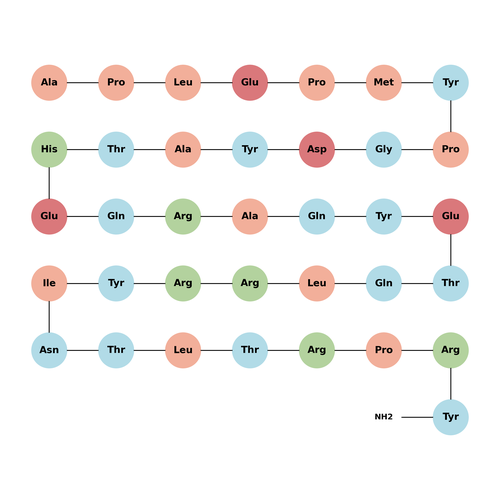
| Sequence | Ala-Pro-Leu-Glu-Pro-Met-Tyr-Pro-Gly-Asp-Tyr-Ala-Thr-His-Glu-Gln-Arg-Ala-Gln-Tyr-Glu-Thr-Gln-Leu-Arg-Arg-Tyr-Ile-Asn-Thr-Leu-Thr-Arg-Pro-Arg-Tyr-NH₂ |
| Sequence Short | APLEPMYPGDYATHEQRAQYETQLRRYINTLTRPRY |
| Storage | Keep away from moisture Powder: -20°C for 3 years | In solvent: -80°C for 1 year Shipping with blue ice/Shipping at ambient temperature. |
| Solubility Information | DMSO: 252.5 mg/mL, Sonication is recommended.  |
 For example, if the intended dosage is 10 mg/kg for animals weighing 20 g , with a dosing volume of 100 μL per animal, and a total of 10 animals are to be administered, using a formulation of
  10% DMSO+ 40% PEG300+ 5% Tween 80+ 45% Saline/PBS/ddH2O , the resulting working solution concentration would be 2 mg/mL.
Dissolve 2 mg of the compound in 100 μL DMSO to obtain a stock solution at a concentration of 20 mg/mL . If the required concentration exceeds the compound's known solubility, please contact us for technical support before proceeding.
1) Add 100 μL of the DMSO stock solution to 400 µL PEG300 and mix thoroughly until the solution becomes clear.
2) Add 50 µL Tween 80 and mix well until fully clarified.
3) Add 450 µL Saline,PBS or ddH2O and mix thoroughly until a homogeneous solution is obtained.
| Size | Quantity | Unit Price | Amount | Operation |
|---|
 Feedback
 Hello! How can I help you today?
Copyright © 2015-2026 TargetMol Chemicals Inc. All Rights Reserved.
