


Shopping Cart
Remove All
  • TargetMol
    Your shopping cart is currently empty

Nicotiflorin

Copy Product Info
😃Good
Catalog No. T6S1294Cas No. 17650-84-9
Alias Nictoflorin, Nicotifloroside, Kaempferol-3-O-Rutinoside
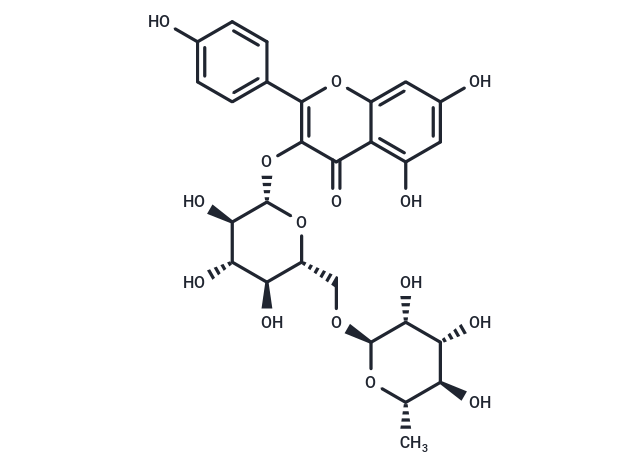
1. Nicotiflorin (Kaempferol-3-O-Rutinoside) has potential therapeutic effects on cerebral ischemic illness. 2. Nicotiflorin has protective effects on reducing memory dysfunction, energy metabolism failure and oxidative stress in multi-infarct dementia model rats.

Nicotiflorin

Nicotiflorin

Copy Product Info
😃Good
Purity: 99.96%
Catalog No. T6S1294Alias Nictoflorin, Nicotifloroside, Kaempferol-3-O-RutinosideCas No. 17650-84-9
1. Nicotiflorin (Kaempferol-3-O-Rutinoside) has potential therapeutic effects on cerebral ischemic illness. 2. Nicotiflorin has protective effects on reducing memory dysfunction, energy metabolism failure and oxidative stress in multi-infarct dementia model rats.
Pack SizePriceUSA WarehouseGlobal WarehouseQuantity
1 mg$38In StockIn Stock
5 mg$84In StockIn Stock
10 mg$122In StockIn Stock
25 mg$196In StockIn Stock
50 mg$298In StockIn Stock
100 mg$442In StockIn Stock
200 mg$643-In Stock
1 mL x 10 mM (in DMSO)$109In StockIn Stock
Add to Cart
Add to Quotation
In Stock Estimated shipping dateUSA Warehouse[1-2 days] Global Warehouse[5-7 days]
All TargetMol products are for research purposes only and cannot be used for human consumption. We do not provide products or services to individuals. Please comply with the intended use and do not use TargetMol products for any other purpose.
Questions
TargetMol
View More

Batch Information

Select Batch
Purity:99.96%
Color:White to Yellow
Contact us for more batch information

Resource Download

Product Introduction

Nicotiflorin AI Summary
Nicotiflorin demonstrates multifaceted bioactivity across various biological assays. It inhibits the diphenolase activity of mushroom tyrosinase at 0.056 mM, resulting in 16.05% inhibition, and further inhibits tyrosinase activity with an IC50 of 0.908 µg/mL. It shows antiprotozoal effects against Entamoeba histolytica and Giardia lamblia with IC50 values of 30.9 µg/mL and 22.5 µg/mL, respectively. This compound also acts as a ligand for the adenosine A1 receptor, displacing 37.0% of bound ligand at 100 µg/mL in rat forebrain membrane studies. Moreover, Nicotiflorin reduces uric acid production by inhibiting xanthine oxidase (IC50 of 14800 nM) and displays antioxidant activities, including superoxide-scavenging (IC50 of 3400 nM) and DPPH radical scavenging, though with a high IC50 of over 100,000 nM in certain assays. It affects the complement system by inhibiting the classical pathway by 19.2% at 1000 µM and activating the alternative pathway by 18.4% at the same concentration. Antiviral properties of Nicotiflorin show efficacy against influenza A H9N2 and H1N1 strains, with EC50 values of 72,900 nM and 40,100 nM, respectively. It noncompetitively inhibits neuraminidase with Ki and IC50 values around 32,700 nM and 31,700 nM. Despite cytotoxicity against MDCK cells, it has a selectivity index greater than 7.48 for H1N1 and 4.12 for H9N2, indicating selective antiviral activity. In enzymatic assays, Nicotiflorin inhibits various targets, including AmpC Beta-Lactamase (562.3 nM), Bacillus stearothermophilus alpha-glucosidase (IC50 of 109,900 nM), and Sprague-Dawley rat lens aldose reductase (IC50 of 11,300 nM). It also exhibits inhibitory effects against human and mouse cell lines impacting inflammatory signaling, namely TNF-alpha-induced NF-kappaB activation in HEK293 cells (62% inhibition at 50 µM) and cytokine production in mouse BMDCs with IC50 values greater than 50,000 nM. Lastly, Nicotiflorin shows anti-inflammatory and antineuroinflammatory activities by inhibiting NO production and TNF-alpha secretion in various cell types, including mouse RAW264.7 and BV2 cells, with respective IC50 values of 45,300 nM and 41,500 nM. Its cytotoxicity varies across different human and animal cell lines, demonstrating specific neuroprotective activity in rat C6 cells and a notable anti-austerity activity against nutrient-deprived human PANC1 cells (PC50 of 67.1 µM)..
Note: Summary generated by AI. Data source: ChEMBL
Bioactivity
Description
1. Nicotiflorin (Kaempferol-3-O-Rutinoside) has potential therapeutic effects on cerebral ischemic illness. 2. Nicotiflorin has protective effects on reducing memory dysfunction, energy metabolism failure and oxidative stress in multi-infarct dementia model rats.
SynonymsNictoflorin, Nicotifloroside, Kaempferol-3-O-Rutinoside
Chemical Properties
Molecular Weight594.52
FormulaC27H30O15
Cas No.17650-84-9
SmilesC[C@@H]1O[C@@H](OC[C@H]2O[C@@H](Oc3c(oc4cc(O)cc(O)c4c3=O)-c3ccc(O)cc3)[C@H](O)[C@@H](O)[C@@H]2O)[C@H](O)[C@H](O)[C@H]1O
Relative Density.1.76g/cm3
Storage & Solubility Information
Storagekeep away from direct sunlight,keep away from moisture,store at low temperature | Powder: -20°C for 3 years | In solvent: -80°C for 1 year | Shipping with blue ice/Shipping at ambient temperature.
Solubility Information
Ethanol: Soluble
Pyridine, Methanol, etc.: Soluble
DMSO: 260 mg/mL (437.33 mM)

Solution Preparation Table
DMSO
1mg5mg10mg50mg
1 mM1.6820 mL8.4101 mL16.8203 mL84.1015 mL
5 mM0.3364 mL1.6820 mL3.3641 mL16.8203 mL
10 mM0.1682 mL0.8410 mL1.6820 mL8.4101 mL
20 mM0.0841 mL0.4205 mL0.8410 mL4.2051 mL
50 mM0.0336 mL0.1682 mL0.3364 mL1.6820 mL
100 mM0.0168 mL0.0841 mL0.1682 mL0.8410 mL

Calculator

  • Molarity Calculator
  • Dilution Calculator
  • Reconstitution Calculator
  • Molecular Weight Calculator

In Vivo Formulation Calculator (Clear solution)

Please enter your animal experiment information in the following box and click Calculate to obtain the stock solution preparation method and in vivo formula preparation method:
TargetMol | Animal experiments For example, if the intended dosage is 10 mg/kg for animals weighing 20 g , with a dosing volume of 100 μL per animal, TargetMol | Animal experiments and a total of 10 animals are to be administered, using a formulation of TargetMol | reagent 10% DMSO+ 40% PEG300+ 5% Tween 80+ 45% Saline/PBS/ddH2O , the resulting working solution concentration would be 2 mg/mL.

Stock Solution Preparation:

Dissolve 2 mg of the compound in 100 μL DMSOTargetMol | reagent to obtain a stock solution at a concentration of 20 mg/mL . If the required concentration exceeds the compound's known solubility, please contact us for technical support before proceeding.

Preparation of the In Vivo Formulation:

1) Add 100 μL of the DMSOTargetMol | reagent stock solution to 400 μL PEG300TargetMol | reagent and mix thoroughly until the solution becomes clear.

2) Add 50 μL Tween 80 and mix well until fully clarified.

3) Add 450 μL Saline,PBS or ddH2OTargetMol | reagent and mix thoroughly until a homogeneous solution is obtained.

This example is provided solely to demonstrate the use of the In Vivo Formulation Calculator and does not constitute a recommended formulation for any specific compound. Please select an appropriate dissolution and formulation strategy based on your experimental model and route of administration.
All co-solvents required for this protocol, includingDMSO, PEG300/PEG400, Tween 80, SBE-β-CD, and Corn oil, are available for purchase on the TargetMol website.
1 Enter information below:
mg/kg
g
μL
2 Enter the in vivo formulation:
% DMSO
%
% Tween 80
% Saline/PBS/ddH2O

Dose Conversion

You can also refer to dose conversion for different animals. More Dose Conversion

Tech Support

Please see Inhibitor Handling Instructions for more frequently ask questions. Topics include: how to prepare stock solutions, how to store products, and cautions on cell-based assays & animal experiments, etc

Keywords

Related Tags: buy Nicotiflorin | purchase Nicotiflorin | Nicotiflorin cost | order Nicotiflorin | Nicotiflorin chemical structure | Nicotiflorin formula | Nicotiflorin molecular weight





