


Shopping Cart
Remove All Your shopping cart is currently empty

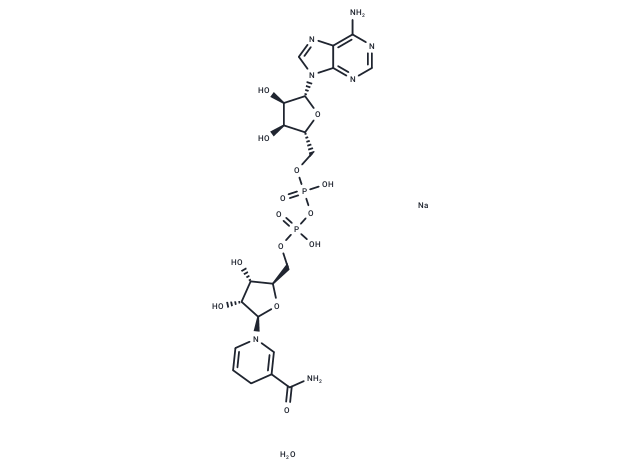
Synonyms: Disodium NADH hydrate
| Pack Size | Price | USA Stock | Global Stock | Quantity |
|---|---|---|---|---|
| 500 mg | $105 | 35 days | 35 days | |
| 1 g | $147 | 35 days | 35 days | |
| 5 g | $678 | 35 days | 35 days |
| Description | NADH disodium salt hydrate, also known as Disodium NADH hydrate, functions as an orally active reduced coenzyme. It serves as a donor of ADP-ribose units in ADP-ribosylation reactions and acts as a precursor to cyclic ADP-ribose. Additionally, it contributes to cellular energy metabolism by acting as a renewable electron donor in processes such as glycolysis, β-oxidation, and the tricarboxylic acid (TCA) cycle [1]. |
| In vitro | NADH is stable under alkaline conditions but unstable under acidic conditions [2]. At concentrations of 0-1 mM over 0-12 hours, NADH increases NAD+ levels in various mammalian cell lines [3]. Additionally, NADH at 1 mM for 24 hours exhibits low toxicity and protects cells from genotoxicity [3]. |
| In vivo | NADH, administered intraperitoneally at 5 μmol/mouse, enhances urinary excretion of nicotinamide and its metabolites in male ICR mice [2]. At a dosage of 500 mg/kg, orally administered NADH promotes alcohol metabolism and protects against early liver injury from acute alcohol exposure in male C57BL/6J mice by modulating blood acetaldehyde levels and maintaining the NAD+/NADH redox balance [3]. Additionally, a 1000 mg/kg intraperitoneal dose of NADH increases tissue NAD+ levels in these mice [3]. |
| Synonyms | Disodium NADH hydrate |
| Molecular Weight | 709.4 |
| Formula | C21H29N7O14P2.xH2O.2Na |
| Cas No. | 1949720-50-6 |
| Smiles | O[C@H]1[C@H](N2C=3C(N=C2)=C(N)N=CN3)O[C@H](COP(OP(OC[C@H]4O[C@H]([C@H](O)[C@@H]4O)N5C=C(C(N)=O)CC=C5)(=O)O)(=O)O)[C@H]1O.[Na].O |
| Storage | Powder: -20°C for 3 years | In solvent: -80°C for 1 year Shipping with blue ice/Shipping at ambient temperature. |
 For example, if the intended dosage is 10 mg/kg for animals weighing 20 g , with a dosing volume of 100 μL per animal, and a total of 10 animals are to be administered, using a formulation of
  10% DMSO+ 40% PEG300+ 5% Tween 80+ 45% Saline/PBS/ddH2O , the resulting working solution concentration would be 2 mg/mL.
Dissolve 2 mg of the compound in 100 μL DMSO to obtain a stock solution at a concentration of 20 mg/mL . If the required concentration exceeds the compound's known solubility, please contact us for technical support before proceeding.
1) Add 100 μL of the DMSO stock solution to 400 µL PEG300 and mix thoroughly until the solution becomes clear.
2) Add 50 µL Tween 80 and mix well until fully clarified.
3) Add 450 µL Saline,PBS or ddH2O and mix thoroughly until a homogeneous solution is obtained.
| Size | Quantity | Unit Price | Amount | Operation |
|---|
 Feedback
 Hello! How can I help you today?
Copyright © 2015-2026 TargetMol Chemicals Inc. All Rights Reserved.
