Shopping Cart
Remove All
  • TargetMol
    Your shopping cart is currently empty

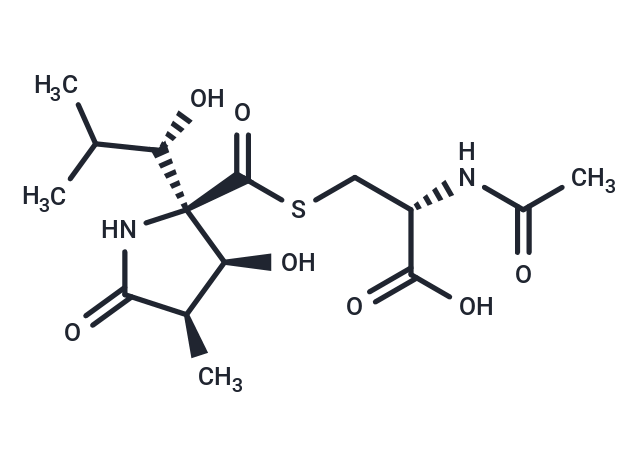
Lactacystin

Copy Product Info
😃Good
Catalog No. T15702Cas No. 133343-34-7

Lactacystin is an orally active, irreversible, and cell-permeable proteasome inhibitor (IC50 = 4.8 μM) that also inhibits the lysosomal enzyme cathepsin A. It induces apoptosis and cell cycle arrest, possesses anticancer, antiviral, and antioxidant activities, can penetrate the blood-brain barrier, and is commonly used in the construction of Parkinson’s disease and dementia models.

Lactacystin

Lactacystin

Copy Product Info
😃Good
Catalog No. T15702Cas No. 133343-34-7
Lactacystin is an orally active, irreversible, and cell-permeable proteasome inhibitor (IC50 = 4.8 μM) that also inhibits the lysosomal enzyme cathepsin A. It induces apoptosis and cell cycle arrest, possesses anticancer, antiviral, and antioxidant activities, can penetrate the blood-brain barrier, and is commonly used in the construction of Parkinson’s disease and dementia models.
Pack SizePriceUSA WarehouseGlobal WarehouseQuantity
50 μg$123-In Stock
100 μg$197-In Stock
1 mg$847-In Stock
Add to Cart
Add to Quotation
In Stock Estimated shipping dateUSA Warehouse[1-2 days] Global Warehouse[5-7 days]
All TargetMol products are for research purposes only and cannot be used for human consumption. We do not provide products or services to individuals. Please comply with the intended use and do not use TargetMol products for any other purpose.
Questions
TargetMol
View More

Batch Information

Select Batch
Appearance:Solid
Contact us for more batch information

Resource Download

Product Introduction

Bioactivity
Description
Lactacystin is an orally active, irreversible, and cell-permeable proteasome inhibitor (IC50 = 4.8 μM) that also inhibits the lysosomal enzyme cathepsin A. It induces apoptosis and cell cycle arrest, possesses anticancer, antiviral, and antioxidant activities, can penetrate the blood-brain barrier, and is commonly used in the construction of Parkinson’s disease and dementia models.
Targets&IC50
Proteasome:4.8 μM
In vitro
Methods: RA-differentiated SH-SY5Y cells were treated with lactacystin (2.5–10 μg/ml, 48 hours) to select the effective concentration for celastrol studies.
Results: Lactacystin at a concentration of 10 μg/ml (26.4 μM) reduced SH-SY5Y cell viability by 40-50%. [3]
In vivo
Methods: Lactacystin (5 μg/2 μl) was administered unilaterally into the left SNc of rats to study its effect on rat body weight.
Results: Lactacystin can reduce the body weight of rats. [3]
Disease Modeling Protocol
Parkinson's Disease (PD) Model
  • Modeling Mechanism:

    Lactacystin, as an irreversible proteasome inhibitor, induces PD pathology through multiple mechanisms: ① It inhibits the function of the ubiquitin-proteasome system, leading to the aggregation of abnormal proteins such as αSyn to form inclusion bodies, mimicking the characteristic Lewy body pathology of PD; ② It induces an imbalance in histone deacetylation (reduced H3-K9 acetylation level), inhibits the expression of neurotrophic factors, and exacerbates the apoptosis of dopaminergic neurons in the substantia nigra pars compacta (SNpc); ③ It damages the substantia nigra-striatum pathway, leading to motor dysfunction, while also causing neuroanatomical changes such as midbrain shrinkage and lateral ventricle dilation.

  • Related Products:

    Lactacystin (T15702)

  • Modeling Method:

    Experimental Subject:

    Rats: Sprague Dawley (SD) strain, male, body weight 250±10g

    Dosage and Administration Route:

    ① Core modelling: Lactacystin (10 μg/4 μL), dissolved in 0.9% saline (concentration 2.5 μg/μL), unilateral stereotaxic injection into substantia nigra pars compacta (SNpc) (coordinates: bregma posterior - 5.2 mm, lateral+2.5 mm, subdural - 7.6 mm), Injection rate 1 μL/min, needle retention for 3 minutes;
    ② Surgical procedure: Isoflurane inhalation anaesthesia, local scalp injection of bupivacaine for anaesthesia, postoperative administration of buprenorphine for analgesia and glucose-saline solution for fluid replacement;
    ③ Control treatment: Isovolumetric saline solution administered via identical injection protocol;
    ④ Intervention validation (optional): Sodium valproate (200/400 mg/kg), Intraperitoneal injection, Initiated 7 days post-modelling, continued for 28 days

    Dosing Frequency and Duration Model:

    Single-dose Lactacystin injection

  • Validation:

    Behavioral indicators: Motor function: One week after modeling, the proportion of contralateral forelimb use decreased, reaching only about 35% in the saline group at five weeks; amphetamine-induced rotational behavior increased (cumulative rotation count significantly increased at five weeks), and sodium valproate intervention could reverse the effect in a dose-dependent manner; Imaging indicators: MRI showed a significant reduction in midbrain volume (ipsilateral side) one week after modeling, with enlarged lateral ventricle volume, and tensor morphometry (TBM) confirmed atrophy of the cortex (cingulate gyrus, motor cortex) and basal ganglia; Pathological indicators: SNpc tyrosine hydroxylase (TH) positive neurons decreased by 64.24±11.34% at five weeks, and Nissl staining confirmed neuronal death (loss of non-TH enzyme expression); Molecular indicators: Decreased H3-K9 acetylation level in brain tissue, downregulated expression of neurotrophic factors (BDNF, GDNF) and anti-apoptotic factor Bcl2, and αSyn aggregation forming inclusion bodies.

*Precautions: Rats were housed in an environment of 21±1℃ and 55±10% humidity, with a 12-hour light-dark cycle.

*References:Harrison IF,et,al. Neurorestoration induced by the HDAC inhibitor sodium valproate in the lactacystin model of Parkinson's is associated with histone acetylation and up-regulation of neurotrophic factors. Br J Pharmacol. 2015 Aug;172(16):4200-15.

Chemical Properties
Molecular Weight376.43
FormulaC15H24N2O7S
Cas No.133343-34-7
SmilesC(SC[C@H](NC(C)=O)C(O)=O)(=O)[C@@]1([C@H](C(C)C)O)[C@@H](O)[C@@H](C)C(=O)N1
Relative Density.1.367 g/cm3
Storage & Solubility Information
Storagestore at low temperature | Powder: -20°C for 3 years | In solvent: -80°C for 1 year | Shipping with blue ice/Shipping at ambient temperature.
Solubility Information
DMSO: 18 mg/mL (47.82 mM), Sonication and heating are recommended.
Solution Preparation Table
DMSO
1mg5mg10mg50mg
1 mM2.6565 mL13.2827 mL26.5654 mL132.8268 mL
5 mM0.5313 mL2.6565 mL5.3131 mL26.5654 mL
10 mM0.2657 mL1.3283 mL2.6565 mL13.2827 mL
20 mM0.1328 mL0.6641 mL1.3283 mL6.6413 mL

Calculator

  • Molarity Calculator
  • Dilution Calculator
  • Reconstitution Calculator
  • Molecular Weight Calculator

In Vivo Formulation Calculator (Clear solution)

Please enter your animal experiment information in the following box and click Calculate to obtain the stock solution preparation method and in vivo formula preparation method:
TargetMol | Animal experiments For example, if the intended dosage is 10 mg/kg for animals weighing 20 g , with a dosing volume of 100 μL per animal, TargetMol | Animal experiments and a total of 10 animals are to be administered, using a formulation of TargetMol | reagent 10% DMSO+ 40% PEG300+ 5% Tween 80+ 45% Saline/PBS/ddH2O , the resulting working solution concentration would be 2 mg/mL.

Stock Solution Preparation:

Dissolve 2 mg of the compound in 100 μL DMSOTargetMol | reagent to obtain a stock solution at a concentration of 20 mg/mL . If the required concentration exceeds the compound's known solubility, please contact us for technical support before proceeding.

Preparation of the In Vivo Formulation:

1) Add 100 μL of the DMSOTargetMol | reagent stock solution to 400 μL PEG300TargetMol | reagent and mix thoroughly until the solution becomes clear.

2) Add 50 μL Tween 80 and mix well until fully clarified.

3) Add 450 μL Saline,PBS or ddH2OTargetMol | reagent and mix thoroughly until a homogeneous solution is obtained.

This example is provided solely to demonstrate the use of the In Vivo Formulation Calculator and does not constitute a recommended formulation for any specific compound. Please select an appropriate dissolution and formulation strategy based on your experimental model and route of administration.
All co-solvents required for this protocol, includingDMSO, PEG300/PEG400, Tween 80, SBE-β-CD, and Corn oil, are available for purchase on the TargetMol website.
1 Enter information below:
mg/kg
g
μL
2 Enter the in vivo formulation:
% DMSO
%
% Tween 80
% Saline/PBS/ddH2O

Dose Conversion

You can also refer to dose conversion for different animals. More Dose Conversion

Tech Support

Please see Inhibitor Handling Instructions for more frequently ask questions. Topics include: how to prepare stock solutions, how to store products, and cautions on cell-based assays & animal experiments, etc

Keywords

Related Tags: buy Lactacystin | purchase Lactacystin | Lactacystin cost | order Lactacystin | Lactacystin chemical structure | Lactacystin in vivo | Lactacystin in vitro | Lactacystin formula | Lactacystin molecular weight