


Shopping Cart
Remove All Your shopping cart is currently empty

Synonyms: Hydroxocobalamin monohydrochloride
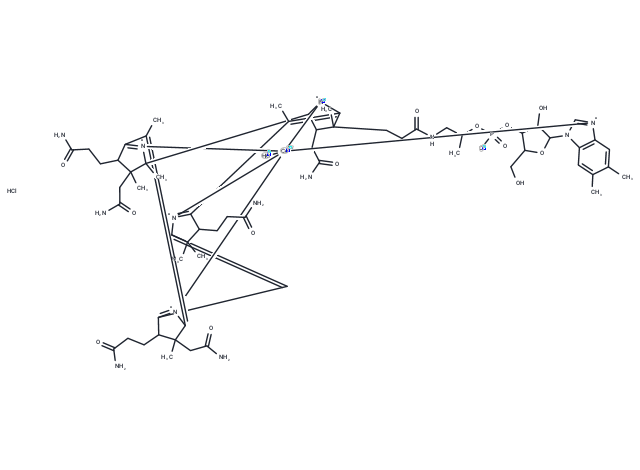
| Pack Size | Price | USA Stock | Global Stock | Quantity |
|---|---|---|---|---|
| 10 mg | $29 | - | In Stock | |
| 25 mg | $37 | - | In Stock | |
| 50 mg | $50 | - | In Stock | |
| 100 mg | $75 | - | In Stock | |
| 1 mL x 10 mM (in DMSO) | $37 | - | In Stock |
| Description | Vitamin B12a monohydrochloride acts as a cofactor in cells and within the body, participating in key biological processes such as methylation and fatty acid metabolism. It plays a crucial role in nervous system function and erythropoiesis, and can be used in research on treatments related to vitamin B12 deficiency (including pernicious anemia). |
| In vitro | Methods: Primary rat hepatocytes were isolated by collagenase perfusion. A 0.5 mM NaSH solution was added to induce toxicity. Concurrently or at a later time, 25–150 μM Vitamin B12a monohydrochloride or 25–100 μM cobalt chloride was added. The samples were incubated at 37°C for 30–180 min, and cell viability was assessed using the trypan blue exclusion assay. Results: Both vitamin B12a monohydrochloride and cobalt chloride dose-dependently inhibited NaSH-induced hepatotoxicity; 100 μM vitamin B12a monohydrochloride provided the greatest protective effect, with protection still observed when administered 60 min later, though administration within 20 min yielded the best results. [1] Methods: 0.5 mM NaSH was added to 0.1 M Tris-HCl buffer (pH 7.4), followed by the addition of either 0.1 mM Vitamin B12a monohydrochloride or 0.1 mM cobalt chloride. The oxygen consumption rate was measured using a Clark oxygen electrode, H₂O₂ production was determined by the catalase assay, and hydroxyl radicals were detected by the deoxyribose degradation assay. Results: Vitamin B12a monohydrochloride significantly promoted NaSH-mediated oxygen consumption and H₂O₂ production (which could be reversed by catalase), did not generate hydroxyl radicals, and exhibited significantly higher catalytic activity than cobalt chloride. [1] |
| In vivo | Methods: Male CD1 mice weighing 25–30 g were selected and administered intraperitoneal injections of NaSH (an H₂S donor) at concentrations of 0.45, 0.54, 0.63 mmol/kg, corresponding to LD₅₀, LD₆₅, and LD₈₅, respectively). Two minutes later, Vitamin B12a monohydrochloride (0.25 mmol/kg) was administered intraperitoneally. A saline control group and a nitrite (0.25 mmol/kg) positive control group were established, and mouse survival rates were observed for 24 hours. Results: Vitamin B12a monohydrochloride significantly improved the survival rate of mice with NaSH poisoning: 100% in the 0.45 mmol/kg NaSH group, 80% in the 0.54 mmol/kg group, and 65% in the 0.63 mmol/kg group; administration of nitrite had no significant protective effect. |
| Synonyms | Hydroxocobalamin monohydrochloride |
| Molecular Weight | 1382.82 |
| Formula | C62H90ClCoN13O15P |
| Cas No. | 59461-30-2 |
| Smiles | Cl.O=C(N)CCC1C=2C=C3[N]4=C(C(=C5[N-]6C7C(CC(=O)N)C5(C)CCC(=O)NCC(OP(=O)([O-])OC8C(O)C(OC8CO)N9C=[N](C=%10C=C(C(=CC%109)C)C)[Co+3]%1146([OH-])[N]2C(=C(C%12=[N]%11C7(C)C(C)(CC(=O)N)C%12CCC(=O)N)C)C1(C)CC(=O)N)C)C)C(CCC(=O)N)C3(C)C |
| Relative Density. | no data available |
| Storage | Keep away from moisture,Keep away from direct sunlight Powder: -20°C for 3 years | In solvent: -80°C for 1 year Shipping with blue ice/Shipping at ambient temperature. |
 For example, if the intended dosage is 10 mg/kg for animals weighing 20 g , with a dosing volume of 100 μL per animal, and a total of 10 animals are to be administered, using a formulation of
  10% DMSO+ 40% PEG300+ 5% Tween 80+ 45% Saline/PBS/ddH2O , the resulting working solution concentration would be 2 mg/mL.
Dissolve 2 mg of the compound in 100 μL DMSO to obtain a stock solution at a concentration of 20 mg/mL . If the required concentration exceeds the compound's known solubility, please contact us for technical support before proceeding.
1) Add 100 μL of the DMSO stock solution to 400 µL PEG300 and mix thoroughly until the solution becomes clear.
2) Add 50 µL Tween 80 and mix well until fully clarified.
3) Add 450 µL Saline,PBS or ddH2O and mix thoroughly until a homogeneous solution is obtained.
| Size | Quantity | Unit Price | Amount | Operation |
|---|
 Feedback
 Hello! How can I help you today?
Copyright © 2015-2026 TargetMol Chemicals Inc. All Rights Reserved.
