


Shopping Cart
Remove All Your shopping cart is currently empty

Synonyms:
| Pack Size | Price | USA Stock | Global Stock | Quantity |
|---|---|---|---|---|
| 10 mg | Inquiry | Inquiry | Inquiry | |
| 50 mg | Inquiry | Inquiry | Inquiry |
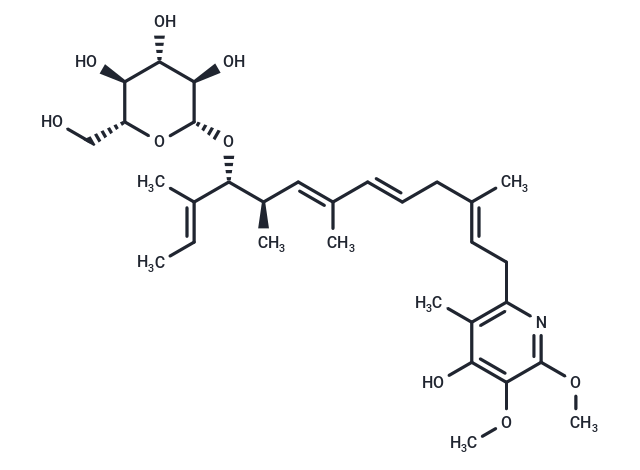
| Description | Glucopiericidin A is a natural piperidine-based compound found in marine-derived Streptomyces strains. It serves as a chemical probe for glucose transporter proteins (GLUT) and can inhibit glycolysis. When combined with Piericidin A (PA), it synergistically inhibits ATP-dependent filopodia formation, yet has no effect alone. Glucopiericidin A induces apoptosis by increasing PRDX1, thereby reducing reactive oxygen species (ROS) levels, and also demonstrates potent antitumor activity in ACHN mouse xenografts. |
| In vitro | Glucopiericidin A exhibits cytotoxic effects against three renal carcinoma cell lines: ACHN with an IC50 of 0.21 μM, and OS-RC-2 and 786-O both with IC50 values exceeding 100 μM. It also affects a normal renal cell line, HK-2, with an IC50 greater than 100 μM [2]. In ACHN cells, Glucopiericidin A at concentrations of 25 and 50 nM for 24 hours leads to the upregulation of PRDX1, with increased mRNA and protein expression and translocation of PRDX1 into the nucleus [2]. Additionally, it reduces reactive oxygen species (ROS) levels in normal ACHN cells [2]. Neither Glucopiericidin A (GPA) nor Piericidin A (PA) alone, at concentrations up to 500 nM and 2.3 mM respectively, exhibit inhibitory activity. However, in combination, significantly lower concentrations of GPA (17 nM) and PA (0.68 nM) inhibit filopodia protrusion [1]. |
| In vivo | Administered intraperitoneally at a dosage of 0.8 mg/kg/day over three weeks, Glucopiericidin A significantly decreases the final tumor weight in nude mice bearing ACHN tumor xenografts [2]. Additionally, it enhances the mRNA and protein expression of PRDX1 within the tumor tissues. |
| Molecular Weight | 577.706 |
| Formula | C31H47NO9 |
| Cas No. | 108073-65-0 |
| Smiles | O([C@H]([C@@H](/C=C(/C=C/C/C(=C/CC=1N=C(OC)C(OC)=C(O)C1C)/C)\C)C)/C(=C/C)/C)[C@@H]2O[C@H](CO)[C@@H](O)[C@H](O)[C@H]2O |
| Storage | Powder: -20°C for 3 years | In solvent: -80°C for 1 year Shipping with blue ice/Shipping at ambient temperature. |
 For example, if the intended dosage is 10 mg/kg for animals weighing 20 g , with a dosing volume of 100 μL per animal, and a total of 10 animals are to be administered, using a formulation of
  10% DMSO+ 40% PEG300+ 5% Tween 80+ 45% Saline/PBS/ddH2O , the resulting working solution concentration would be 2 mg/mL.
Dissolve 2 mg of the compound in 100 μL DMSO to obtain a stock solution at a concentration of 20 mg/mL . If the required concentration exceeds the compound's known solubility, please contact us for technical support before proceeding.
1) Add 100 μL of the DMSO stock solution to 400 µL PEG300 and mix thoroughly until the solution becomes clear.
2) Add 50 µL Tween 80 and mix well until fully clarified.
3) Add 450 µL Saline,PBS or ddH2O and mix thoroughly until a homogeneous solution is obtained.
| Size | Quantity | Unit Price | Amount | Operation |
|---|
 Feedback
 Hello! How can I help you today?
Copyright © 2015-2026 TargetMol Chemicals Inc. All Rights Reserved.
