


Shopping Cart
Remove All Your shopping cart is currently empty


Synonyms: Human GLP-1 (7-36), amide acetate, Glucagon-like peptide-1 (GLP-1)(7-36), amide acetate
| Pack Size | Price | USA Stock | Global Stock | Quantity |
|---|---|---|---|---|
| 500 µg | $118 | In Stock | In Stock | |
| 1 mg | $197 | In Stock | In Stock | |
| 5 mg | $593 | In Stock | In Stock | |
| 10 mg | $943 | In Stock | In Stock | |
| 25 mg | $1,380 | In Stock | In Stock | |
| 50 mg | $1,880 | In Stock | In Stock | |
| 100 mg | $2,530 | In Stock | In Stock |
| Description | GLP-1(7-36), amide acetate is a derivative of GLP-1 peptide (glucagon-like peptide-1).GLP-1(7-36), amide is able to activate the GLP-1 receptor, which has the ability to promote insulin secretion and inhibit glucagon secretion, with the potential to treat type 2 diabetes mellitus and obesity. |
| In vitro | Cells exposed to phorbol 12-myristate 13-acetate for 2 hours exhibited significantly enhanced GLP-1(7-36) levels compared to untreated controls. Similarly, glucose exposure augmented GLP-1 secretion in a dose-responsive manner. Fatty acids, including palmitic, oleic, linoleic, and linolenic acids, also elevated GLP-1 secretion dose-dependently, with unsaturated fatty acids (oleic, linoleic, and linolenic acids) proving more potent than saturated palmitic acid. Furthermore, treatment with CPE on NCI-H716 cells led to a dose-dependent increase in GLP-1 levels, with a notable 37% rise at 0.1% CPE concentration[1]. |
| In vivo | Gastrointestinal administration of glucose increased active GLP-1(7-36), amide acetate levels in portal vein blood 10 minutes later, followed by a significant decrease in active GLP-1 levels 30 minutes later. TO active GLP-1 levels also increased 10 minutes after gastric administration, then decreased to basal levels at 60 minutes. [1] |
| Synonyms | Human GLP-1 (7-36), amide acetate, Glucagon-like peptide-1 (GLP-1)(7-36), amide acetate |
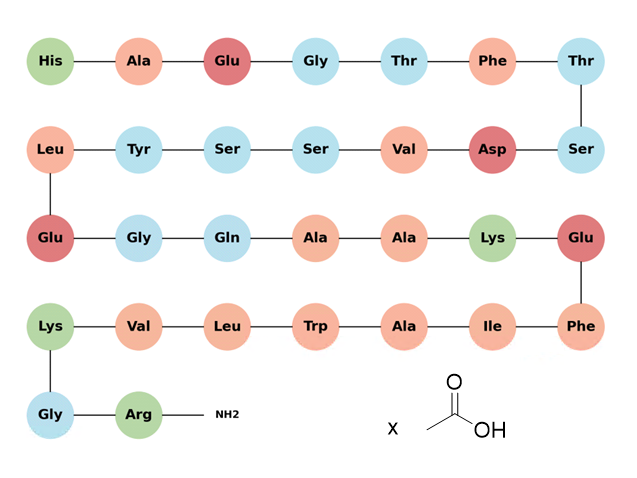
| Formula | C149H226N40O45. xC2H4O2 |
| Cas No. | 1119517-19-9 |
| Smiles | N=C(N)NCCC[C@@H](C(N)=O)NC(CNC([C@H](CCCCN)NC([C@H](C(C)C)NC([C@H](CC(C)C)NC([C@@H](NC([C@H](C)NC([C@H]([C@@H](C)CC)NC([C@@H](NC([C@H](CCC(O)=O)NC([C@H](CCCCN)NC([C@H](C)NC([C@H](C)NC([C@H](CCC(N)=O)NC(CNC([C@H](CCC(O)=O)NC([C@H](CC(C)C)NC([C@@H](NC([C@H](CO)NC([C@H](CO)NC([C@H](C(C)C)NC([C@H](CC(O)=O)NC([C@H](CO)NC([C@H]([C@H](O)C)NC([C@@H](NC([C@H]([C@H](O)C)NC(CNC([C@H](CCC(O)=O)NC([C@H](C)NC([C@@H](N)CC1=CN=CN1)=O)=O)=O)=O)=O)CC2=CC=CC=C2)=O)=O)=O)=O)=O)=O)=O)CC3=CC=C(C=C3)O)=O)=O)=O)=O)=O)=O)=O)=O)=O)CC4=CC=CC=C4)=O)=O)=O)CC5=CNC6=CC=CC=C56)=O)=O)=O)=O)=O. xC2H4O2 |
| Relative Density. | no data available |
| Sequence | His-Ala-Glu-Gly-Thr-Phe-Thr-Ser-Asp-Val-Ser-Ser-Tyr-Leu-Glu-Gly-Gln-Ala-Ala-Lys-Glu-Phe-Ile-Ala-Trp-Leu-Val-Lys-Gly-Arg-NH₂ |
| Sequence Short | HAEGTFTSDVSSYLEGQAAKEFIAWLVKGR |
| Storage | Keep away from moisture Powder: -20°C for 3 years | In solvent: -80°C for 1 year Shipping with blue ice/Shipping at ambient temperature. |
| Solubility Information | H2O: 255.00 mg/mL, Sonication is recommended.  |
 For example, if the intended dosage is 10 mg/kg for animals weighing 20 g , with a dosing volume of 100 μL per animal, and a total of 10 animals are to be administered, using a formulation of
  10% DMSO+ 40% PEG300+ 5% Tween 80+ 45% Saline/PBS/ddH2O , the resulting working solution concentration would be 2 mg/mL.
Dissolve 2 mg of the compound in 100 μL DMSO to obtain a stock solution at a concentration of 20 mg/mL . If the required concentration exceeds the compound's known solubility, please contact us for technical support before proceeding.
1) Add 100 μL of the DMSO stock solution to 400 µL PEG300 and mix thoroughly until the solution becomes clear.
2) Add 50 µL Tween 80 and mix well until fully clarified.
3) Add 450 µL Saline,PBS or ddH2O and mix thoroughly until a homogeneous solution is obtained.
| Size | Quantity | Unit Price | Amount | Operation |
|---|
 Feedback
 Hello! How can I help you today?
Copyright © 2015-2026 TargetMol Chemicals Inc. All Rights Reserved.
