


Shopping Cart
Remove All Your shopping cart is currently empty


Synonyms:

| Pack Size | Price | USA Stock | Global Stock | Quantity |
|---|---|---|---|---|
| 2 mg | $35 | In Stock | In Stock | |
| 5 mg | $57 | In Stock | In Stock | |
| 10 mg | $91 | In Stock | In Stock | |
| 25 mg | $203 | In Stock | In Stock | |
| 50 mg | $359 | In Stock | In Stock | |
| 100 mg | $563 | In Stock | In Stock | |
| 200 mg | $788 | In Stock | In Stock | |
| 1 mL x 10 mM (in DMSO) | $66 | In Stock | In Stock |
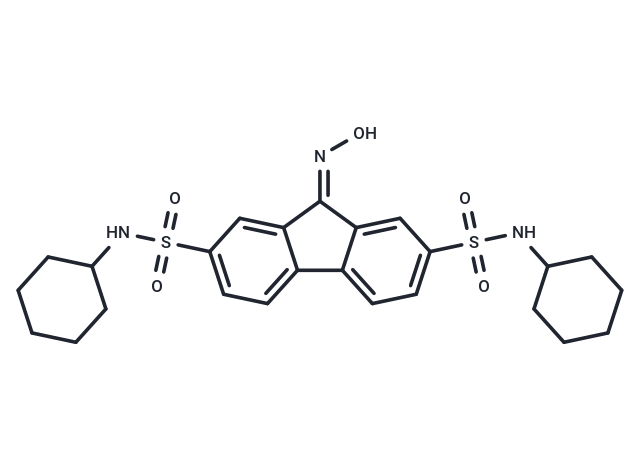
| Description | FIN56 is an iron death-specific inducer that binds to and activates squalene synthase, inducing ferroptosis by triggering GPX4 degradation. FIN56 can be used in studies of ferroptosis regulatory mechanisms, autophagy-ferroptosis crosstalk, and tumor therapy. |
| Targets & IC50 | Human foreskin fibroblasts cells:24 μM, HT29 cells:21.26 μM, LN-229 cells:4.2 µM, U118 cells:2.6 µM, Caco-2 cells:15.23 μM |
| In vitro | Methods: Human bladder cancer cell lines J82, 253J, T24, and RT-112 were treated with FIN56 at concentration gradients (0.3, 1, 3, 10 μM) for 3, 6, 9, 24, and 72 hours, and cell viability was assessed using the CCK-8 assay. Results: FIN56 induced cell death in all four cell lines. [1] Methods: FIN56 (10 μM), α-tocopherol (ferroptosis inhibitor), and Liproxstatin-1 (ferroptosis inhibitor) were added to 253J and T24 cells and incubated for 24 hours; cell viability was assessed using the CCK-8 assay. Results: Both ferroptosis inhibitors significantly inhibited FIN56-induced cell death, confirming that FIN56 exerts its effects via ferroptosis. [1] Methods: Human glioblastoma LN229 and U118 cells. The cells were treated with 1 μM FIN56 for 24 h, or with 1 μM Ferrostatin-1 for 1 h followed by co-treatment with FIN56. Lipid peroxidation and ferroptosis levels were assessed using BODIPY 581/591 C11, CellRox Green, 4-HNE immunofluorescence, and transmission electron microscopy. Results: FIN56 significantly induced lipid peroxidation and ferrocytosis in LN229 and U118 cells, and this effect was blocked by Ferrostatin-1. [2] |
| In vivo | Methods: A subcutaneous tumor xenograft model was established in LN229-bearing nude mice. FIN56 (10 mg/kg) or a control agent was administered intraperitoneally for 30 consecutive days. Tumor volume, Ki67 (proliferation), and 4-HNE (ferroptosis) were assessed. Results: FIN56 significantly reduced tumor volume, decreased the proportion of Ki67-positive cells, and increased 4-HNE levels, thereby inhibiting glioblastoma growth and inducing ferroptosis in vivo. [2] |
| Cell Research | 1000 cells/36 μL are seeded in each well in 384-well plates. Lethal compounds are dissolved and a 2-fold, 12-point dilution series are prepared in DMSO. Compound solutions are further diluted with media at 1:25 and 4 μL/well of the diluted solutions are added to cell cultures immediately after cells are seeded. When ferroptosis inhibitors (100 μM α-tocopherol, 152 μM deferoxamine, or 10 μM U-0126) are co-treated with lethal inducers, they are supplemented to cell culture at the same time as lethal compounds are added, and the cells are incubated for 24 hrs. When other cell death modulating compounds (100 nM sodium selenite, 1 μM cerivastatin, 100 μg/mL mevalonic acid) are co-treated, they are first supplemented to cell culture for 24 hrs before lethal compounds are added to cell culture and further incubated for 24 hrs at 37°C under 5% CO2. On the day of the viability measurement, 10 μL/well of 50% Alamar Blue diluted in media is added and further incubated at 37°C for 6 hrs. Fluorescence intensity (ex/em: 530/590) is measured with a Victor 3 plate reader and the normalized viability is calculated by VL = (IL-I0)/(IV-I0), where VL, I0, IV, and IL are the normalized viability, raw fluorescence intensities from the wells containing media, cells treated with a vehicle (negative control), and cells with the lethal compound (L), respectively. When the effect of a chemical modulator (M) on L is calculated, we instead used the equation: VL|M = (IM, L-I0)/(IM, V-I0), where VL|M, IM, L and IM, V are the normalized viability, and fluorescence intensity from cells treated with M and V, and from cells with M and L. respectively. The viability is typically measured in biological triplicates unless otherwise specified. A representative dose-response curve, the mean and standard error of normalized viability from one replicate are plotted. |
| Molecular Weight | 517.66 |
| Formula | C25H31N3O5S2 |
| Cas No. | 1083162-61-1 |
| Smiles | ON=C1c2cc(ccc2-c2ccc(cc12)S(=O)(=O)NC1CCCCC1)S(=O)(=O)NC1CCCCC1 |
| Relative Density. | 1.50 g/cm3 (Predicted) |
| Storage | The compound is unstable in solution. Please use soon Powder: -20°C for 3 years | In solvent: -80°C for 1 year Shipping with blue ice/Shipping at ambient temperature. | |||||||||||||||||||||||||||||||||||
| Solubility Information | DMSO: 247.5 mg/mL (478.11 mM), The compound is unstable in solution, please use soon.  | |||||||||||||||||||||||||||||||||||
| In Vivo Formulation | 10% DMSO+90% Corn Oil: 3.3 mg/mL (6.37 mM), Sonication is recommended. Please add the solvents sequentially, clarifying the solution as much as possible before adding the next one. Dissolve by heating and/or sonication if necessary. Working solution is recommended to be prepared and used immediately. The formulation provided above is for reference purposes only. In vivo formulations may vary and should be modified based on specific experimental conditions. | |||||||||||||||||||||||||||||||||||
Solution Preparation Table | ||||||||||||||||||||||||||||||||||||
DMSO
Note : The dilution table applies only to solid products. For liquid products, please calculate the stock solution based on the stated concentration and/or density. | ||||||||||||||||||||||||||||||||||||
 For example, if the intended dosage is 10 mg/kg for animals weighing 20 g , with a dosing volume of 100 μL per animal, and a total of 10 animals are to be administered, using a formulation of
  10% DMSO+ 40% PEG300+ 5% Tween 80+ 45% Saline/PBS/ddH2O , the resulting working solution concentration would be 2 mg/mL.
Dissolve 2 mg of the compound in 100 μL DMSO to obtain a stock solution at a concentration of 20 mg/mL . If the required concentration exceeds the compound's known solubility, please contact us for technical support before proceeding.
1) Add 100 μL of the DMSO stock solution to 400 µL PEG300 and mix thoroughly until the solution becomes clear.
2) Add 50 µL Tween 80 and mix well until fully clarified.
3) Add 450 µL Saline,PBS or ddH2O and mix thoroughly until a homogeneous solution is obtained.
| Size | Quantity | Unit Price | Amount | Operation |
|---|
 Feedback
 Hello! How can I help you today?
Copyright © 2015-2026 TargetMol Chemicals Inc. All Rights Reserved.
