


Shopping Cart
Remove All Your shopping cart is currently empty

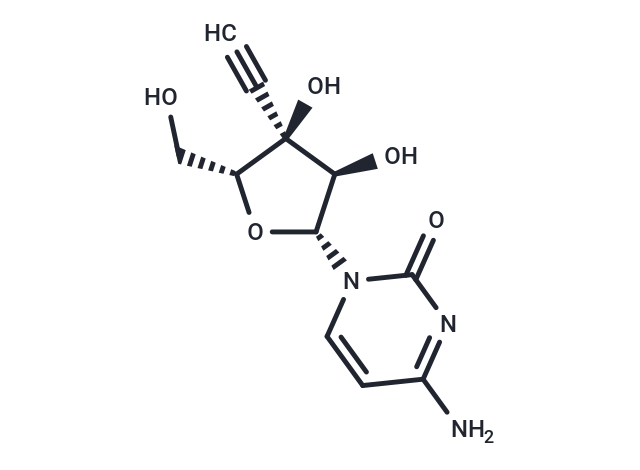
Synonyms: TAS-106, ECyD, 3'-C-Ethynylcytidine

| Pack Size | Price | USA Stock | Global Stock | Quantity |
|---|---|---|---|---|
| 5 mg | $117 | - | In Stock | |
| 10 mg | $198 | - | In Stock | |
| 25 mg | $441 | - | In Stock | |
| 50 mg | Inquiry | - | In Stock | |
| 1 mL x 10 mM (in DMSO) | $128 | - | In Stock |
| Description | Ethynylcytidine is a nucleoside analog and a highly potent inhibitor of RNA synthesis, exerting inhibitory effects on RNA polymerases I, II and III. It exhibits significant anti-tumor activity in a variety of cancer models and also serves as an important click chemistry reagent; its molecular structure contains an alkyne group, which can undergo copper-catalyzed azide-alkyne cycloaddition (CuAAC) with azide-modified molecules. |
| In vitro | After exposure of five human tumor cell lines to Ethynylcytidine for 4 h, 24 h and 72 h, the half-maximal inhibitory concentration (IC₅₀) values were 0.114~1.032 μM, 0.015~0.067 μM and 0.008~0.058 μM [1]. |
| In vivo | In the OCUM-2MD3 and LX-1 xenograft models, Ethynylcytidine induced tumor regression at the minimally toxic dose, exhibiting highly potent anti-tumor activity. the tumor growth inhibition rate (IR) of this compound reached 90% or higher on the 15th day of the experiment under all three administration regimens. Among them, a single weekly administration at a dose of 6 mg/kg showed an especially prominent anti-tumor effect, with the inhibition rate against LX-1 tumors reaching as high as 98% and achieving significant tumor regression. Although administration three or five times a week also exerted a strong anti-tumor effect with an inhibition rate of approximately 85%, an insufficient dose for single weekly administration led to a drop in the inhibition rate to below 60%, resulting in a significant attenuation of anti-tumor activity [1]. |
| Synonyms | TAS-106, ECyD, 3'-C-Ethynylcytidine |
| Molecular Weight | 267.24 |
| Formula | C11H13N3O5 |
| Cas No. | 180300-43-0 |
| Smiles | O[C@H]1[C@@H](O[C@H](CO)[C@@]1(C#C)O)N2C(=O)N=C(N)C=C2 |
| Relative Density. | 1.61 g/cm3 (Predicted) |
| Storage | Powder: -20°C for 3 years | In solvent: -80°C for 1 year Shipping with blue ice/Shipping at ambient temperature. | ||||||||||||||||||||||||||||||||||||||||
| Solubility Information | DMSO: 200 mg/mL (748.39 mM), Sonication is recommended. Saline: 2.5 mg/mL (9.35 mM), Sonication is recommended. | ||||||||||||||||||||||||||||||||||||||||
| In Vivo Formulation | 10% DMSO+40% PEG300+5% Tween-80+45% Saline: 3.3 mg/mL (12.35 mM), Sonication is recommended. Please add the solvents sequentially, clarifying the solution as much as possible before adding the next one. Dissolve by heating and/or sonication if necessary. Working solution is recommended to be prepared and used immediately. The formulation provided above is for reference purposes only. In vivo formulations may vary and should be modified based on specific experimental conditions. | ||||||||||||||||||||||||||||||||||||||||
Solution Preparation Table | |||||||||||||||||||||||||||||||||||||||||
Saline/DMSO
DMSO
Note : The dilution table applies only to solid products. For liquid products, please calculate the stock solution based on the stated concentration and/or density. | |||||||||||||||||||||||||||||||||||||||||
 For example, if the intended dosage is 10 mg/kg for animals weighing 20 g , with a dosing volume of 100 μL per animal, and a total of 10 animals are to be administered, using a formulation of
  10% DMSO+ 40% PEG300+ 5% Tween 80+ 45% Saline/PBS/ddH2O , the resulting working solution concentration would be 2 mg/mL.
Dissolve 2 mg of the compound in 100 μL DMSO to obtain a stock solution at a concentration of 20 mg/mL . If the required concentration exceeds the compound's known solubility, please contact us for technical support before proceeding.
1) Add 100 μL of the DMSO stock solution to 400 µL PEG300 and mix thoroughly until the solution becomes clear.
2) Add 50 µL Tween 80 and mix well until fully clarified.
3) Add 450 µL Saline,PBS or ddH2O and mix thoroughly until a homogeneous solution is obtained.
| Size | Quantity | Unit Price | Amount | Operation |
|---|
 Feedback
 Hello! How can I help you today?
Copyright © 2015-2026 TargetMol Chemicals Inc. All Rights Reserved.
