


Shopping Cart
Remove All Your shopping cart is currently empty

Synonyms:

| Pack Size | Price | USA Stock | Global Stock | Quantity |
|---|---|---|---|---|
| 1 mg | $118 | - | In Stock | |
| 5 mg | $288 | - | In Stock | |
| 10 mg | $427 | - | In Stock | |
| 25 mg | $693 | - | In Stock | |
| 50 mg | $987 | - | In Stock |
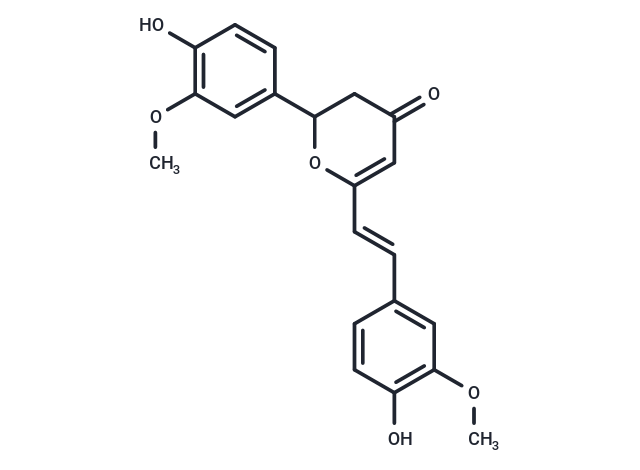
| Description | Cyclocurcumin is a minor curcuminoid derived from the rhizome of Curcuma longa that differs structurally from curcumin despite sharing the same molecular formula (C21H20O6), Cyclocurcumin features an α,β-unsaturated dihydropyranone moiety that drives trans–cis photoisomerization instead of the diketone/keto–enol tautomerism characteristic of curcumin. Cyclocurcumin demonstrates potent biochemical activities, including selective inhibition of human aromatase (CYP19A1) with an IC50 of 4.43 μM—approximately fivefold stronger than curcumin—making it valuable for studying estrogen-related pathways, and uniquely stimulates melanogenesis and melanin export in both melanocyte and melanoma models, positioning it as a promising research tool for investigating hypopigmentary skin disorders. |
| In vitro | Cyclocurcumin (10-40 μM, 18 hours) significantly inhibited LPS-stimulated TNF-α release in Homo sapiens macrophages in a dose-dependent manner [1]. Cyclocurcumin (5-25 μM) concentration-dependently antagonized phenylephrine-induced vasoconstriction in freshly isolated rat aortic rings, with a half-maximal inhibitory concentration (IC50) of 14.9±1.0 μM [2]. Cyclocurcumin (5-25 μM, 30 minutes) dose-dependently inhibited intracellular calcium influx [2]. |
| Molecular Weight | 368.38 |
| Formula | C21H20O6 |
| Cas No. | 153127-42-5 |
| Smiles | C(=C/C1=CC(OC)=C(O)C=C1)\C=2OC(CC(=O)C2)C3=CC(OC)=C(O)C=C3 |
| Relative Density. | 1.352 g/cm3 (Predicted) |
| Storage | Keep away from direct sunlight Powder: -20°C for 3 years | In solvent: -80°C for 1 year Shipping with blue ice/Shipping at ambient temperature. | |||||||||||||||||||||||||||||||||||
| Solubility Information | DMSO: 80 mg/mL (217.17 mM), Sonication is recommended. | |||||||||||||||||||||||||||||||||||
Solution Preparation Table | ||||||||||||||||||||||||||||||||||||
DMSO
Note : The dilution table applies only to solid products. For liquid products, please calculate the stock solution based on the stated concentration and/or density. | ||||||||||||||||||||||||||||||||||||
 For example, if the intended dosage is 10 mg/kg for animals weighing 20 g , with a dosing volume of 100 μL per animal, and a total of 10 animals are to be administered, using a formulation of
  10% DMSO+ 40% PEG300+ 5% Tween 80+ 45% Saline/PBS/ddH2O , the resulting working solution concentration would be 2 mg/mL.
Dissolve 2 mg of the compound in 100 μL DMSO to obtain a stock solution at a concentration of 20 mg/mL . If the required concentration exceeds the compound's known solubility, please contact us for technical support before proceeding.
1) Add 100 μL of the DMSO stock solution to 400 µL PEG300 and mix thoroughly until the solution becomes clear.
2) Add 50 µL Tween 80 and mix well until fully clarified.
3) Add 450 µL Saline,PBS or ddH2O and mix thoroughly until a homogeneous solution is obtained.
| Size | Quantity | Unit Price | Amount | Operation |
|---|
 Feedback
 Hello! How can I help you today?
Copyright © 2015-2026 TargetMol Chemicals Inc. All Rights Reserved.
