


Shopping Cart
Remove All Your shopping cart is currently empty

Synonyms: CCX140-B
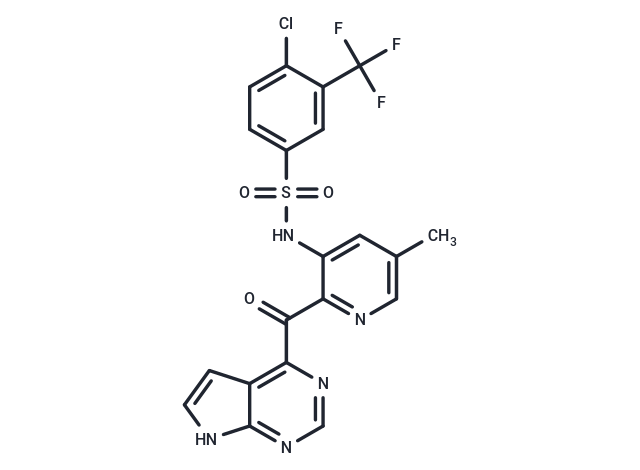

| Pack Size | Price | USA Stock | Global Stock | Quantity |
|---|---|---|---|---|
| 2 mg | $50 | In Stock | In Stock | |
| 5 mg | $62 | In Stock | In Stock | |
| 10 mg | $92 | In Stock | In Stock | |
| 25 mg | $138 | In Stock | In Stock | |
| 50 mg | $205 | - | In Stock | |
| 100 mg | $308 | - | In Stock | |
| 1 mL x 10 mM (in DMSO) | $72 | In Stock | In Stock |
| Description | CCX140 (CCX140-B) (CCX140-B) is an antagonist of CCR2. |
| Targets & IC50 | CCR2:3 nM (in THP-1 cells), CCR2 (human):2.3 nM (kd)(in monocytes), CCR5:7 μM (in Activated T lymphocytes) |
| In vitro | CCX140 inhibits the binding of 125I-CCL2 to monocytes with an IC50 value of 17 nM and it also inhibits CCL2-induced Ca2+ mobilization in monocytes with an IC50 value of 3 nM. CCX140 (CCX140-B) potently inhibits CCL2-induced chemotaxis of purified human blood monocytes with IC50 values of 8 nM in buffer and 200 nM in the presence of 100% human serum. CCX140 has a Kd value of 2.3 nM toward hCCR2. CCX140 also inhibits monocyte chemotaxis mediated by the other CCR2 ligands: CCL8/MCP-2, CCL7/MCP-3, and CCL13/MCP-4[1]. |
| In vivo | CCX140 effectively moderates various metabolic and immunological parameters. It decreases urine and glucose excretion, lowers hepatic glycogen and triglyceride contents, and reduces glucose 6-phosphatase levels. In hCCR2 KI mice, CCX140-B dosage exhibits a significant, dose-dependent capability to mitigate peritoneal leukocyte count following thioglycollate induction, displaying robust leukocyte infiltration inhibition at 30 mg/kg, partial inhibition at 10 mg/kg, and no effect at 3 mg/kg. Additionally, in diet-induced obese (DIO) mice, CCX140 acts as a CCR2 antagonist, fully preventing inflammatory macrophage recruitment to visceral adipose tissue. For DIO hCCR2 KI mice treated with 100 mg/kg of CCX140, there's an evident halt in the escalating urine albumin excretion rate (UAER) and albumin to creatinine ratio (ACR), with sustained lower levels throughout an 8-week dosage period. The treated mice also show reduced hyperglycemia and insulin levels, enhanced insulin sensitivity, escalated circulating adiponectin levels, diminished pancreatic islet size, and an increase in islet number, demonstrating CCX140's comprehensive therapeutic potential. |
| Synonyms | CCX140-B |
| Molecular Weight | 495.86 |
| Formula | C20H13ClF3N5O3S |
| Cas No. | 1100318-47-5 |
| Smiles | Cc1cnc(C(=O)c2ncnc3[nH]ccc23)c(NS(=O)(=O)c2ccc(Cl)c(c2)C(F)(F)F)c1 |
| Relative Density. | 1.596 g/cm3 (Predicted) |
| Storage | Keep away from direct sunlight Powder: -20°C for 3 years | In solvent: -80°C for 1 year Shipping with blue ice/Shipping at ambient temperature. |
| Solubility Information | H2O: 0.25 mg/mL (0.5 mM), Sonication and heating are recommended. DMSO: 100 mg/mL (201.67 mM), Sonication is recommended. |
| In Vivo Formulation | 10% DMSO+40% PEG300+5% Tween 80+45% Saline: 4 mg/mL (8.07 mM), Sonication is recommended. Please add the solvents sequentially, clarifying the solution as much as possible before adding the next one. Dissolve by heating and/or sonication if necessary. Working solution is recommended to be prepared and used immediately. The formulation provided above is for reference purposes only. In vivo formulations may vary and should be modified based on specific experimental conditions. |
 For example, if the intended dosage is 10 mg/kg for animals weighing 20 g , with a dosing volume of 100 μL per animal, and a total of 10 animals are to be administered, using a formulation of
  10% DMSO+ 40% PEG300+ 5% Tween 80+ 45% Saline/PBS/ddH2O , the resulting working solution concentration would be 2 mg/mL.
Dissolve 2 mg of the compound in 100 μL DMSO to obtain a stock solution at a concentration of 20 mg/mL . If the required concentration exceeds the compound's known solubility, please contact us for technical support before proceeding.
1) Add 100 μL of the DMSO stock solution to 400 µL PEG300 and mix thoroughly until the solution becomes clear.
2) Add 50 µL Tween 80 and mix well until fully clarified.
3) Add 450 µL Saline,PBS or ddH2O and mix thoroughly until a homogeneous solution is obtained.
| Size | Quantity | Unit Price | Amount | Operation |
|---|
 Feedback
 Hello! How can I help you today?
Copyright © 2015-2026 TargetMol Chemicals Inc. All Rights Reserved.
