


Shopping Cart
Remove All Your shopping cart is currently empty


Synonyms:

| Pack Size | Price | USA Stock | Global Stock | Quantity |
|---|---|---|---|---|
| 1 mg | $51 | In Stock | In Stock | |
| 2 mg | $74 | In Stock | In Stock | |
| 5 mg | $122 | In Stock | In Stock | |
| 10 mg | $197 | In Stock | In Stock | |
| 25 mg | $413 | In Stock | In Stock | |
| 50 mg | $618 | In Stock | In Stock | |
| 100 mg | $879 | In Stock | In Stock | |
| 1 mL x 10 mM (in DMSO) | $135 | In Stock | In Stock |
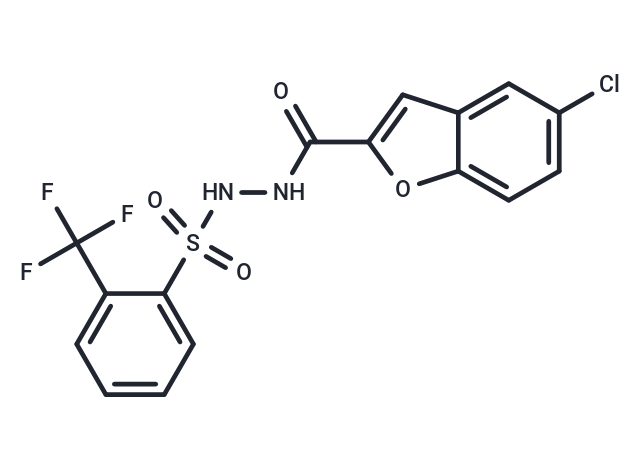
| Description | BCATc Inhibitor 2 exhibited an IC50 of 0.8 microM in the hBCATc assays; it is an active and selective inhibitor. BCATc Inhibitor 2 also blocked calcium influx into neuronal cells following inhibition of glutamate uptake, and demonstrated neuroprotective efficacy in vivo[1]. Branched-chain amino acid transferases (BCATs) have been implicated in catalyzing reversible transamination of isoleucine, leucine, and valine branched-chain amino acids to their corresponding α-keto acids, generating L-glutamate. It has been identified that there are two forms of BCAT in mammals: mitochondrial BCAT (BCATm) and cytosolic BCAT (BCATc). BCATc is expressed in particular brain region and involved in regulating glutamate synthesis for release during neuronal excitation. Thus, BCATc inhibition may be useful for the treatment of neurodegenerative and behavioral disorders involving disturbances of the glutamatergic system [2]. |
| Targets & IC50 | BCATc (human):0.8 μM (IC50), BCATm (rat):3.0 μM (IC50), BCATc (rat):0.2 μM (IC50) |
| In vitro | BCATc inhibition is likely to be useful for the treatment of neurodegenerative and other neurological disorders involving disturbances of the glutamatergic system. In the hBCATc assays, BCATc Inhibitor 2 exhibited an IC50 of 0.8 ± 0.05 μM. In a recombinant rat BCATc assay and a crude rat BCATm assay, the IC50 was 0.2 μM ± 0.02 and 3.0 μM ± 0.5 (n=5), respectively. BCATc Inhibitor 2 decreased calcium influx in neuronal cultures with an IC50 of 4.8 ± 1.2 μM (n=4) [1]. |
| In vivo | BCATc Inhibitor 2 blocked calcium influx into neuronal cells following inhibition of glutamate uptake, and demonstrated neuroprotective efficacy in vivo. In Lewis rats, after treatment with 30 mg/kg BCATc Inhibitor 2 (subcutaneous injection), the peak plasma concentration (Cmax) reached 8.28 μg/ml at 0.5 h (tmax). The mean plasma exposure (AUC) value was 19.9 μg h/ml, and the mean terminal half-life ranged from 12 to 15 h, indicating favorable PK parameters of BCATc Inhibitor 2. Daily administration of the mitochondrial neurotoxin, 3-nitroproprionic acid (3-NP) produced striatal lesions and led to motor deficits. Administration of BCATc Inhibitor 2 for 9 days almost completely reversed the effects of 3-NP [1]. |
| Molecular Weight | 418.77 |
| Formula | C16H10ClF3N2O4S |
| Cas No. | 406191-34-2 |
| Smiles | FC(F)(F)c1ccccc1S(=O)(=O)NNC(=O)c1cc2cc(Cl)ccc2o1 |
| Relative Density. | no data available |
| Storage | Powder: -20°C for 3 years | In solvent: -80°C for 1 year Shipping with blue ice/Shipping at ambient temperature. | |||||||||||||||||||||||||||||||||||
| Solubility Information | DMSO: 65 mg/mL (155.22 mM), Sonication is recommended.  | |||||||||||||||||||||||||||||||||||
| In Vivo Formulation | 10% DMSO+90% Corn Oil: 2.5 mg/mL (5.97 mM), Sonication is recommended. Please add the solvents sequentially, clarifying the solution as much as possible before adding the next one. Dissolve by heating and/or sonication if necessary. Working solution is recommended to be prepared and used immediately. The formulation provided above is for reference purposes only. In vivo formulations may vary and should be modified based on specific experimental conditions. | |||||||||||||||||||||||||||||||||||
Solution Preparation Table | ||||||||||||||||||||||||||||||||||||
DMSO
Note : The dilution table applies only to solid products. For liquid products, please calculate the stock solution based on the stated concentration and/or density. | ||||||||||||||||||||||||||||||||||||
 For example, if the intended dosage is 10 mg/kg for animals weighing 20 g , with a dosing volume of 100 μL per animal, and a total of 10 animals are to be administered, using a formulation of
  10% DMSO+ 40% PEG300+ 5% Tween 80+ 45% Saline/PBS/ddH2O , the resulting working solution concentration would be 2 mg/mL.
Dissolve 2 mg of the compound in 100 μL DMSO to obtain a stock solution at a concentration of 20 mg/mL . If the required concentration exceeds the compound's known solubility, please contact us for technical support before proceeding.
1) Add 100 μL of the DMSO stock solution to 400 µL PEG300 and mix thoroughly until the solution becomes clear.
2) Add 50 µL Tween 80 and mix well until fully clarified.
3) Add 450 µL Saline,PBS or ddH2O and mix thoroughly until a homogeneous solution is obtained.
| Size | Quantity | Unit Price | Amount | Operation |
|---|
 Feedback
 Hello! How can I help you today?
Copyright © 2015-2026 TargetMol Chemicals Inc. All Rights Reserved.
