


Shopping Cart
Remove All Your shopping cart is currently empty

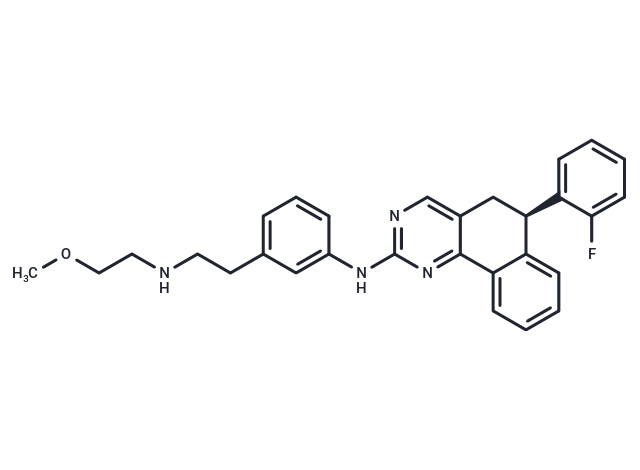
Synonyms: ARQ-087
| Pack Size | Price | USA Stock | Global Stock | Quantity |
|---|---|---|---|---|
| 1 mg | $48 | In Stock | In Stock | |
| 5 mg | $118 | In Stock | In Stock | |
| 10 mg | $172 | In Stock | In Stock | |
| 25 mg | $286 | In Stock | In Stock | |
| 50 mg | $423 | In Stock | In Stock | |
| 100 mg | $629 | In Stock | In Stock | |
| 200 mg | $895 | - | In Stock | |
| 1 mL x 10 mM (in DMSO) | $127 | In Stock | In Stock |
| Description | Derazantinib (ARQ-087) is a potent, ATP-competitive, orally active tyrosine kinase inhibitor with IC50 values of 4.5/1.8/4.35/3.4 nM for chondrocyte FGFR1/FGFR2/FGFR3/FGFR4, respectively. |
| Targets & IC50 | FGFR2:1.8 nM, FGFR3:4.5 nM, FGFR1:4.5 nM |
| In vitro | METHODS: COS-1 cells ectopically expressing FGFR1, FGFR2, FGFR3, or FGFR4 were treated with derazantinib (ARQ-087) (0.1, 0.3, 1.1, 3.3, 10 μM, 2 hours) and stimulated with 100 pM FGF1/2/7 for 15 minutes. Total and phosphorylated FGFRs were assessed by Western blot analysis. RESULTS Derazantinib inhibited phosphorylation of FGFR1, FGFR2, FGFR3, and FGFR4 with IC50 values of <0.123 μM, 0.185 μM, 0.463 μM, and >10 μM, respectively, together with EC. [1] |
| In vivo | METHODS: Derazantinib (ARQ-087) (25, 50, 75 mg/kg) treated SNU-16 and NCI-H716 xenograft athymic mouse models; Derazantinib (50, 100, 150 mg/kg) treated Ba/F3-FGFR2 xenograft athymic mouse models Thymic mouse model; Derazantinib (75 mg/kg) treated Ba/F3-INSR xenograft athymic mouse model; both were administered orally and the in vivo anti-tumor effect of Derazantinib was evaluated. RESULTS Derazantinib showed potent tumor growth inhibition in the Ba/F3-FGFR2 model but failed to inhibit the growth of the Ba/F3-INSR model; in the SNU-16 xenograft study, 75 mg/kg and 50 mg /kg treatment achieved TGI of 83% and 69%, respectively; in the NCI-H716 human cecum model, 50 mg/kg and 75 mg/kg showed significant TGI of 68% and 96%, respectively. [1] |
| Synonyms | ARQ-087 |
| Kinase Assay | Derazantinib is titrated in DMSO utilizing a 3-fold dilution scheme and then diluted 10-fold further in deionized water for a final DMSO concentration of 10%. A volume (2.5 μL) of these dilutions or vehicle is added to each well of a reaction plate. FGFR1 or FGFR2 is added to assay buffer to each well in a volume of 17.5 μL for a final concentration of 0.50 or 0.25 nM, respectively. After a 30-minute pre-incubation period, ATP and substrate are added in assay buffer (5 μL) for final concentrations of 0-1,000 μM ATP and 80 nM biotinylated-PYK2, for a final reaction volume of 25 μL. The plates are incubated for 60 minutes at room temperature and then stopped in the dark by the addition of 10 μL stop/detection mixture prepared in assay buffer containing EDTA [1]. |
| Cell Research | Cells are seeded at 3000-5000 cells per well with 130 μL media in 96-well tissue culture-treated plates. The cells are incubated overnight and subsequently treated with 3-fold serial dilutions of Derazantinib starting at 100 μM. The cells are returned to a 37°C humidified incubator for 72 hours. Cell proliferation is measured using the MTS assay [1]. |
| Animal Research | Female NCr nu/nu mice (SNU-16) or CB17 SCID mice (NCI-H716) with well established (400 mg) subcutaneous tumors are given a single oral dose of Derazantinib or vehicle control. Plasma and tumor samples are collected 4 hours post single dose. Derazantinib is administered orally. The dosing volume for all groups is 10 mL/kg or 0.1 mL/10 g body weight [1]. |
| Molecular Weight | 468.57 |
| Formula | C29H29FN4O |
| Cas No. | 1234356-69-4 |
| Smiles | COCCNCCc1cccc(Nc2ncc3C[C@@H](c4ccccc4F)c4ccccc4-c3n2)c1 |
| Relative Density. | 1.218 g/cm3 (Predicted) |
| Storage | Powder: -20°C for 3 years | In solvent: -80°C for 1 year Shipping with blue ice/Shipping at ambient temperature. | |||||||||||||||||||||||||||||||||||
| Solubility Information | DMSO: 100 mg/mL (213.42 mM), Sonication is recommended.  | |||||||||||||||||||||||||||||||||||
| In Vivo Formulation | 10% DMSO+40% PEG300+5% Tween 80+45% Saline: < 10 mg/mL (21.34 mM), Lower concentrations may be soluble, but exact solubility limit is unknown. 10% DMSO+90% (20% SBE-β-CD in Saline): < 10 mg/mL (21.34 mM), Lower concentrations may be soluble, but exact solubility limit is unknown. 10% DMSO+90% Saline: < 10 mg/mL (21.34 mM), Lower concentrations may be soluble, but exact solubility limit is unknown. 10% DMSO+90% Corn oil: < 10 mg/mL (21.34 mM), Lower concentrations may be soluble, but exact solubility limit is unknown. Please add the solvents sequentially, clarifying the solution as much as possible before adding the next one. Dissolve by heating and/or sonication if necessary. Working solution is recommended to be prepared and used immediately. The formulation provided above is for reference purposes only. In vivo formulations may vary and should be modified based on specific experimental conditions. | |||||||||||||||||||||||||||||||||||
Solution Preparation Table | ||||||||||||||||||||||||||||||||||||
DMSO
Note : The dilution table applies only to solid products. For liquid products, please calculate the stock solution based on the stated concentration and/or density. | ||||||||||||||||||||||||||||||||||||
 For example, if the intended dosage is 10 mg/kg for animals weighing 20 g , with a dosing volume of 100 μL per animal, and a total of 10 animals are to be administered, using a formulation of
  10% DMSO+ 40% PEG300+ 5% Tween 80+ 45% Saline/PBS/ddH2O , the resulting working solution concentration would be 2 mg/mL.
Dissolve 2 mg of the compound in 100 μL DMSO to obtain a stock solution at a concentration of 20 mg/mL . If the required concentration exceeds the compound's known solubility, please contact us for technical support before proceeding.
1) Add 100 μL of the DMSO stock solution to 400 µL PEG300 and mix thoroughly until the solution becomes clear.
2) Add 50 µL Tween 80 and mix well until fully clarified.
3) Add 450 µL Saline,PBS or ddH2O and mix thoroughly until a homogeneous solution is obtained.
| Size | Quantity | Unit Price | Amount | Operation |
|---|
 Feedback
 Hello! How can I help you today?
Copyright © 2015-2026 TargetMol Chemicals Inc. All Rights Reserved.
