


Shopping Cart
Remove All Your shopping cart is currently empty

Synonyms:
| Pack Size | Price | USA Stock | Global Stock | Quantity |
|---|---|---|---|---|
| 1 mg | $223 | 35 days | 35 days | |
| 5 mg | $978 | 35 days | 35 days | |
| 10 mg | $1,720 | 35 days | 35 days |
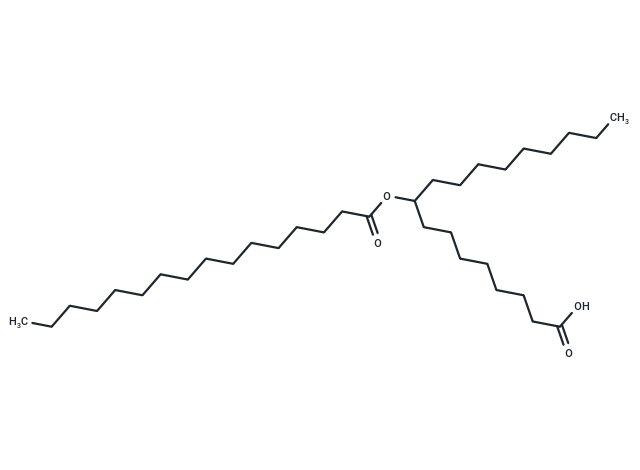
| Description | Branched fatty acid esters of hydroxy fatty acids (FAHFAs) are newly identified endogenous lipids regulated by fasting and high-fat feeding and associated with insulin sensitivity. Structurally, these esters are comprised of a C-16 or C-18 fatty acid (e.g., palmitoleic, palmitic, oleic, or stearic acid) linked to a hydroxylated C-16 or C-18 lipid. 9-PAHSA is a FAHFA in which palmitic acid is esterified to 9-hydroxy stearic acid. PAHSAs are the most abundant forms of FAHFA in serum as well as white and brown adipose tissues of glucose tolerant AG4OX mice, which overexpress Glut4 specifically in adipose tissue. 9-PAHSA is the predominant isomer of PAHSA in wild type and AG4OX mice. It is found in humans and is reduced in the serum and adipose tissues of insulin-resistant humans. 9-PAHSA improves glucose tolerance, stimulates insulin secretion, and has anti-inflammatory effects in mice. |
| Molecular Weight | 538.898 |
| Formula | C34H66O4 |
| Cas No. | 1481636-31-0 |
| Smiles | CCCCCCCCCCCCCCCC(=O)OC(CCCCCCCCC)CCCCCCCC(O)=O |
| Storage | Powder: -20°C for 3 years | In solvent: -80°C for 1 year Shipping with blue ice/Shipping at ambient temperature. |
| Solubility Information | DMSO: 15 mg/mL (27.83 mM), Sonication is recommended. Ethanol: 20 mg/mL (37.11 mM), Sonication is recommended. Ethanol:PBS(pH 7.2) (1:1): 0.5 mg/mL (0.93 mM), Sonication is recommended. DMF: 20 mg/mL (37.11 mM), Sonication is recommended. |
| In Vivo Formulation | 10% DMSO+40% PEG300+5% Tween-80+45% Saline: 0.5 mg/mL (0.93 mM), Sonication is recommended. Please add the solvents sequentially, clarifying the solution as much as possible before adding the next one. Dissolve by heating and/or sonication if necessary. Working solution is recommended to be prepared and used immediately. The formulation provided above is for reference purposes only. In vivo formulations may vary and should be modified based on specific experimental conditions. |
 For example, if the intended dosage is 10 mg/kg for animals weighing 20 g , with a dosing volume of 100 μL per animal, and a total of 10 animals are to be administered, using a formulation of
  10% DMSO+ 40% PEG300+ 5% Tween 80+ 45% Saline/PBS/ddH2O , the resulting working solution concentration would be 2 mg/mL.
Dissolve 2 mg of the compound in 100 μL DMSO to obtain a stock solution at a concentration of 20 mg/mL . If the required concentration exceeds the compound's known solubility, please contact us for technical support before proceeding.
1) Add 100 μL of the DMSO stock solution to 400 µL PEG300 and mix thoroughly until the solution becomes clear.
2) Add 50 µL Tween 80 and mix well until fully clarified.
3) Add 450 µL Saline,PBS or ddH2O and mix thoroughly until a homogeneous solution is obtained.
| Size | Quantity | Unit Price | Amount | Operation |
|---|
 Feedback
 Hello! How can I help you today?
Copyright © 2015-2026 TargetMol Chemicals Inc. All Rights Reserved.
