


Shopping Cart
Remove All Your shopping cart is currently empty

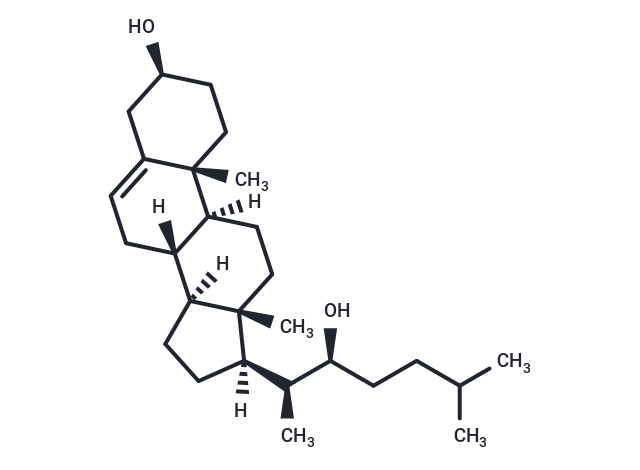
Synonyms: 22β-hydroxy Cholesterol, 22(S)-hydroxy Cholesterol
| Pack Size | Price | USA Stock | Global Stock | Quantity |
|---|---|---|---|---|
| 1 mg | $88 | 35 days | 35 days | |
| 5 mg | $338 | 35 days | 35 days | |
| 10 mg | $593 | 35 days | 35 days |
| Description | 22(S)-hydroxy Cholesterol is a synthetic oxysterol and a modulator of the liver X receptor (LXR). [1] t prevents monocyte chemoattractant protein 1 (MCP-1) expression induced by the LXR agonist GW 3965 in primary hepatocytes and downregulates mRNA expression of the LXR target genes CD36, ACSL1, and SCD-1 in human myotubes. It decreases triacylglycerol and diacylglycerol synthesis from labeled palmitate and acetate, respectively, in human myoblasts by 50% when used at a concentration of 10 uM. 22(S)-hydroxy Cholesterol also reduces fatty acid synthase (FAS) reporter activity through an LXR response element in the promoter region in COS-1 cells transfected with RXRα and LXRα and decreases the expression of MCP-1 and CCR2 in a mouse model of chronic ethanol consumption.[1] [2] Dietary supplementation of 22(S)-hydroxy cholesterol (30 mg/kg per day) leads to less body weight gain and lower liver triacylglycerol levels in rats when fed either a regular chow or high-fat diet as well as prevents an increase in plasma triacylglycerol levels resulting from a high-fat diet.[3] |
| Synonyms | 22β-hydroxy Cholesterol, 22(S)-hydroxy Cholesterol |
| Molecular Weight | 402.65 |
| Formula | C27H46O2 |
| Cas No. | 22348-64-7 |
| Smiles | C[C@@]12[C@]([C@]3([C@@]([C@]4(C)C(=CC3)C[C@@H](O)CC4)(CC1)[H])[H])(CC[C@@]2([C@@H]([C@H](CCC(C)C)O)C)[H])[H] |
| Storage | Powder: -20°C for 3 years | In solvent: -80°C for 1 year Shipping with blue ice/Shipping at ambient temperature. |
| Solubility Information | DMSO: 0.1 mg/mL (0.25 mM), Sonication is recommended. DMF: 2 mg/mL (4.97 mM), Sonication is recommended. Ethanol: 20 mg/mL (49.67 mM), Sonication is recommended. Ethanol:PBS (pH 7.2)(1:2): 0.3 mg/mL (0.75 mM), Sonication is recommended. |
 For example, if the intended dosage is 10 mg/kg for animals weighing 20 g , with a dosing volume of 100 μL per animal, and a total of 10 animals are to be administered, using a formulation of
  10% DMSO+ 40% PEG300+ 5% Tween 80+ 45% Saline/PBS/ddH2O , the resulting working solution concentration would be 2 mg/mL.
Dissolve 2 mg of the compound in 100 μL DMSO to obtain a stock solution at a concentration of 20 mg/mL . If the required concentration exceeds the compound's known solubility, please contact us for technical support before proceeding.
1) Add 100 μL of the DMSO stock solution to 400 µL PEG300 and mix thoroughly until the solution becomes clear.
2) Add 50 µL Tween 80 and mix well until fully clarified.
3) Add 450 µL Saline,PBS or ddH2O and mix thoroughly until a homogeneous solution is obtained.
| Size | Quantity | Unit Price | Amount | Operation |
|---|
 Feedback
 Hello! How can I help you today?
Copyright © 2015-2026 TargetMol Chemicals Inc. All Rights Reserved.
