


Shopping Cart
Remove All Your shopping cart is currently empty


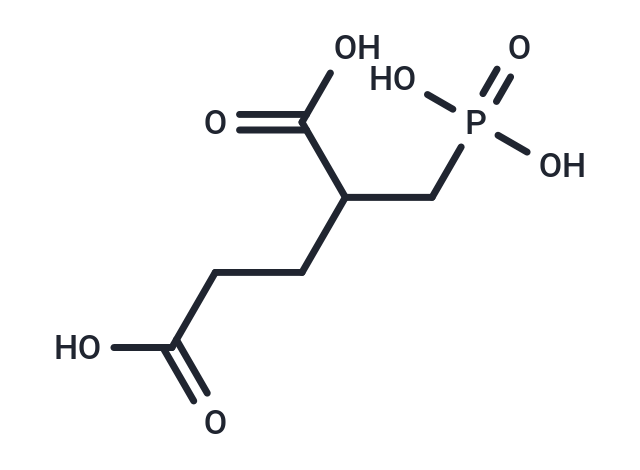
Synonyms: 2-(Phosphonomethyl)pentanedioic acid

| Pack Size | Price | USA Stock | Global Stock | Quantity |
|---|---|---|---|---|
| 5 mg | $61 | In Stock | In Stock | |
| 10 mg | $94 | In Stock | In Stock | |
| 25 mg | $189 | In Stock | In Stock | |
| 50 mg | $273 | In Stock | In Stock | |
| 100 mg | $453 | In Stock | In Stock |
| Description | 2-PMPA (2-(Phosphonomethyl)pentanedioic acid) is a potent and selective inhibitor of glutamate carboxypeptidase II (GCPII) (IC50=300 pM). |
| Targets & IC50 | GCP II:300 pM |
| In vitro | 2-PMPA acts as a potent, selective inhibitor of the enzyme GCPII, which breaks down the prevalent neuropeptide N-acetyl-aspartyl-glutamate (NAAG) into N-acetylaspartate (NAA) and glutamate. It has shown considerable effectiveness across various animal models of neurological disease. Despite its high polarity and multiple negative charges which pose analytical challenges in biological matrices[1], 2-PMPA notably mitigates the reduction in cell viability and elevation in LDH levels induced by ketamine in mixed cultures, an effect not observed in neuronal cultures[2]. |
| In vivo | Administering 100 mg/kg of 2-PMPA intraperitoneally achieves a peak plasma concentration of 275 μg/mL at 0.25 hours, with pharmacokinetic parameters including a half-life of 0.64 hours, an area under the curve (AUC) of 210 μg×h/mL, an apparent clearance of 7.93 mL/min/kg, and a volume of distribution of 0.44 L/kg[1]. At a dosage of 250 mg/kg in anesthetized mice, 2-PMPA causes an initial increase followed by a rapid decrease and significant attenuation of BOLD signals in gray matter, with its impact on T2* brain signals at dosages of 167 and 250 mg/kg characterized by a notable initial rise lasting several minutes[3]. 2-PMPA shows neuroprotective effects in stroke animal models and anti-allodynic properties in the CCI model. Furthermore, its administration at 50 mg/kg leads to a peak plasma concentration of approximately 29.66±8.1 μM, which is vastly above the threshold needed for inhibiting NAAG peptidase, indicating exceptional brain penetration. This dosage also results in a continuous increase in extracellular NAAG levels starting immediately after administration[4]. |
| Synonyms | 2-(Phosphonomethyl)pentanedioic acid |
| Cell Research | Neuronal cultures and neuron–glia mixed cultures are treated with ketamine diluted in the culture medium (1, 3, 10, 30, 100, 300, 1000, 2000, 3000 μM) for 24 h to compare neurotoxicity in these two different cell cultures. 2-PMPA is selected to explore the protective effect on ketamine-induced neurotoxicity in these two different cell cultures. Cells are exposed to 2-PMPA (20, 50, 100 μM) half an hour before 10 μM ketamine treatment in neuronal cultures and 2 mM ketamine treatment in neuron–glia mixed cultures for 24 h. Different doses of ketamine chosen in neuronal cultures and neuron–glia mixed cultures are based on the results of cell viability tests[2]. |
| Molecular Weight | 226.12 |
| Formula | C6H11O7P |
| Cas No. | 173039-10-6 |
| Smiles | C(CCC(O)=O)(CP(=O)(O)O)C(O)=O |
| Relative Density. | 1.658 g/cm3 (Predicted) |
| Storage | Pure form: -20°C for 3 years | In solvent: -80°C for 1 year Shipping with blue ice/Shipping at ambient temperature. | |||||||||||||||||||||||||||||||||||
| Solubility Information | H2O: 250 mg/mL (1105.61 mM), Sonication is recommended.  | |||||||||||||||||||||||||||||||||||
Solution Preparation Table | ||||||||||||||||||||||||||||||||||||
H2O
Note : The dilution table applies only to solid products. For liquid products, please calculate the stock solution based on the stated concentration and/or density. | ||||||||||||||||||||||||||||||||||||
 For example, if the intended dosage is 10 mg/kg for animals weighing 20 g , with a dosing volume of 100 μL per animal, and a total of 10 animals are to be administered, using a formulation of
  10% DMSO+ 40% PEG300+ 5% Tween 80+ 45% Saline/PBS/ddH2O , the resulting working solution concentration would be 2 mg/mL.
Dissolve 2 mg of the compound in 100 μL DMSO to obtain a stock solution at a concentration of 20 mg/mL . If the required concentration exceeds the compound's known solubility, please contact us for technical support before proceeding.
1) Add 100 μL of the DMSO stock solution to 400 µL PEG300 and mix thoroughly until the solution becomes clear.
2) Add 50 µL Tween 80 and mix well until fully clarified.
3) Add 450 µL Saline,PBS or ddH2O and mix thoroughly until a homogeneous solution is obtained.
| Size | Quantity | Unit Price | Amount | Operation |
|---|
 Feedback
 Hello! How can I help you today?
Copyright © 2015-2026 TargetMol Chemicals Inc. All Rights Reserved.
