


Shopping Cart
Remove All Your shopping cart is currently empty

Synonyms: 1,2-Benzenedicarboxylic acid
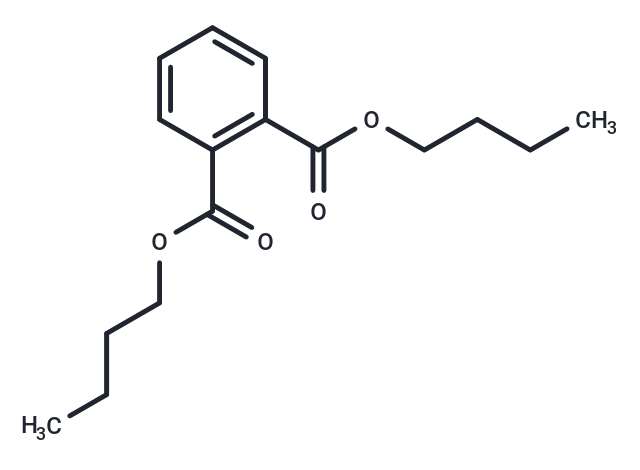
| Pack Size | Price | USA Stock | Global Stock | Quantity |
|---|---|---|---|---|
| 25 mg | $31 | - | In Stock | |
| 50 mg | $42 | - | In Stock | |
| 100 mg | $58 | - | In Stock | |
| 500 mg | $133 | - | In Stock | |
| 1 g | $195 | - | In Stock |
| Description | Dibutyl phthalate (1,2-Benzenedicarboxylic acid) is a plasticizer, commonly used in industrial manufacturing, that causes cardiac damage by disrupting Ca(2+) transfer from the endoplasmic reticulum to the mitochondria and triggering subsequent cellular death.Dibutyl phthalate induces oxidative damage in the brain of zebrafish. |
| In vitro | The compound was isolated by direct fractionation of ethyl acetate extracts of air-dried seeds and pods and subjected to microbial susceptibility testing. Antibacterial screening results show that Acacia ethyl acetate extract has the highest activity against the tested microorganisms, with an inhibition zone diameter of 27-32mm, and is effective against Salmonella typhi, Escherichia coli, Streptococcus faecalis, Staphylococcus aureus, Candida krusei and Shigella dysenteriae [1]; grass carp hepatocytes were treated with 300 μM Dibutyl phthalate for 24 h, and hepatocytes were treated with 1 μM taxolin (TAX) for 24 h to study its antagonistic effect on Dibutyl phthalate. After exposure to Dibutyl phthalate, hepatocyte oxidative stress levels and inflammation increased, and the mRNA and protein expression of apoptosis-related markers significantly increased, leading to hepatocyte apoptosis [6]; treated with 10–1000 μg/ml Dibutyl phthalate When follicles are exposed to 48 hours, Dibutyl phthalate is harmful to ovarian antral follicles when the exposure is ≥10 μg/ml. The presence of MBP does not affect the growth and vitality of Dibutyl phthalate on antral follicles [3]. |
| In vivo | Treatment with dibutyl phthalate (DBP; 10 or 100 mg/kg/d, po) for five weeks in adult male mice induced immunotoxicity by reducing total leukocyte counts and classical monocyte and T helper cell populations, but not classical monocytogenes. Increased populations of nuclear cells and PMN-MDSCs, leading to sustained immunosuppression [2]; Dibutyl phthalate (200, 400 or 600 mg/kg/day) causes weight loss, impaired spermatogenesis, serum follicle-stimulating hormone and testosterone in mice Decreased levels, changes in testicular LDH, increased LPO and decreased enzyme antioxidant levels, accompanied by histopathological abnormalities [4]; Dibutyl phthalate (6.25, 12.5, 25, 50, 100 and 200mg/kg) may produce Some neurobehavioral adverse effects [5]. |
| Synonyms | 1,2-Benzenedicarboxylic acid |
| Molecular Weight | 278.34 |
| Formula | C16H22O4 |
| Cas No. | 84-74-2 |
| Smiles | O=C(OCCCC)C=1C=CC=CC1C(=O)OCCCC |
| Relative Density. | 1.043 g/cm3 at 25℃ (lit.) |
| Storage | Store at low temperature,Keep away from direct sunlight Pure form: -20°C for 3 years | In solvent: -80°C for 1 year Shipping with blue ice/Shipping at ambient temperature. | |||||||||||||||||||||||||||||||||||
| Solubility Information | Ethanol: 30 mg/mL (107.78 mM), Sonication is recommended. DMSO: 250 mg/mL (898.18 mM), Sonication is recommended.  | |||||||||||||||||||||||||||||||||||
| In Vivo Formulation | 10% DMSO+40% PEG300+5% Tween 80+45% Saline: 3.3 mg/mL (11.86 mM), Sonication is recommended. 10% DMSO+90% Saline: 10 mg/mL (35.93 mM), Suspension. Please add the solvents sequentially, clarifying the solution as much as possible before adding the next one. Dissolve by heating and/or sonication if necessary. Working solution is recommended to be prepared and used immediately. The formulation provided above is for reference purposes only. In vivo formulations may vary and should be modified based on specific experimental conditions. | |||||||||||||||||||||||||||||||||||
Solution Preparation Table | ||||||||||||||||||||||||||||||||||||
Ethanol/DMSO
Note : The dilution table applies only to solid products. For liquid products, please calculate the stock solution based on the stated concentration and/or density. | ||||||||||||||||||||||||||||||||||||
 For example, if the intended dosage is 10 mg/kg for animals weighing 20 g , with a dosing volume of 100 μL per animal, and a total of 10 animals are to be administered, using a formulation of
  10% DMSO+ 40% PEG300+ 5% Tween 80+ 45% Saline/PBS/ddH2O , the resulting working solution concentration would be 2 mg/mL.
Dissolve 2 mg of the compound in 100 μL DMSO to obtain a stock solution at a concentration of 20 mg/mL . If the required concentration exceeds the compound's known solubility, please contact us for technical support before proceeding.
1) Add 100 μL of the DMSO stock solution to 400 µL PEG300 and mix thoroughly until the solution becomes clear.
2) Add 50 µL Tween 80 and mix well until fully clarified.
3) Add 450 µL Saline,PBS or ddH2O and mix thoroughly until a homogeneous solution is obtained.
| Size | Quantity | Unit Price | Amount | Operation |
|---|
 Feedback
 Hello! How can I help you today?
Copyright © 2015-2026 TargetMol Chemicals Inc. All Rights Reserved.
