


Shopping Cart
Remove All Your shopping cart is currently empty

Synonyms:

| Pack Size | Price | USA Stock | Global Stock | Quantity |
|---|---|---|---|---|
| 1 mg | $55 | - | In Stock | |
| 5 mg | $129 | - | In Stock | |
| 10 mg | $208 | - | In Stock | |
| 25 mg | $419 | - | In Stock | |
| 50 mg | $673 | - | In Stock | |
| 100 mg | $1,080 | - | In Stock | |
| 1 mL x 10 mM (in DMSO) | $143 | - | In Stock |
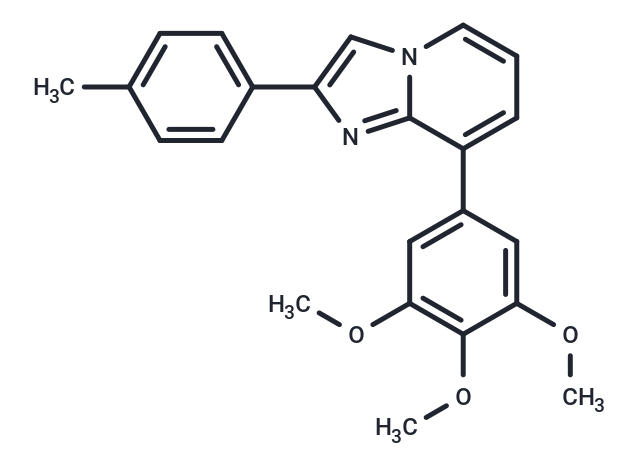
| Description | Tubulin polymerization-IN-84 can inhibit the polymerization process of tubulin (Tubulin) by targeting the colchicine-binding pocket, with an IC50 value of 10.9 μM. Tubulin polymerization-IN-84 exhibits antiproliferative activity against four cell lines, namely Jurkat, B16-F10, HCT116 and MDA-MB-231, with corresponding IC50 values of 60 nM, 380 nM, 138 nM and 1.054 μM, respectively. In B16-F10 cells, Tubulin polymerization-IN-84 can induce G2/M phase cell cycle arrest and further trigger cell apoptosis. In addition, in the B16-F10 melanoma model, it can effectively inhibit the growth of tumor tissue; when combined with PD-L1 monoclonal antibody, it can also enhance the in vivo anti-tumor immune response, and can be used in the related research fields of T-cell acute lymphoblastic leukemia, melanoma, colon cancer and breast cancer. |
| Targets & IC50 | MDA-MB-231 cells:1.054 μM, HCT116 cells:138 nM, Tubulin polymerization:10.9 μM, Jurkat cells:60 nM |
| In vitro | Tubulin polymerization-IN-84 (Compound 5b) exhibits inhibitory effects on the proliferation of four cell lines, namely Jurkat, B16-F10, HCT116, and MDA-MB-231, with the corresponding IC50 values of 60 nM, 380 nM, 138 nM, and 1.054 μM, respectively [1]. When B16-F10 cells are treated with 0.5-5 μM Tubulin polymerization-IN-84 for 48 hours, it can induce G2/M phase cell cycle arrest. Among them, the proportion of G2/M phase cells in the control group is 9.75%, and that in the 5 μM dose group can reach 81.1% [1]. Likewise, at a concentration of 0.5-5 μM and a treatment duration of 48 hours, Tubulin polymerization-IN-84 can effectively induce apoptosis in B16-F10 cells [1]. Tubulin polymerization-IN-84 can directly bind to β-tubulin, with a KD value of 31.84 μM for the binding between the two [1]. In the concentration range of 0.1-5 μM, Tubulin polymerization-IN-84 can compete with EBI for binding to the colchicine-binding site on β-tubulin in B16-F10 cells in a concentration-dependent manner [1]. Treating B16-F10 cells with 0.5-5 μM Tubulin polymerization-IN-84 for 12 hours can lead to the depolymerization of the microtubule network in the cytoplasm of the cells [1]. When HUVEC cells are treated at a concentration of 0.5-5 μM for 6 hours, Tubulin polymerization-IN-84 can dose-dependently disrupt the capillary-like network structure formed by HUVEC cells on Matrigel matrix and reduce the number of network connection points [1]. |
| In vivo | When Tubulin polymerization-IN-84 is administered by intraperitoneal injection at a dose of 10 mg/kg, once daily for 14 consecutive days, it can effectively inhibit the growth of B16-F10 melanoma tumors in C57BL/6 mice, with a tumor growth inhibition rate (TGI) of 27.5% [1]. When Tubulin polymerization-IN-84 is co-administered with PD-L1 monoclonal antibody (both at a dose of 10 mg/kg, total dose 10 + 10 mg/kg), its anti-tumor efficacy is further enhanced, with the tumor growth inhibition rate (TGI) increased to 36.2%, and no significant weight loss was observed in the mice during the entire administration period [1]. |
| Molecular Weight | 374.43 |
| Formula | C23H22N2O3 |
| Cas No. | 2982893-14-9 |
| Smiles | N=1C(=CN2C=CC=C(C=3C=C(OC)C(OC)=C(OC)C3)C12)C=4C=CC(=CC4)C |
| Relative Density. | no data available |
| Storage | Powder: -20°C for 3 years | In solvent: -80°C for 1 year Shipping with blue ice/Shipping at ambient temperature. |
 For example, if the intended dosage is 10 mg/kg for animals weighing 20 g , with a dosing volume of 100 μL per animal, and a total of 10 animals are to be administered, using a formulation of
  10% DMSO+ 40% PEG300+ 5% Tween 80+ 45% Saline/PBS/ddH2O , the resulting working solution concentration would be 2 mg/mL.
Dissolve 2 mg of the compound in 100 μL DMSO to obtain a stock solution at a concentration of 20 mg/mL . If the required concentration exceeds the compound's known solubility, please contact us for technical support before proceeding.
1) Add 100 μL of the DMSO stock solution to 400 µL PEG300 and mix thoroughly until the solution becomes clear.
2) Add 50 µL Tween 80 and mix well until fully clarified.
3) Add 450 µL Saline,PBS or ddH2O and mix thoroughly until a homogeneous solution is obtained.
| Size | Quantity | Unit Price | Amount | Operation |
|---|
 Feedback
 Hello! How can I help you today?
Copyright © 2015-2026 TargetMol Chemicals Inc. All Rights Reserved.
