


Shopping Cart
Remove All Your shopping cart is currently empty

Synonyms: Tiludronic acid disodium hemihydrate
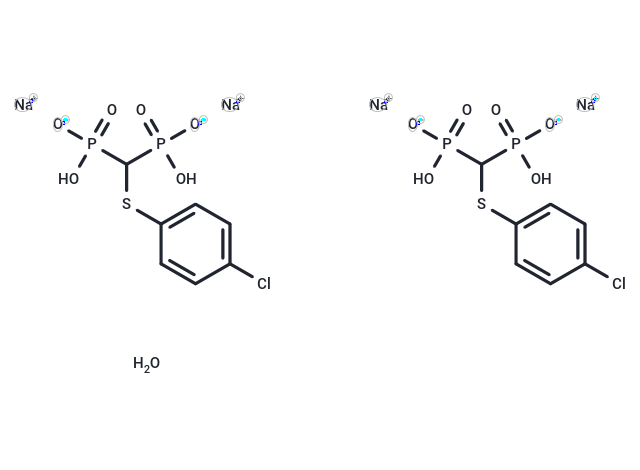
| Pack Size | Price | USA Stock | Global Stock | Quantity |
|---|---|---|---|---|
| 25 mg | $1,520 | 4-6 weeks | 4-6 weeks | |
| 50 mg | $1,980 | 4-6 weeks | 4-6 weeks | |
| 100 mg | $2,500 | 4-6 weeks | 4-6 weeks |
| Description | Tiludronate (Tiludronic Acid) disodium hemihydrate is an orally active bisphosphonate compound used primarily in metabolic bone disorder research. It functions as an osteoregulator and acts as a potent inhibitor of the osteoclast vacuolar H+ -ATPase, possessing antiresorptive and anti-inflammatory properties [4]. |
| In vitro | Tiludronate exhibits significantly enhanced potency in inhibiting proton transport, with a five-fold greater efficacy in kidney-derived vesicles (IC 50 =1.1 mM) and an even more pronounced, ten-thousand-fold increase in vesicles sourced from osteoclasts (IC 50 =466 nM). Additionally, it effectively inhibits proton transport in yeast microsomal preparations (IC 50 =3.5 microM) and disrupts the function of purified yeast V-ATPase. Notably, Tiludronate's inhibition of proton transport mediated by osteoclast V-ATPase is characterized by its rapid onset, pH-dependence, and reversibility[3]. |
| In vivo | Tiludronate exhibits a dose-dependent inhibitory effect on bone resorption, primarily by diminishing the mature osteoclasts' ability to secrete protons into the resorption space and promoting their detachment from the bone matrix. Furthermore, Tiludronate has been evaluated in various osteoporosis models, notably preventing the reduction in skeletal mass in the castrated male rat model (doses ranging from 5-200 mg/kg; orally). This prevention was confirmed through physical assessments of bone weight and density, as well as chemical analyses of calcium and phosphate content[3]. |
| Synonyms | Tiludronic acid disodium hemihydrate |
| Molecular Weight | 743.16 |
| Formula | C14H16Cl2Na4O13P4S2 |
| Cas No. | 155453-10-4 |
| Smiles | OP([O-])(C(P([O-])(O)=O)Sc1ccc(Cl)cc1)=O.OP([O-])(C(P([O-])(O)=O)Sc2ccc(Cl)cc2)=O.[Na+].[Na+].O.[Na+].[Na+] |
| Relative Density. | no data available |
| Storage | Powder: -20°C for 3 years | In solvent: -80°C for 1 year Shipping with blue ice/Shipping at ambient temperature. |
 For example, if the intended dosage is 10 mg/kg for animals weighing 20 g , with a dosing volume of 100 μL per animal, and a total of 10 animals are to be administered, using a formulation of
  10% DMSO+ 40% PEG300+ 5% Tween 80+ 45% Saline/PBS/ddH2O , the resulting working solution concentration would be 2 mg/mL.
Dissolve 2 mg of the compound in 100 μL DMSO to obtain a stock solution at a concentration of 20 mg/mL . If the required concentration exceeds the compound's known solubility, please contact us for technical support before proceeding.
1) Add 100 μL of the DMSO stock solution to 400 µL PEG300 and mix thoroughly until the solution becomes clear.
2) Add 50 µL Tween 80 and mix well until fully clarified.
3) Add 450 µL Saline,PBS or ddH2O and mix thoroughly until a homogeneous solution is obtained.
| Size | Quantity | Unit Price | Amount | Operation |
|---|
 Feedback
 Hello! How can I help you today?
Copyright © 2015-2026 TargetMol Chemicals Inc. All Rights Reserved.
