


Shopping Cart
Remove All Your shopping cart is currently empty

Synonyms: Tat-NR2Baa
| Pack Size | Price | USA Stock | Global Stock | Quantity |
|---|---|---|---|---|
| 1 mg | $183 | Inquiry | Inquiry | |
| 5 mg | $456 | Inquiry | Inquiry | |
| 10 mg | $789 | Inquiry | Inquiry |
| Description | Tat-NR2BAA is an inactive control peptide of Tat-NR2B9c. It shares a similar sequence with Tat-NR2B9c, but possesses a double-point mutation in the COOH terminal tSXV motif. This mutation renders Tat-NR2BAA unable to bind PSD-95. Tat-NR2B9c, on the other hand, is a membrane-permeable peptide that interferes with PSD-95/NMDAR binding. This interference leads to the decoupling of NR2B- and/or NR2A-type NMDARs from PSD-95[1][2]. |
| In vitro | Tat-NR2BAA (125 ng; 20 mins) does not affect the interaction between PSD-95 and NR2B subunits. Conversely, this interaction is significantly reduced in rats pre-treated with Tat-NR2B9c in lumbar dorsal horn tissue, as shown by coimmunoprecipitation results [1]. Tat-NR2BAA (125 ng or 1.25 μg; 20 minutes before tissue collection) does not influence these interactions, even at doses 100 times greater than the effective Tat-NR2B9c [1]. Additionally, Tat-NR2BAA (1 μM; pre-treatment 1 hour) is used as a control in a co-immunoprecipitation assay where Tat-NR2B9c (1 μM) specifically disrupts the NR2B/PSD-95 interaction. This disruption indicates greater sensitivity of NR2B/PSD-95 coupling compared to NR2A/PSD-95 in hippocampal neurons, with Tat-NR2B9c causing a significant reduction in post-discharge, highlighting cellular hyperexcitability [2]. |
| Synonyms | Tat-NR2Baa |
| Molecular Weight | 2474.87 |
| Formula | C103H184N42O29 |
| Cas No. | 847829-41-8 |
| Smiles | CC[C@H](C)[C@H](NC(=O)[C@H](CO)NC(=O)[C@H](CO)NC(=O)[C@H](CC(C)C)NC(=O)[C@H](CCCCN)NC(=O)[C@H](CCCNC(N)=N)NC(=O)[C@H](CCCNC(N)=N)NC(=O)[C@H](CCCNC(N)=N)NC(=O)[C@H](CCC(N)=O)NC(=O)[C@H](CCCNC(N)=N)NC(=O)[C@H](CCCNC(N)=N)NC(=O)[C@H](CCCCN)NC(=O)[C@H](CCCCN)NC(=O)[C@H](CCCNC(N)=N)NC(=O)CNC(=O)[C@@H](N)Cc1ccc(O)cc1)C(=O)N[C@@H](CCC(O)=O)C(=O)N[C@@H](C)C(=O)N[C@@H](CC(O)=O)C(=O)N[C@@H](C)C(O)=O |
| Relative Density. | 1.52 g/cm3 (Predicted) |
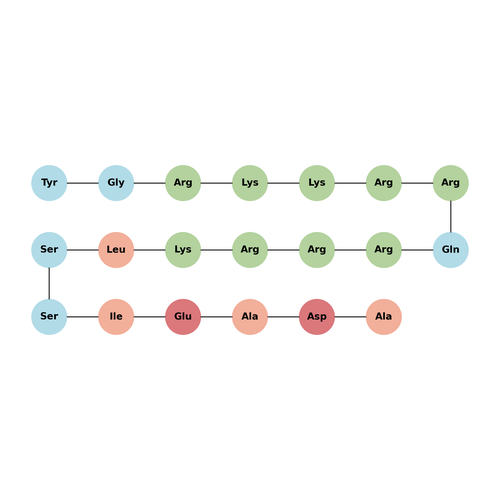
| Sequence | Tyr-Gly-Arg-Lys-Lys-Arg-Arg-Gln-Arg-Arg-Arg-Lys-Leu-Ser-Ser-Ile-Glu-Ala-Asp-Ala |
| Sequence Short | YGRKKRRQRRRKLSSIEADA |
| Storage | Keep away from moisture Powder: -20°C for 3 years | In solvent: -80°C for 1 year Shipping with blue ice/Shipping at ambient temperature. |
 For example, if the intended dosage is 10 mg/kg for animals weighing 20 g , with a dosing volume of 100 μL per animal, and a total of 10 animals are to be administered, using a formulation of
  10% DMSO+ 40% PEG300+ 5% Tween 80+ 45% Saline/PBS/ddH2O , the resulting working solution concentration would be 2 mg/mL.
Dissolve 2 mg of the compound in 100 μL DMSO to obtain a stock solution at a concentration of 20 mg/mL . If the required concentration exceeds the compound's known solubility, please contact us for technical support before proceeding.
1) Add 100 μL of the DMSO stock solution to 400 µL PEG300 and mix thoroughly until the solution becomes clear.
2) Add 50 µL Tween 80 and mix well until fully clarified.
3) Add 450 µL Saline,PBS or ddH2O and mix thoroughly until a homogeneous solution is obtained.
| Size | Quantity | Unit Price | Amount | Operation |
|---|
 Feedback
 Hello! How can I help you today?
Copyright © 2015-2026 TargetMol Chemicals Inc. All Rights Reserved.
