


Shopping Cart
Remove All Your shopping cart is currently empty

Synonyms:
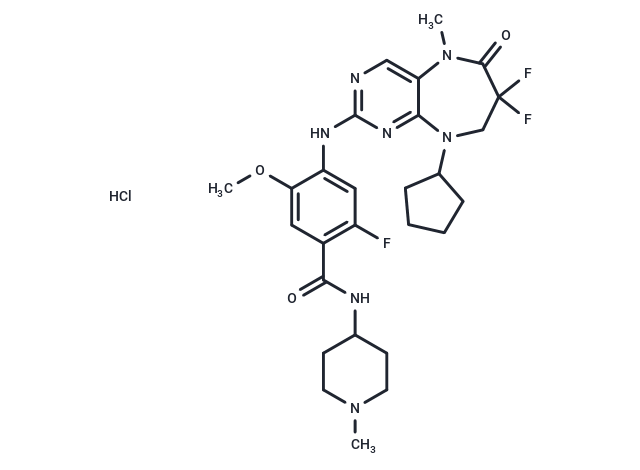
| Pack Size | Price | USA Stock | Global Stock | Quantity |
|---|---|---|---|---|
| 10 mg | $1,190 | 35 days | 35 days | |
| 50 mg | $4,900 | 35 days | 35 days |
| Description | TAK-960 monohydrochloride is an orally available compound that selectively inhibits polo-like kinase 1 (PLK1) with an IC₅₀ of 0.8 nM. It also demonstrates inhibitory activity against PLK2 (IC₅₀ of 16.9 nM) and PLK3 (IC₅₀ of 50.2 nM), and effectively suppresses the proliferation of various cancer cell lines, exhibiting significant efficacy against multiple tumor xenografts. |
| In vitro | Treatment with TAK-960 monohydrochloride induces G2-M cell accumulation, abnormal polo-like kinase mitosis morphology, and elevates histone H3 phosphorylation (pHH3). At concentrations ranging from 2-1000 nM over 72 hours, TAK-960 monohydrochloride effectively suppresses the proliferation of a broad spectrum of cancer cell lines, exhibiting mean EC 50 values between 8.4 and 46.9 nM, while sparing nondividing normal cells[1]. Specifically, an 8 nM concentration of TAK-960 monohydrochloride results in G2/M cell cycle arrest, demonstrating minimal cytotoxicity in HeLa cells[2]. This inhibition includes cells regardless of TP53 and KRAS mutation status, as well as MDR1 expression, highlighting its potential broad applicability in cancer treatment. |
| In vivo | TAK-960 monohydrochloride, administered orally at a dosage of 10 mg/kg once daily for two weeks, has demonstrated significant efficacy in treating multiple tumor xenografts, including those in nude or SCID mice implanted with a variety of cancer cells such as HCT116, PC-3, BT474, A549, NCI-H1299, NCI-H1975, A2780, and MV4-11. This compound notably increases pHH3 levels in a dose-dependent manner and has shown considerable effectiveness in inhibiting the growth of HT-29 colorectal cancer xenografts, exhibiting both substantial antitumor activity and good tolerability in these models. |
| Molecular Weight | 598.07 |
| Formula | C27H35ClF3N7O3 |
| Cas No. | 2108449-45-0 |
| Smiles | Cl.COc1cc(C(=O)NC2CCN(C)CC2)c(F)cc1Nc1ncc2N(C)C(=O)C(F)(F)CN(C3CCCC3)c2n1 |
| Relative Density. | no data available |
| Storage | Powder: -20°C for 3 years | In solvent: -80°C for 1 year Shipping with blue ice/Shipping at ambient temperature. |
 For example, if the intended dosage is 10 mg/kg for animals weighing 20 g , with a dosing volume of 100 μL per animal, and a total of 10 animals are to be administered, using a formulation of
  10% DMSO+ 40% PEG300+ 5% Tween 80+ 45% Saline/PBS/ddH2O , the resulting working solution concentration would be 2 mg/mL.
Dissolve 2 mg of the compound in 100 μL DMSO to obtain a stock solution at a concentration of 20 mg/mL . If the required concentration exceeds the compound's known solubility, please contact us for technical support before proceeding.
1) Add 100 μL of the DMSO stock solution to 400 µL PEG300 and mix thoroughly until the solution becomes clear.
2) Add 50 µL Tween 80 and mix well until fully clarified.
3) Add 450 µL Saline,PBS or ddH2O and mix thoroughly until a homogeneous solution is obtained.
| Size | Quantity | Unit Price | Amount | Operation |
|---|
 Feedback
 Hello! How can I help you today?
Copyright © 2015-2026 TargetMol Chemicals Inc. All Rights Reserved.
