


Shopping Cart
Remove All Your shopping cart is currently empty

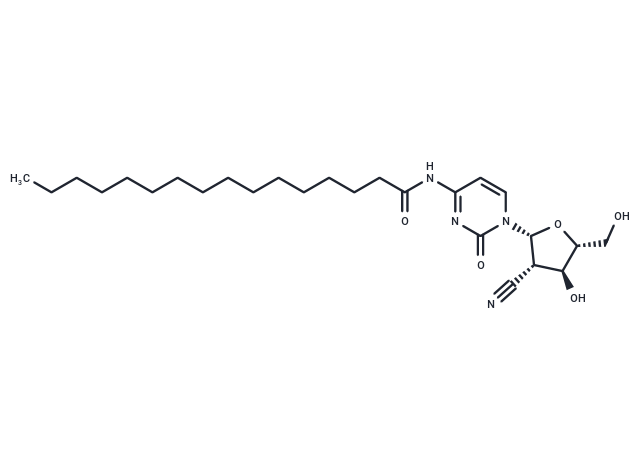
Synonyms: CYC682, CS682
| Pack Size | Price | USA Stock | Global Stock | Quantity |
|---|---|---|---|---|
| 2 mg | $38 | - | In Stock |
| Description | Sapacitabine (CS682) is an orally available nucleoside analog precursor compound with potential anti-tumor activity for the study of acute myeloid leukemia. |
| In vitro | The IC50 values of sapacitabine concentrations against colon cancer cell line HCT116 and breast cancer cell line MDA-MB-435 were 3 ± 0.6 µM and 67 ± 14 µM. Cell cycle analysis showed that 35% of the cells treated with sapacitabine were arrested in the late S phase and 41% were arrested in the G2/M phase. Sapacitabine is sensitive (IC50 20±6 μM) to L1210 cells with deoxycytidine kinase (dCK) activity [1]. |
| In vivo | On day 14, the average tumor volume in the sapacitabine (5 mg/kg) + vorinostat (33 mg/kg) group was 245 mm3, and the tumor growth inhibition (TGI) was 92%, while the sapacitabine (15 mg) group /kg) group, the average tumor volume was 245mm3, and the tumor growth inhibition (TGI) was 92%; the +vorinostat (33 mg/kg) group had an average tumor volume of 107mm3, and the TGI was 112% [2]. |
| Synonyms | CYC682, CS682 |
| Cell Research | A panel of the colon (HT29, HCT116, COLO205, HCC2998), breast (MCF7, MDA-MB-435), lung (HOP62, HOP92), ovarian (OVCAR3, IGROV1) cancer cell lines are used in this study. The cell cycle stage and percentage of apoptotic cells are assessed by flow cytometry. In brief, cells are seeded in 25 cm3 flasks and are untreated or treated with various concentrations of Sapacitabine. At the indicated time points, adherent and non-adherent cells are collected, washed with PBS, fixed in 70% ethanol and stored at 4°C until use. Cells are rehydrated in PBS, incubated for 20?min at room temperature (25°C) with 250?μg/mL RNAse A with Triton X-100 and 20?min at 4°C with 50?μg/mL propidium iodide in the dark. The cell cycle distribution and percentage of apoptotic cells are determined with a flow cytometer and analysed by FACS Calibur [1]. |
| Animal Research | Female (nu/nu) mice are injected subcutaneously with 1×10⁷ MV4-11 cells resuspended in 50% Matrigel at a single site on their flanks. Once tumour volumes are 126 to 256?mm3 (16 days post-implantation) animals are pair-matched by tumour size into treatment groups (minimum of six mice per group) with a mean tumour size of ~190?mm3. Tumour measurements are calculated using the formula: volume (mm3)=width2 (mm)×length (mm)×0.5. Sapacitabine is administered once a day orally (5 or 15?mg/kg) for 4 days, followed by a 3-day break before another 4 days of treatment; dosing starts on the same day as distribution to the treatment groups [2]. |
| Molecular Weight | 490.64 |
| Formula | C26H42N4O5 |
| Cas No. | 151823-14-2 |
| Smiles | CCCCCCCCCCCCCCCC(=O)Nc1ccn([C@@H]2O[C@H](CO)[C@@H](O)[C@@H]2C#N)c(=O)n1 |
| Relative Density. | 1.31g/cm3 |
| Storage | Store at low temperature Powder: -20°C for 3 years | In solvent: -80°C for 1 year Shipping with blue ice/Shipping at ambient temperature. | |||||||||||||||||||||||||
| Solubility Information | DMSO: 20 mg/mL (40.76 mM), Sonication is recommended. | |||||||||||||||||||||||||
Solution Preparation Table | ||||||||||||||||||||||||||
DMSO
Note : The dilution table applies only to solid products. For liquid products, please calculate the stock solution based on the stated concentration and/or density. | ||||||||||||||||||||||||||
 For example, if the intended dosage is 10 mg/kg for animals weighing 20 g , with a dosing volume of 100 μL per animal, and a total of 10 animals are to be administered, using a formulation of
  10% DMSO+ 40% PEG300+ 5% Tween 80+ 45% Saline/PBS/ddH2O , the resulting working solution concentration would be 2 mg/mL.
Dissolve 2 mg of the compound in 100 μL DMSO to obtain a stock solution at a concentration of 20 mg/mL . If the required concentration exceeds the compound's known solubility, please contact us for technical support before proceeding.
1) Add 100 μL of the DMSO stock solution to 400 µL PEG300 and mix thoroughly until the solution becomes clear.
2) Add 50 µL Tween 80 and mix well until fully clarified.
3) Add 450 µL Saline,PBS or ddH2O and mix thoroughly until a homogeneous solution is obtained.
| Size | Quantity | Unit Price | Amount | Operation |
|---|
 Feedback
 Hello! How can I help you today?
Copyright © 2015-2026 TargetMol Chemicals Inc. All Rights Reserved.
