


Shopping Cart
Remove All Your shopping cart is currently empty


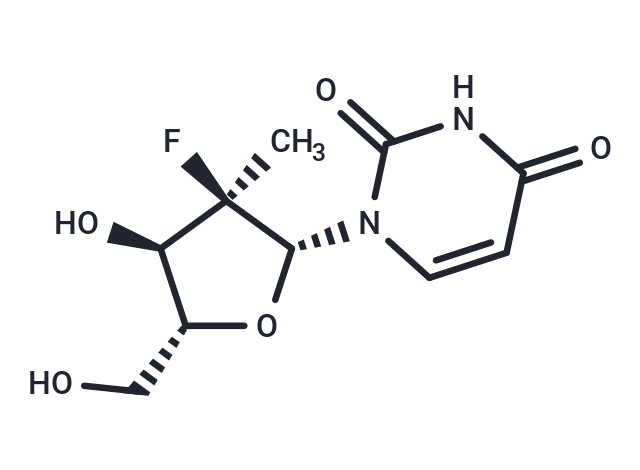
Synonyms: RO 2433, GS-331007, 2'-deoxy-2'-fluoro-2'-C-methyluridine
| Pack Size | Price | USA Stock | Global Stock | Quantity |
|---|---|---|---|---|
| 25 mg | $31 | In Stock | In Stock | |
| 50 mg | $35 | In Stock | In Stock | |
| 100 mg | $48 | In Stock | In Stock | |
| 200 mg | $64 | In Stock | In Stock | |
| 1 mL x 10 mM (in DMSO) | $29 | In Stock | In Stock |
| Description | PSI-6206 (RO 2433) (RO2433) is a selective HCV RNA polymerase inhibitor. |
| In vitro | PSI-6206 (RO2433), a deaminated derivative of PSI-6130, a potent and selective inhibitor of HCV NS5B polymerase, has been evaluated for its anti-HCV efficacy employing both a cell-based quantitative real-time RT-PCR assay and surrogate bovine viral diarrhea virus (BVDV) assays. It showed no activity or cytotoxicity in these assays. The formation of 5′-triphosphate (TP) forms of PSI-6130 (PSI-6130-TP) and RO2433 (RO2433-TP) progressively increased, achieving steady state levels after 48 hours. Notably, RO2433-TP effectively inhibits RNA synthesis by both the native HCV replicase from HCV replicon cells and the recombinant HCV polymerase NS5B, highlighting its potential mechanism of action against HCV replication. |
| Synonyms | RO 2433, GS-331007, 2'-deoxy-2'-fluoro-2'-C-methyluridine |
| Kinase Assay | Protein Kinase Assays: The in vitro kinase assays are performed in 96-well plates (30 μL) at ambient temperature for 15–45 min using the recombinant glutathione S-transferase-fused kinase domains (4-100 ng, depending on specific activity). [γ33P]ATP is used as phosphate donor and polyGluTyr-(4:1) peptide as acceptor. With the exception of protein kinase C-α, cyclin-dependent kinase 1/cycB and protein kinase A are protamine sulfate (200 μg/mL), histone H1 (100 μg/mL), and the heptapeptide Leu-Arg-Arg-Ala-Ser-Leu-Gly (known as Kemptide Bachem) respectively and are used as peptide substrates. Assays are optimized for each kinase using the following ATP concentrations: 1.0 μM (c-Kit, c-Met, c-Fms, c-Raf-1, and RET), 2.0 μM (EGFR, erbB2, ErbB3, and ErbB4), 5.0 μM (c-abl), 8.0 μM (Flt-1, Flt-3, Flt-4, Flk, KDR, FGFR-1, and Tek), 10.0 μM (PDGFR-β, protein kinase C-α, and cyclin-dependent kinase 1), and 20.0 μM (c-Src and protein kinase A). The reaction is terminated by the addition of 20 μL 125 mM EDTA. Thirty μL (c-abl, c-Src, insulin-like growth factor-1R, RET-Men2A, and RET-Men2B) or 40 μL (all other kinases) of the reaction mixture is transferred onto Immobilon-polyvinylidene difluoride membrane, presoaked with 0.5% H3PO4 and mounted on a vacuum manifold. Vacuum is then applied and each well rinsed with 200 μL 0.5% H3PO4. Membranes are removed and washed four times with 1.0% H3PO4 and once with ethanol. Dried membranes are counted after mounting in a Packard TopCount 96-well frame and with the addition of 10 μL/well of Microscint. IC50 values (±SE) are calculated by linear regression analysis of the percentage inhibition and are averages of at least three determinations. |
| Molecular Weight | 260.22 |
| Formula | C10H13FN2O5 |
| Cas No. | 863329-66-2 |
| Smiles | C[C@]1(F)[C@@H](O[C@H](CO)[C@H]1O)N2C(=O)NC(=O)C=C2 |
| Relative Density. | 1.55 g/cm3 |
| Storage | Powder: -20°C for 3 years | In solvent: -80°C for 1 year Shipping with blue ice/Shipping at ambient temperature. | |||||||||||||||||||||||||||||||||||
| Solubility Information | DMSO: 60 mg/mL (230.57 mM), Sonication is recommended.  | |||||||||||||||||||||||||||||||||||
| In Vivo Formulation | 10% DMSO+40% PEG300+5% Tween 80+45% Saline: 2 mg/mL (7.69 mM), Sonication is recommended. Please add the solvents sequentially, clarifying the solution as much as possible before adding the next one. Dissolve by heating and/or sonication if necessary. Working solution is recommended to be prepared and used immediately. The formulation provided above is for reference purposes only. In vivo formulations may vary and should be modified based on specific experimental conditions. | |||||||||||||||||||||||||||||||||||
Solution Preparation Table | ||||||||||||||||||||||||||||||||||||
DMSO
Note : The dilution table applies only to solid products. For liquid products, please calculate the stock solution based on the stated concentration and/or density. | ||||||||||||||||||||||||||||||||||||
 For example, if the intended dosage is 10 mg/kg for animals weighing 20 g , with a dosing volume of 100 μL per animal, and a total of 10 animals are to be administered, using a formulation of
  10% DMSO+ 40% PEG300+ 5% Tween 80+ 45% Saline/PBS/ddH2O , the resulting working solution concentration would be 2 mg/mL.
Dissolve 2 mg of the compound in 100 μL DMSO to obtain a stock solution at a concentration of 20 mg/mL . If the required concentration exceeds the compound's known solubility, please contact us for technical support before proceeding.
1) Add 100 μL of the DMSO stock solution to 400 µL PEG300 and mix thoroughly until the solution becomes clear.
2) Add 50 µL Tween 80 and mix well until fully clarified.
3) Add 450 µL Saline,PBS or ddH2O and mix thoroughly until a homogeneous solution is obtained.
| Size | Quantity | Unit Price | Amount | Operation |
|---|
 Feedback
 Hello! How can I help you today?
Copyright © 2015-2026 TargetMol Chemicals Inc. All Rights Reserved.
