


Shopping Cart
Remove All Your shopping cart is currently empty

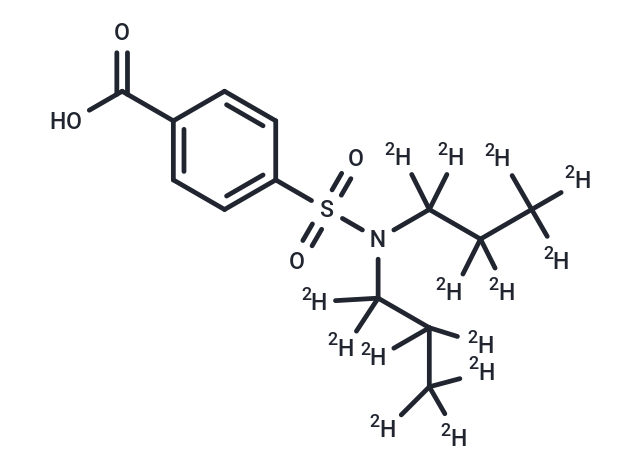
Synonyms: 4-[bis(1,1,2,2,3,3,3-heptadeuteriopropyl)sulfamoyl]benzoic acid, 4[(Dipropylamino-d14)sulfonyl]benzoic Acid
| Pack Size | Price | USA Stock | Global Stock | Quantity |
|---|---|---|---|---|
| 10 mg | Inquiry | - | In Stock | |
| 50 mg | Inquiry | - | In Stock |
| Description | Probenecid-D14 (4[(Dipropylamino-d14)sulfonyl]benzoic Acid) is a deuterium-labeled isotope of Probenecid (T0457) and can be used for isotope tracing. Probenecid, a benzoic acid derivative, exhibits antihyperuricemic properties and selectively activates the transient receptor potential vanilloid receptor 2 (TRPV2) while also inhibiting the pannexin 1 channel. |
| Targets & IC50 | TAS2R16 (human):292 μM, TAS2R38 (human):211 μM |
| In vitro | Method: In Sf9 insect cell membrane vesicles expressing MRP1 or MRP2, 4 μM N-ethylmaleimide glutathione (NEM-GS) was added as a substrate, along with varying concentrations of probenecid. ATP-dependent NEM-GS uptake was measured using a rapid filtration method. In the same membrane vesicles, the effect of probenecid on MRP1 and MRP2 ATPase activities was assessed by measuring vanadate-sensitive ATPase activity. Result: Probenecid inhibited NEM-GS uptake in both MRP1 and MRP2. Regarding ATPase activity, probenecid primarily inhibited MRP1 but significantly stimulated MRP2 ATPase activity, with maximal stimulation observed at approximately 2 mM, exhibiting a bell-shaped curve. In the presence of GSH, probenecid further increased MRP2 ATPase activity [1]. Method: A GPCR calcium mobilization assay was used to evaluate the inhibitory effects of probenecid on the bitter taste receptor subtypes hTAS2R16, hTAS2R38, and hTAS2R43. Cells were pre-incubated with probenecid prior to receptor activation to determine whether probenecid exerts its inhibitory effects via an allosteric mechanism. Result: Probenecid specifically inhibited hTAS2R16-mediated cellular responses, but had no significant effect on hTAS2R38 or hTAS2R43. Its mechanism of action was determined to be non-competitive allosteric inhibition, providing evidence for a direct interaction between probenecid and GPCRs. Furthermore, probenecid can be used to enhance cellular signaling in GPCR calcium mobilization assays [2]. |
| In vivo | Method: Wild-type mice were injected with various doses of Probenecid (2–200 mg/kg) via the tail vein. Cardiac function was assessed using echocardiography (M-mode and B-mode). Ejection fraction (EF) and fractional shortening (FS) were measured, and a dose-response curve was generated. Result: Probenecid dose-dependently increased the ejection fraction in wild-type mice, with an EC50 of approximately 49.33 mg/kg. The effect occurred within 5 minutes after administration and lasted for at least 1 hour [1]. Method: Wild-type mice were intravenously injected with Probenecid (30 mg/kg and 100 mg/kg). A pressure catheter was inserted into the right carotid artery to monitor changes in left ventricular +dP/dt. Result: Probenecid rapidly increased +dP/dt at both 30 mg/kg and 100 mg/kg, indicating an enhancement of myocardial contractility [1]. |
| Synonyms | 4-[bis(1,1,2,2,3,3,3-heptadeuteriopropyl)sulfamoyl]benzoic acid, 4[(Dipropylamino-d14)sulfonyl]benzoic Acid |
| Molecular Weight | 299.45 |
| Formula | C13H19NO4S |
| Cas No. | 1189657-87-1 |
| Smiles | S(N(C(C(C([2H])([2H])[2H])([2H])[2H])([2H])[2H])C(C(C([2H])([2H])[2H])([2H])[2H])([2H])[2H])(=O)(=O)C1=CC=C(C(O)=O)C=C1 |
| Storage | Store at low temperature Powder: -20°C for 3 years | In solvent: -80°C for 1 year Shipping with blue ice/Shipping at ambient temperature. | ||||||||||||||||||||||||||||||
| Solubility Information | DMSO: 24 mg/mL (80.15 mM), Sonication and heating are recommended. | ||||||||||||||||||||||||||||||
Solution Preparation Table | |||||||||||||||||||||||||||||||
DMSO
Note : The dilution table applies only to solid products. For liquid products, please calculate the stock solution based on the stated concentration and/or density. | |||||||||||||||||||||||||||||||
 For example, if the intended dosage is 10 mg/kg for animals weighing 20 g , with a dosing volume of 100 μL per animal, and a total of 10 animals are to be administered, using a formulation of
  10% DMSO+ 40% PEG300+ 5% Tween 80+ 45% Saline/PBS/ddH2O , the resulting working solution concentration would be 2 mg/mL.
Dissolve 2 mg of the compound in 100 μL DMSO to obtain a stock solution at a concentration of 20 mg/mL . If the required concentration exceeds the compound's known solubility, please contact us for technical support before proceeding.
1) Add 100 μL of the DMSO stock solution to 400 µL PEG300 and mix thoroughly until the solution becomes clear.
2) Add 50 µL Tween 80 and mix well until fully clarified.
3) Add 450 µL Saline,PBS or ddH2O and mix thoroughly until a homogeneous solution is obtained.
| Size | Quantity | Unit Price | Amount | Operation |
|---|
 Feedback
 Hello! How can I help you today?
Copyright © 2015-2026 TargetMol Chemicals Inc. All Rights Reserved.
