


Shopping Cart
Remove All Your shopping cart is currently empty

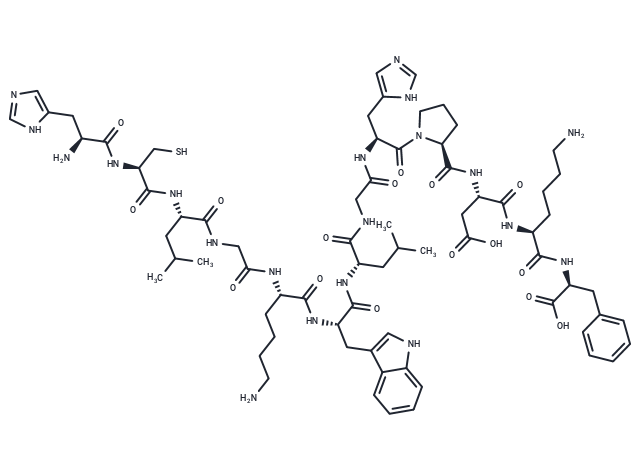
Synonyms: PLP 139-151, Myelin Proteolipid Protein (139-151)
| Pack Size | Price | USA Stock | Global Stock | Quantity |
|---|---|---|---|---|
| 1 mg | $85 | Inquiry | Inquiry | |
| 5 mg | $355 | Inquiry | Inquiry |
| Description | PLP (139-151) is the amino acid fragment from positions 139 to 151 of myelin proteolipid protein (PLP), and can be used to induce the relapsing-remitting experimental autoimmune encephalomyelitis (RR-EAE) model. |
| In vitro | Method: Lymphocytes isolated from the lymph nodes and spleens of SJL/j mice were treated with various concentrations (0, 1, 3, 10, 20 μM) of PLP(139–151) peptide. Result: PLP(139-151) induced an antigen-specific proliferative response in lymphocytes from immunized mice and promoted the release of IL-17 and IFN-γ [1]. |
| In vivo | Method: Female SJL/j mice were immunized twice subcutaneously on day 0 and day 7 with an emulsion containing PLP139-151 (200 μg/mouse) and heat-killed Mycobacterium tuberculosis (8 mg/ml) in incomplete Freund's adjuvant, and received intraperitoneal injections of pertussis toxin (500 ng/mouse) on the day of immunization and 24 hours later to induce relapsing-remitting experimental autoimmune encephalomyelitis (RR-EAE). Result: Immunization with PLP139-151 induced typical RR-EAE in SJL/j mice, characterized by progressively worsening clinical scores, central nervous system inflammatory infiltration, demyelination, and axonal loss [1]. Method: Female SJL/j mice were subcutaneously immunized with an emulsion containing 150 μg of PLP(139-151) and complete Freund's adjuvant (supplemented with 4 mg/mL Mycobacterium tuberculosis), and received intraperitoneal injections of 200 ng of pertussis toxin on days 0 and 2 to establish a relapsing-remitting experimental autoimmune encephalomyelitis (RR-EAE) model. Result: Following PLP139-151 immunization, model mice developed severe clinical symptoms (flaccid tail, hind limb paralysis), CNS inflammation and demyelination, elevated serum levels of IFN-γ and IL-17A, and increased proportions of Th1 and Th17 cells [2]. |
| Synonyms | PLP 139-151, Myelin Proteolipid Protein (139-151) |
| Disease Modeling Protocol | Experimental autoimmune encephalomyelitis (EAE) model
*Precautions: Brain and spinal cord tissues were collected from all mice at the time of sacrifice and fixed in 10% formalin or OCT and frozen. |
| Molecular Weight | 1537.79 |
| Formula | C72H104N20O16S |
| Cas No. | 131334-43-5 |
| Smiles | C([C@H](NC([C@@H](NC(CNC([C@@H](NC([C@@H](NC([C@H](CC1=CN=CN1)N)=O)CS)=O)CC(C)C)=O)=O)CCCCN)=O)C(N[C@H](C(NCC(N[C@H](C(=O)N2[C@H](C(N[C@H](C(N[C@H](C(N[C@@H](CC3=CC=CC=C3)C(O)=O)=O)CCCCN)=O)CC(O)=O)=O)CCC2)CC4=CN=CN4)=O)=O)CC(C)C)=O)C=5C=6C(NC5)=CC=CC6 |
| Relative Density. | 1.332 g/cm3 (Predicted) |
| Sequence | His-Cys-Leu-Gly-Lys-Trp-Leu-Gly-His-Pro-Asp-Lys-Phe |
| Sequence Short | HCLGKWLGHPDKF |
| Storage | Keep away from moisture, Powder: -20°C for 3 years | In solvent: -80°C for 1 year Shipping with blue ice/Shipping at ambient temperature. | ||||||||||||||||||||||||||||||
| Solubility Information | H2O: 80 mg/mL (52.02 mM), Sonication is recommended. | ||||||||||||||||||||||||||||||
Solution Preparation Table | |||||||||||||||||||||||||||||||
H2O
Note : The dilution table applies only to solid products. For liquid products, please calculate the stock solution based on the stated concentration and/or density. | |||||||||||||||||||||||||||||||
 For example, if the intended dosage is 10 mg/kg for animals weighing 20 g , with a dosing volume of 100 μL per animal, and a total of 10 animals are to be administered, using a formulation of
  10% DMSO+ 40% PEG300+ 5% Tween 80+ 45% Saline/PBS/ddH2O , the resulting working solution concentration would be 2 mg/mL.
Dissolve 2 mg of the compound in 100 μL DMSO to obtain a stock solution at a concentration of 20 mg/mL . If the required concentration exceeds the compound's known solubility, please contact us for technical support before proceeding.
1) Add 100 μL of the DMSO stock solution to 400 µL PEG300 and mix thoroughly until the solution becomes clear.
2) Add 50 µL Tween 80 and mix well until fully clarified.
3) Add 450 µL Saline,PBS or ddH2O and mix thoroughly until a homogeneous solution is obtained.
| Size | Quantity | Unit Price | Amount | Operation |
|---|
 Feedback
 Hello! How can I help you today?
Copyright © 2015-2026 TargetMol Chemicals Inc. All Rights Reserved.
