


Shopping Cart
Remove All Your shopping cart is currently empty

Synonyms:
| Pack Size | Price | USA Stock | Global Stock | Quantity |
|---|---|---|---|---|
| 10 mg | Inquiry | Inquiry | Inquiry | |
| 50 mg | Inquiry | Inquiry | Inquiry |
| Description | Papiliocin is a potent peptide antibiotic with both anti-inflammatory and antimicrobial properties. It exhibits significant activity primarily against Gram-negative bacteria. Papiliocin demonstrates high anti-inflammatory efficacy by inhibiting the production of NO and the secretion of TNF-α and MIP-2. It functions by suppressing the Toll-like Receptor pathway and NF-κB in innate defense response mechanisms. Additionally, Papiliocin induces apoptosis in fungal cells by raising intracellular ROS levels. It acts as an effective antimicrobial peptide in sepsis models and can be utilized in anti-inflammatory and antibacterial research. |
| In vitro | Papiliocin exhibits antibacterial activity against Gram-negative bacteria such as Escherichia coli, Salmonella typhimurium, and Pseudomonas aeruginosa, and Gram-positive bacteria like Bacillus subtilis, Staphylococcus epidermidis, and Staphylococcus aureus, with MIC values of 0.25, 0.5, 1, 16, 2, and 32 μM, respectively, at 37 °C for 16 hours. It shows resistance to calcium and magnesium in Gram-negative bacteria. Papiliocin (0-100 μM, 37 °C for 1 hour) lacks hemolytic activity and is non-cytotoxic to RAW264.7 cells, with an IC50 of 58 μM. It inhibits the expression of NO, TNF-α, MIP-2, iNOS, TLR4, NF-κB, and various inflammatory cytokine genes such as IL-1β, IL-6, MIP-1, MIP-2, and TNF-α in LPS-stimulated RAW264.7 cells at concentrations of 0-25 μM for 3-24 hours. Papiliocin (0-10 μM) induces lipid vesicle permeability and demonstrates a low Stern-Volmer quenching constant (KSV) in micelles or SUVs, leading to the dissociation of LPS aggregates through interaction. At 30 μM, it induces ROS production, hydroxyl radical level increase, apoptosis, membrane depolarization, mitochondrial caspase activation, and DNA damage in Candida albicans cells at 28 °C for 2 hours. Papiliocin displaces 74.6% BC probe on LPS, neutralizes LPS with a binding affinity of 0.063 μM, and inhibits 52% of FITC-LPS binding to RAW 264.7 cell surfaces while competitively replacing 25% of pre-bound LPS on the LPS-receptor complex on these cells. It reduces TLR4-mediated SEAP activity with an IC50 of 1.1 μM and blocks LPS-induced inflammation by targeting the TLR4 and MAPK pathways and inhibiting p-NF-κB nuclear translocation in RAW 264.7 cells at 0.1-10 μM for 1 hour. |
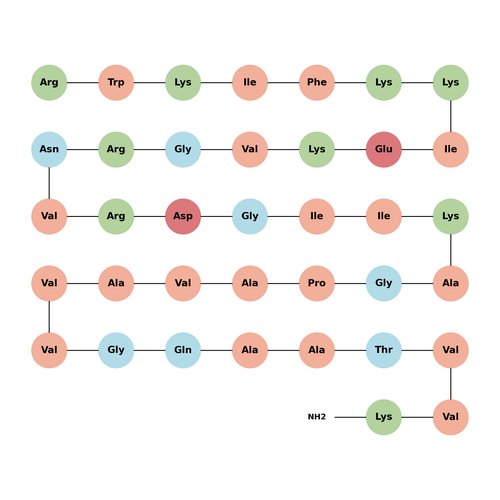
| Sequence | Arg-Trp-Lys-Ile-Phe-Lys-Lys-Ile-Glu-Lys-Val-Gly-Arg-Asn-Val-Arg-Asp-Gly-Ile-Ile-Lys-Ala-Gly-Pro-Ala-Val-Ala-Val-Val-Gly-Gln-Ala-Ala-Thr-Val-Val-Lys-NH₂ |
| Sequence Short | RWKIFKKIEKVGRNVRDGIIKAGPAVAVVGQAATVVK |
| Storage | Keep away from moisture Powder: -20°C for 3 years | In solvent: -80°C for 1 year Shipping with blue ice/Shipping at ambient temperature. |
 For example, if the intended dosage is 10 mg/kg for animals weighing 20 g , with a dosing volume of 100 μL per animal, and a total of 10 animals are to be administered, using a formulation of
  10% DMSO+ 40% PEG300+ 5% Tween 80+ 45% Saline/PBS/ddH2O , the resulting working solution concentration would be 2 mg/mL.
Dissolve 2 mg of the compound in 100 μL DMSO to obtain a stock solution at a concentration of 20 mg/mL . If the required concentration exceeds the compound's known solubility, please contact us for technical support before proceeding.
1) Add 100 μL of the DMSO stock solution to 400 µL PEG300 and mix thoroughly until the solution becomes clear.
2) Add 50 µL Tween 80 and mix well until fully clarified.
3) Add 450 µL Saline,PBS or ddH2O and mix thoroughly until a homogeneous solution is obtained.
| Size | Quantity | Unit Price | Amount | Operation |
|---|
 Feedback
 Hello! How can I help you today?
Copyright © 2015-2026 TargetMol Chemicals Inc. All Rights Reserved.
