


Shopping Cart
Remove All Your shopping cart is currently empty

Synonyms:
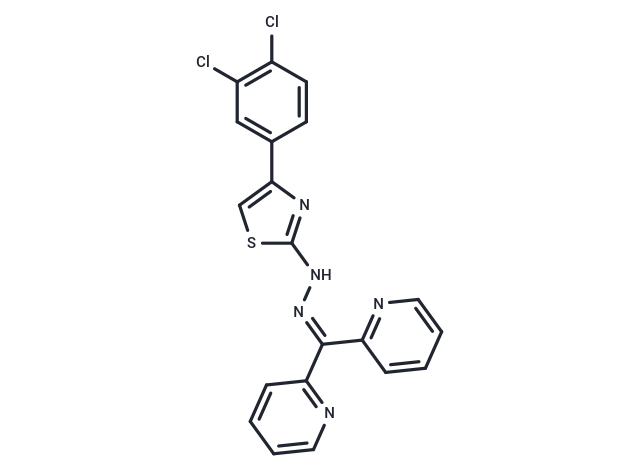
| Pack Size | Price | USA Stock | Global Stock | Quantity |
|---|---|---|---|---|
| 10 mg | Inquiry | 10-14 weeks | 10-14 weeks | |
| 50 mg | Inquiry | 10-14 weeks | 10-14 weeks |
| Description | Nrf2-IN-4 is an Nrf2 inhibitor that induces ferroptosis by disrupting cellular iron homeostasis, promoting ferritin degradation, and ultimately triggering ferroptosis. It activates lysosomes through iron-dependent reactive oxygen species (ROS) production and lysosomal acidification. Nrf2-IN-4 demonstrates significant antitumor effects and is applicable in breast cancer research. |
| In vitro | Nrf2-IN-4 (Compound PhcY) demonstrates inhibitory effects on various cancer cell lines at concentrations ranging from 0.01-10 μM over 72 hours. The IC50 values are as follows: MCF-7 cells at 80 nM, HepG2 cells at 3.26 μM, T24 cells at 0.90 μM, HCT116 cells at 2.89 μM, L929 fibroblast cells at 3.27 μM, and HEK293 human embryonic kidney cells at 5.36 μM. In MCF-7 cells, Nrf2-IN-4 (40-160 nM) induces "ballooning" and rounded cell morphology with cytoplasmic vacuolization. It inhibits colony formation in MCF-7 cells in a dose-dependent manner at 40-80 nM over 14 days. At concentrations of 80-160 nM for 24-48 hours, it increases labile iron pool (LIP) and ferroptosis in MCF-7 cells by inhibiting Nrf2. Nrf2-IN-4 (80-320 nM, 24 h) induces lysosomal activation in MCF-7 cells by promoting iron-dependent reactive oxygen species (ROS) production and lysosomal acidification. Additionally, Nrf2-IN-4 (40-320 nM, 0-12 h) induces ferritin degradation in MCF-7 cells through ferritinophagy. It also induces oxidative stress leading to a significant decrease in mitochondrial membrane potential in MCF-7 cells, an effect mitigated by Acetylcysteine (N-acetylcysteine) (NAC). Nrf2-IN-4 (0.1-0.2 μM) is notably more effective than ML385 in inhibiting tumor organoid growth. |
| In vivo | Nrf2-IN-4 (Compound PhcY) (10 mg/kg, administered intraperitoneally once daily for 21 consecutive days) demonstrates significant antitumor activity in the MCF-7 xenograft mouse model. |
| Molecular Weight | 426.32 |
| Formula | C20H13Cl2N5S |
| Cas No. | 2417486-06-5 |
| Smiles | ClC=1C=CC(=CC1Cl)C=2N=C(SC2)NN=C(C3=NC=CC=C3)C4=NC=CC=C4 |
| Relative Density. | no data available |
| Storage | Powder: -20°C for 3 years | In solvent: -80°C for 1 year Shipping with blue ice/Shipping at ambient temperature. |
 For example, if the intended dosage is 10 mg/kg for animals weighing 20 g , with a dosing volume of 100 μL per animal, and a total of 10 animals are to be administered, using a formulation of
  10% DMSO+ 40% PEG300+ 5% Tween 80+ 45% Saline/PBS/ddH2O , the resulting working solution concentration would be 2 mg/mL.
Dissolve 2 mg of the compound in 100 μL DMSO to obtain a stock solution at a concentration of 20 mg/mL . If the required concentration exceeds the compound's known solubility, please contact us for technical support before proceeding.
1) Add 100 μL of the DMSO stock solution to 400 µL PEG300 and mix thoroughly until the solution becomes clear.
2) Add 50 µL Tween 80 and mix well until fully clarified.
3) Add 450 µL Saline,PBS or ddH2O and mix thoroughly until a homogeneous solution is obtained.
| Size | Quantity | Unit Price | Amount | Operation |
|---|
 Feedback
 Hello! How can I help you today?
Copyright © 2015-2026 TargetMol Chemicals Inc. All Rights Reserved.
