


Shopping Cart
Remove All Your shopping cart is currently empty

Synonyms: NSC 375101D

| Pack Size | Price | USA Stock | Global Stock | Quantity |
|---|---|---|---|---|
| 10 mg | $35 | In Stock | In Stock | |
| 25 mg | $68 | In Stock | In Stock | |
| 50 mg | $126 | In Stock | In Stock | |
| 100 mg | $187 | In Stock | In Stock | |
| 500 mg | $463 | - | In Stock |
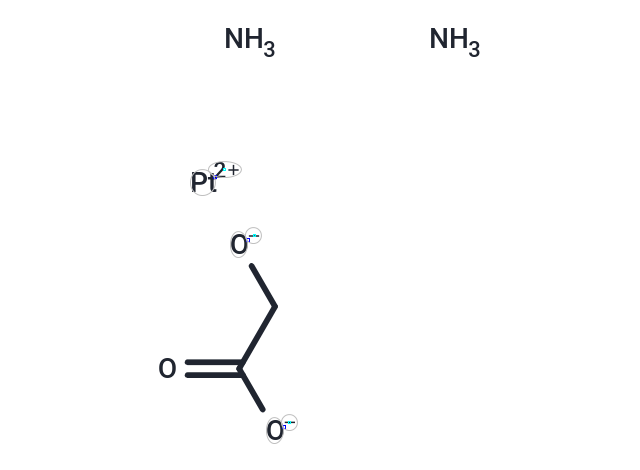
| Description | Nedaplatin (NSC-375101D) is a derivative of cisplatin and DNA damage agent for tumor colony forming units (IC50: 94 μM). Containing a novel ring structure in which glycolate is bound to the platinum by a bidentate ligand, nedaplatin forms reactive platinum complexes that bind to nucleophilic groups in DNA, resulting in intrastrand and interstrand DNA cross-links, apoptosis and cell death. |
| Targets & IC50 | DNA damage:94 μM |
| In vitro | Compared to the use of each of the three drugs individually, pre-treating with 5-FU continuously before Nedaplatin or Cisplatin (FN or FC treatment) demonstrates a synergistic enhancement in inhibiting tumor growth and extending survival time. |
| In vivo | Nedaplatin (Aqupla), a derivative of cisplatin, inhibits tumor clonogenic colony formation with an IC50 of 28.5 μg/mL. At concentrations ranging from 0.005 to 0.5 μg/mL, Nedaplatin suppresses the proliferation of SBC-3 cells by 2% to 98%, with an IC50 of 0.053 μg/mL. |
| Synonyms | NSC 375101D |
| Cell Research | The inhibition of cell (including human SCLC cell line SBC-3 and human NSCLC cell line PC-14) proliferation after drug treatments as the antitumor activity using a regrowth assay is messured. Briefly, cells are exposed to drugs alone or in combination for 6 days at 37°C in an atmosphere of 100% humidity with 5% CO2; the cells are then pipetted six to eight times until almost all cells appeared as single cells and counted with a counter. For each drug, concentration-effect curves are drawn as plots of the fraction of surviving cells (unaffected cell fraction, fu) versus drug concentration. The cell proliferation ratio of the treated:control cultures (T:C%) is calculated as follows: [(the number of treated cells on day 6)/(the number of treated cells on day 0)]/[(the number of control cells on day 6)/(the number of control cells on day 0)] × 100%. The IC50 is defined as the drug concentration required for a 50% reduction in the number of cells. Four or five independent experiments are carried out for each. To check the effect of the drug treatment schedule on the effect of the combination, the cells are treated either by simultaneous exposure to the two drugs or by sequential exposure to Nedaplatin followed by irinotecan (Nedaplatin→irinotecan) and vice versa (irinotecan→Nedaplatin) for 3 hours. For the sequential exposure treatment, cells are exposed to the first drug for 3 hours, ished in fresh medium once, and then immediately exposed to the second drug for 3 hours. The treated cells are cultured in drug-free medium until evaluation.(Only for Reference) |
| Molecular Weight | 303.17 |
| Formula | C2H8N2O3Pt |
| Cas No. | 95734-82-0 |
| Smiles | N.N.[Pt++].[O-]CC([O-])=O |
| Relative Density. | no data available |
| Storage | Keep away from direct sunlight,The compound is unstable in solution. Please use soon Powder: -20°C for 3 years Shipping with blue ice/Shipping at ambient temperature. | |||||||||||||||||||||||||
| Solubility Information | DMSO: Insoluble, DMSO inactivates the activity of Nedaplatin. H2O: 9.21 mg/mL (30.38 mM), Sonication is recommended.  | |||||||||||||||||||||||||
Solution Preparation Table | ||||||||||||||||||||||||||
H2O
Note : The dilution table applies only to solid products. For liquid products, please calculate the stock solution based on the stated concentration and/or density. | ||||||||||||||||||||||||||
 For example, if the intended dosage is 10 mg/kg for animals weighing 20 g , with a dosing volume of 100 μL per animal, and a total of 10 animals are to be administered, using a formulation of
  10% DMSO+ 40% PEG300+ 5% Tween 80+ 45% Saline/PBS/ddH2O , the resulting working solution concentration would be 2 mg/mL.
Dissolve 2 mg of the compound in 100 μL DMSO to obtain a stock solution at a concentration of 20 mg/mL . If the required concentration exceeds the compound's known solubility, please contact us for technical support before proceeding.
1) Add 100 μL of the DMSO stock solution to 400 µL PEG300 and mix thoroughly until the solution becomes clear.
2) Add 50 µL Tween 80 and mix well until fully clarified.
3) Add 450 µL Saline,PBS or ddH2O and mix thoroughly until a homogeneous solution is obtained.
| Size | Quantity | Unit Price | Amount | Operation |
|---|
 Feedback
 Hello! How can I help you today?
Copyright © 2015-2026 TargetMol Chemicals Inc. All Rights Reserved.
