


Shopping Cart
Remove All Your shopping cart is currently empty

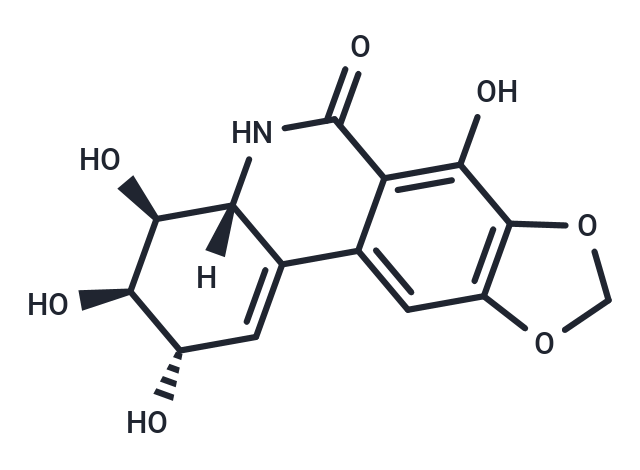
Synonyms: Lycoricidinol
| Pack Size | Price | USA Stock | Global Stock | Quantity |
|---|---|---|---|---|
| 1 mg | $97 | In Stock | In Stock | |
| 5 mg | $431 | In Stock | In Stock | |
| 10 mg | $638 | - | In Stock | |
| 25 mg | Inquiry | - | In Stock | |
| 50 mg | Inquiry | - | In Stock | |
| 1 mL x 10 mM (in DMSO) | $473 | - | In Stock |
| Description | Narciclasine (Lycoricidinol), a natural product, modulates the Rho/Rho-kinase/LIM kinase/cofilin signaling pathway, greatly increasing GTPase RhoA activity. |
| In vitro | Narciclasine activates Rho and stress fibers in glioblastoma multiforme cells (mean IC50: ~50 nM on the 6 human glioblastoma multiforme). It has a mean IC50 value of 47 nM across a panel of 60 cancer cell lines [1], and the IC50 for radicle growth inhibition is 0.1 μM for Narciclasine [2]. |
| In vivo | Intravenous (i.v.) administration of Narciclasine at 1 mg/kg significantly increases the survival of GL19 glioblastoma multiforme-bearing mice. Oral administration at the same dose, five times a week for 5 consecutive weeks, similarly enhances survival in this model. Oral treatment with Narciclasine at 1 mg/kg also significantly increases the survival of Hs683 glioblastoma multiforme-bearing mice. However, increasing the frequency of doses per week does not further improve survival in Hs683 glioblastoma multiforme-bearing mice [1]. |
| Synonyms | Lycoricidinol |
| Cell Research | The Narciclasine IC50 concentration, the Narciclasine concentration that decreased by 50% the global growth rate of a given cell population, is assessed with the MTT assay. The cells are incubated for 72 h in the presence and absence of the Narciclasine (with concentrations ranging between 1 and 10000 nM concentrate) for the determination of Narciclasine IC50 values [1]. |
| Animal Research | The Hs683 cell line and GL19 primoculture grafted into the brains of nude immunodeficient mice both produced invasive brain tumors. Xenograft-bearing mice receive vehicle alone, oral temozolomide at 40 mg/kg (5 administrations per week for 5 consecutive weeks), or Narciclasine at 1 mg/kg either oral (once per week for 5 weeks) or i.v. (twice per week for 5 weeks). Drug administration is initiated respectively on days 5 and 7 post-tumor graftings for the Hs683 and GL19 models. The temozolomide dose and treatment schedule are selected based on previously optimized regimens. Narciclasine dose and treatment schedule are selected based on Narciclasine toxicity study in rats after oral administration and pharmacokinetic study that we have recently published. In toxicity study, Narciclasine (25, 10, or 1 mg/kg) is administered five times a week for 3 weeks and the no adverse effect level dose is defined to be 1 mg/kg/d p.o., with minimal acanthosis reactive changes and minor variations in some biochemistry parameters observed at this dose level considered to be nonadverse [1]. |
| Molecular Weight | 307.26 |
| Formula | C14H13NO7 |
| Cas No. | 29477-83-6 |
| Smiles | [H][C@@]12NC(=O)c3c(O)c4OCOc4cc3C1=C[C@H](O)[C@@H](O)[C@H]2O |
| Relative Density. | 1.85g/cm3 |
| Storage | Store at low temperature,Keep away from direct sunlight,Keep away from moisture Powder: -20°C for 3 years | In solvent: -80°C for 1 year Shipping with blue ice/Shipping at ambient temperature. | ||||||||||||||||||||||||||||||
| Solubility Information | DMSO: 25 mg/mL (81.36 mM), Sonication is recommended. | ||||||||||||||||||||||||||||||
| In Vivo Formulation | 10% DMSO+40% PEG300+5% Tween 80+45% Saline: 1 mg/mL (3.25 mM), Sonication is recommended. Please add the solvents sequentially, clarifying the solution as much as possible before adding the next one. Dissolve by heating and/or sonication if necessary. Working solution is recommended to be prepared and used immediately. The formulation provided above is for reference purposes only. In vivo formulations may vary and should be modified based on specific experimental conditions. | ||||||||||||||||||||||||||||||
Solution Preparation Table | |||||||||||||||||||||||||||||||
DMSO
Note : The dilution table applies only to solid products. For liquid products, please calculate the stock solution based on the stated concentration and/or density. | |||||||||||||||||||||||||||||||
 For example, if the intended dosage is 10 mg/kg for animals weighing 20 g , with a dosing volume of 100 μL per animal, and a total of 10 animals are to be administered, using a formulation of
  10% DMSO+ 40% PEG300+ 5% Tween 80+ 45% Saline/PBS/ddH2O , the resulting working solution concentration would be 2 mg/mL.
Dissolve 2 mg of the compound in 100 μL DMSO to obtain a stock solution at a concentration of 20 mg/mL . If the required concentration exceeds the compound's known solubility, please contact us for technical support before proceeding.
1) Add 100 μL of the DMSO stock solution to 400 µL PEG300 and mix thoroughly until the solution becomes clear.
2) Add 50 µL Tween 80 and mix well until fully clarified.
3) Add 450 µL Saline,PBS or ddH2O and mix thoroughly until a homogeneous solution is obtained.
| Size | Quantity | Unit Price | Amount | Operation |
|---|
 Feedback
 Hello! How can I help you today?
Copyright © 2015-2026 TargetMol Chemicals Inc. All Rights Reserved.
