


Shopping Cart
Remove All Your shopping cart is currently empty

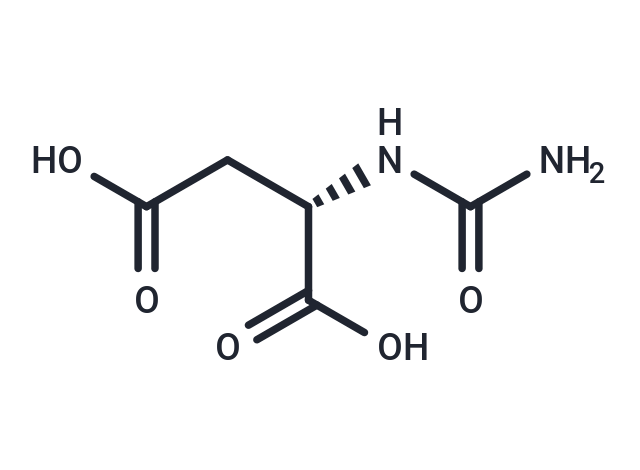
Synonyms: N-carbamoyl-L-aspartate, L-Ureidosuccinic acid
| Pack Size | Price | USA Stock | Global Stock | Quantity |
|---|---|---|---|---|
| 10 mg | Inquiry | Inquiry | Inquiry | |
| 50 mg | Inquiry | Inquiry | Inquiry |
| Description | N-Carbamoyl-L-aspartic acid is an intermediate in pyrimidine metabolism and can be utilized for the measurement of dihydroorotase (DHOase) enzymatic activity. The metabolic role of N-Carbamoyl-L-aspartic acid supports the application of N-Carbamoyl-L-aspartic acid in studies of nucleotide biosynthesis, metabolic pathway characterization, enzymology, and biochemical assay development. |
| In vitro | Method: Wild-type and pyrimidine-biosynthesis mutant strains of Saccharomyces cerevisiae were exposed to L-ureidosuccinic acid, and their growth and purine-biosynthetic responses were compared. Rresult: L-Ureidosuccinic acid inhibited yeast growth by interfering with de novo purine biosynthesis at a step before the formation of 5-aminoimidazole ribonucleotide. Mutants blocked after dihydroorotate formation were more resistant than wild-type cells and mutants blocked at earlier steps of pyrimidine biosynthesis.[1] Method: An in vitro one-pot multienzyme cascade containing carbamoyl phosphate synthase, aspartate transcarbamoylase, dihydroorotase, and dihydroorotate dehydrogenase was constructed to convert CO₂ and other feedstocks into N-carbamoyl-L-aspartate and orotate. Polyphosphate kinase was coupled to the system for ATP regeneration. Rresult: Under the optimized conditions, the cascade produced 19.2 mM N-carbamoyl-L-aspartate within 3 h, enabling the subsequent production of 15.5 mM orotate.[2] Method: An in vitro multienzyme cascade was constructed in which carbonic anhydrase hydrated CO₂ to bicarbonate, Pyrococcus furiosus carbamate kinase converted ammonia and bicarbonate into carbamoyl phosphate in an ATP-dependent reaction, and aspartate transcarbamoylase converted carbamoyl phosphate and L-aspartate into N-carbamoyl-L-aspartate. Rresult: The one-pot multienzyme system remained highly active between 50 and 80°C and achieved an overall CO₂ conversion rate of 5.70%, confirming enzymatic production of N-carbamoyl-L-aspartate from ammonia and CO₂.[3] |
| In vivo | Method: Human TNF-α transgenic arthritic mice were divided into control and Gancao Nourish-Yin Decoction groups. After 8 weeks of treatment, liver metabolites were analyzed using liquid chromatography–mass spectrometry. Rresult: N-Carbamoyl-L-aspartic acid was identified as one of six significantly upregulated liver metabolites after treatment. Its abundance was positively correlated with creatinine and L-anserine, with correlation coefficients of 0.631 and 0.720, respectively.[4] Method: Healthy rats received hydrogen-rich water or inhaled hydrogen gas for 6 months, after which plasma metabolites and fecal microbiota were analyzed using LC–MS-based pseudotargeted metabolomics and 16S rRNA sequencing. Rresult: Hydrogen gas inhalation significantly increased plasma N-carbamoyl-L-aspartic acid compared with the control group. Its plasma abundance was moderately positively correlated with Paraprevotella and negatively correlated with Bifidobacterium.[5] Method: Serum metabolomic profiles and gut microbial compositions were analyzed in an F6 pig population classified into high- and low-fatness groups. Rresult: Serum N-carbamoyl-L-aspartic acid abundance was significantly lower in the high-fatness group than in the low-fatness group, with values of 874398.2 ± 257244.08 and 1107077.74 ± 284038.44, respectively; the p value was 0.017 and the VIP value was 1.409.[6] Method: Milk samples from dairy cows receiving six corn-silage-based feeding systems were analyzed using untargeted high-resolution mass spectrometry to identify discriminant metabolites associated with dietary composition. Rresult: N-Carbamoyl-L-aspartate was identified as a discriminant pyrimidine-biosynthesis intermediate with a VIP score of 1.25 ± 0.15. Its log2 fold changes in high-moisture-ear-corn-based diets versus feeding clusters 2, 3, and 5 were 0.86, 0.27, and −0.03, respectively.[7] |
| Synonyms | N-carbamoyl-L-aspartate, L-Ureidosuccinic acid |
| Molecular Weight | 176.13 |
| Formula | C5H8N2O5 |
| Cas No. | 13184-27-5 |
| Smiles | [C@@H](CC(O)=O)(NC(N)=O)C(O)=O |
| Storage | Powder: -20°C for 3 years | In solvent: -80°C for 1 year Shipping with blue ice/Shipping at ambient temperature. | |||||||||||||||||||||||||||||||||||
| Solubility Information | H2O: 25 mg/mL (141.94 mM), Sonication is recommended. | |||||||||||||||||||||||||||||||||||
Solution Preparation Table | ||||||||||||||||||||||||||||||||||||
H2O
Note : The dilution table applies only to solid products. For liquid products, please calculate the stock solution based on the stated concentration and/or density. | ||||||||||||||||||||||||||||||||||||
 For example, if the intended dosage is 10 mg/kg for animals weighing 20 g , with a dosing volume of 100 μL per animal, and a total of 10 animals are to be administered, using a formulation of
  10% DMSO+ 40% PEG300+ 5% Tween 80+ 45% Saline/PBS/ddH2O , the resulting working solution concentration would be 2 mg/mL.
Dissolve 2 mg of the compound in 100 μL DMSO to obtain a stock solution at a concentration of 20 mg/mL . If the required concentration exceeds the compound's known solubility, please contact us for technical support before proceeding.
1) Add 100 μL of the DMSO stock solution to 400 µL PEG300 and mix thoroughly until the solution becomes clear.
2) Add 50 µL Tween 80 and mix well until fully clarified.
3) Add 450 µL Saline,PBS or ddH2O and mix thoroughly until a homogeneous solution is obtained.
| Size | Quantity | Unit Price | Amount | Operation |
|---|
 Feedback
 Hello! How can I help you today?
Copyright © 2015-2026 TargetMol Chemicals Inc. All Rights Reserved.
