


Shopping Cart
Remove All Your shopping cart is currently empty

Synonyms: NAP
| Pack Size | Price | USA Stock | Global Stock | Quantity |
|---|---|---|---|---|
| 200 mg | $31 | - | In Stock | |
| 500 mg | $48 | - | In Stock | |
| 1 g | $68 | - | In Stock | |
| 1 mL x 10 mM (in DMSO) | $29 | - | In Stock |
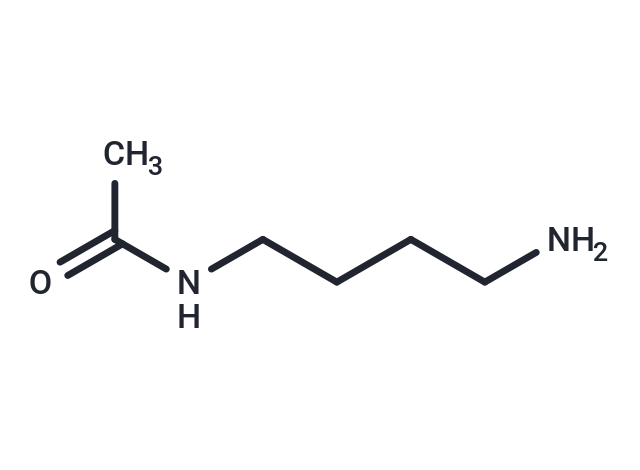
| Description | N-Acetylputrescine is an acetylated metabolite of the polyamine putrescine. N-Acetylputrescine participates in polyamine metabolism and regulatory processes within cells and reflects the dynamic balance between polyamine synthesis and degradation. N-Acetylputrescine exhibits activity toward the peroxisomal N(1)-acetyl-spermine/spermidine oxidase (PAOX) (Ki = 800 μM) and is commonly used as a metabolic biomarker to study polyamine metabolic changes in cellular proliferation, gut microbiota metabolism, and related disease states. |
| In vitro | N-Acetylputrescine (radioactive label; 72 h) is synthesized by putrescine in human lymphocyte culture, which can be released into the culture medium. Its production is related to the cell proliferation state and may participate in the regulation of polyamine metabolism [2]. |
| In vivo | The concentration of N-Acetylputrescine in rat lung squamous cell carcinoma (SCCL) model induced by 3-methylcholanthrene increased significantly with the progress of cancer, and after being treated with anticancer agents, the concentration of N-Acetylputrescine decreased, which can be used as a potential biomarker for early diagnosis and evaluation of SCC [3]. |
| Synonyms | NAP |
| Molecular Weight | 130.19 |
| Formula | C6H14N2O |
| Cas No. | 5699-41-2 |
| Smiles | O=C(NCCCCN)C |
| Storage | Keep away from direct sunlight Powder: -20°C for 3 years | In solvent: -80°C for 1 year Shipping with blue ice/Shipping at ambient temperature. | |||||||||||||||||||||||||||||||||||
| Solubility Information | H2O: 100.00 mg/mL (768.11 mM), Sonication is recommended. DMSO: 100.00 mg/mL (768.11 mM), Sonication is recommended. | |||||||||||||||||||||||||||||||||||
Solution Preparation Table | ||||||||||||||||||||||||||||||||||||
H2O/DMSO
Note : The dilution table applies only to solid products. For liquid products, please calculate the stock solution based on the stated concentration and/or density. | ||||||||||||||||||||||||||||||||||||
 For example, if the intended dosage is 10 mg/kg for animals weighing 20 g , with a dosing volume of 100 μL per animal, and a total of 10 animals are to be administered, using a formulation of
  10% DMSO+ 40% PEG300+ 5% Tween 80+ 45% Saline/PBS/ddH2O , the resulting working solution concentration would be 2 mg/mL.
Dissolve 2 mg of the compound in 100 μL DMSO to obtain a stock solution at a concentration of 20 mg/mL . If the required concentration exceeds the compound's known solubility, please contact us for technical support before proceeding.
1) Add 100 μL of the DMSO stock solution to 400 µL PEG300 and mix thoroughly until the solution becomes clear.
2) Add 50 µL Tween 80 and mix well until fully clarified.
3) Add 450 µL Saline,PBS or ddH2O and mix thoroughly until a homogeneous solution is obtained.
| Size | Quantity | Unit Price | Amount | Operation |
|---|
 Feedback
 Hello! How can I help you today?
Copyright © 2015-2026 TargetMol Chemicals Inc. All Rights Reserved.
