


Shopping Cart
Remove All Your shopping cart is currently empty

Synonyms: Glucopyranosyl lipid A
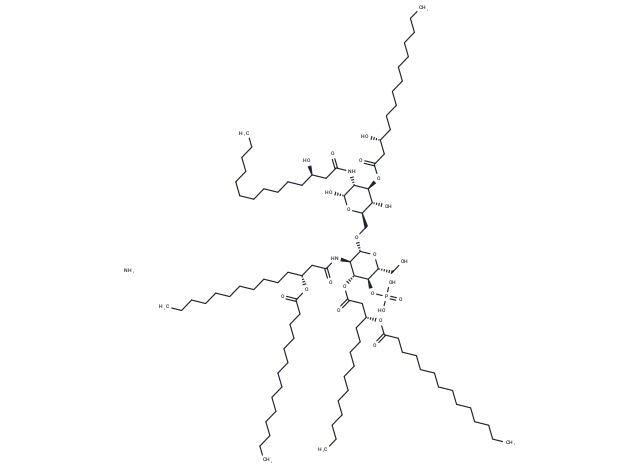
| Pack Size | Price | USA Stock | Global Stock | Quantity |
|---|---|---|---|---|
| 1 mg | $1,110 | 7-10 days | 7-10 days |
| Description | Monophosphoryl lipid A (MPLA), also known as Glucopyranosyl lipid A, is an agonist of toll-like receptor 4. Derived from the cell wall of nonpathogenic Salmonella, MPLA is a valuable compound for research on immunization and vaccine development. |
| In vitro | Monophosphoryl lipid A, at a concentration of 100 µg/ml for 2 hours, induces NF-κB activation and modulates TLR2 in dendritic cells, as evidenced by Western Blot Analysis. The same compound, ranging from 5 to 100 µg/ml over 24 hours, stimulates IL-12 production in human dendritic cells. Furthermore, increasing Monophosphoryl lipid A levels from 0.1 to 1 µg results in a higher percentage of matured bone marrow-derived dendritic cells (BMDCs). It also enhances cell surface markers on dendritic cells and boosts T cell responses, including the upregulation of calcium mobilization in activated CD4 T cells. |
| In vivo | The synthesized Monophosphoryl lipid A activates antigen-presenting cells (APCs) and amplifies the production of Th1- and Th2-specific immune responses in mice[2]. |
| Synonyms | Glucopyranosyl lipid A |
| Molecular Weight | 1763.501 |
| Formula | C96H184N3O22P |
| Cas No. | 1246298-63-4 |
| Smiles | N.CCCCCCCCCCCCCC(=O)O[C@H](CCCCCCCCCCC)CC(=O)N[C@H]1[C@H](OC[C@H]2O[C@H](O)[C@H](NC(=O)C[C@H](O)CCCCCCCCCCC)[C@@H](OC(=O)C[C@H](O)CCCCCCCCCCC)[C@@H]2O)O[C@H](CO)[C@@H](OP(O)(O)=O)[C@@H]1OC(=O)C[C@@H](CCCCCCCCCCC)OC(=O)CCCCCCCCCCCCC |
| Relative Density. | no data available |
| Storage | Powder: -20°C for 3 years | In solvent: -80°C for 1 year Shipping with blue ice/Shipping at ambient temperature. |
 For example, if the intended dosage is 10 mg/kg for animals weighing 20 g , with a dosing volume of 100 μL per animal, and a total of 10 animals are to be administered, using a formulation of
  10% DMSO+ 40% PEG300+ 5% Tween 80+ 45% Saline/PBS/ddH2O , the resulting working solution concentration would be 2 mg/mL.
Dissolve 2 mg of the compound in 100 μL DMSO to obtain a stock solution at a concentration of 20 mg/mL . If the required concentration exceeds the compound's known solubility, please contact us for technical support before proceeding.
1) Add 100 μL of the DMSO stock solution to 400 µL PEG300 and mix thoroughly until the solution becomes clear.
2) Add 50 µL Tween 80 and mix well until fully clarified.
3) Add 450 µL Saline,PBS or ddH2O and mix thoroughly until a homogeneous solution is obtained.
| Size | Quantity | Unit Price | Amount | Operation |
|---|
 Feedback
 Hello! How can I help you today?
Copyright © 2015-2026 TargetMol Chemicals Inc. All Rights Reserved.
