


Shopping Cart
Remove All Your shopping cart is currently empty

Synonyms:
| Pack Size | Price | USA Stock | Global Stock | Quantity |
|---|---|---|---|---|
| 1 mg | $178 | 35 days | 35 days | |
| 5 mg | $783 | 35 days | 35 days | |
| 10 mg | $1,370 | 35 days | 35 days | |
| 25 mg | $2,870 | 35 days | 35 days |
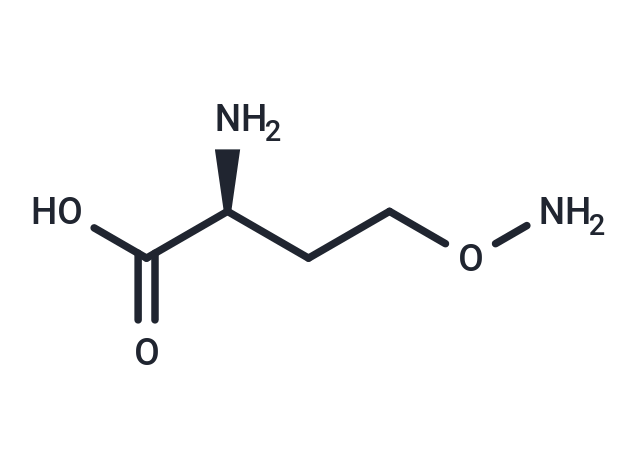
| Description | L-Canaline, a nonprotein amino acid found in many leguminous plants, exhibits potent anticancer and antiproliferative effects. It effectively inhibits the growth of the malaria parasite Plasmodium falciparum with an IC50 of 297 nM. Additionally, L-Canaline acts as a cytotoxic metabolite produced from L-canavanine through arginase catalysis and serves as a potent and irreversible inhibitor of ornithine aminotransferase. |
| Targets & IC50 | P. falciparum:297 nM |
| In vitro | L-Canaline is slightly less toxic to PBMCs stimulated via the mixed lymphocyte reaction (IC50 of 0.54 mM). L-canaline inhibits L-lysine flux competitively (Ki of 4.6 mM) in astrocytes and astrocytoma cells.L-Canaline treatment inhibits the proliferation of PBMCs after stimulation by phorbol 12-myristate-13-acetate (PMA) or via the mixed lymphocyte reaction.?The greatest effect is seen with PMA-stimulated cells, where L-canaline has an IC50 of 0.26 mM. |
| In vivo | Administering 100 μg of L-canaline via intraseptal injection to male Sprague-Dawley rats results in a significant 90% reduction in ornithine aminotransferase activity in septum tissues, assessed in specimens euthanized one hour post-treatment. Moreover, L-canaline lowers the aspartic acid levels in the medulla oblongata tissues of male Wistar rats, although it does not influence the stimulated release of this nonprotein amino acid into the tissues. |
| Molecular Weight | 134.13 |
| Formula | C4H10N2O3 |
| Cas No. | 496-93-5 |
| Smiles | [C@@H](C(O)=O)(CCON)N |
| Relative Density. | 1.298g/cm3 |
| Storage | Powder: -20°C for 3 years | In solvent: -80°C for 1 year Shipping with blue ice/Shipping at ambient temperature. |
 For example, if the intended dosage is 10 mg/kg for animals weighing 20 g , with a dosing volume of 100 μL per animal, and a total of 10 animals are to be administered, using a formulation of
  10% DMSO+ 40% PEG300+ 5% Tween 80+ 45% Saline/PBS/ddH2O , the resulting working solution concentration would be 2 mg/mL.
Dissolve 2 mg of the compound in 100 μL DMSO to obtain a stock solution at a concentration of 20 mg/mL . If the required concentration exceeds the compound's known solubility, please contact us for technical support before proceeding.
1) Add 100 μL of the DMSO stock solution to 400 µL PEG300 and mix thoroughly until the solution becomes clear.
2) Add 50 µL Tween 80 and mix well until fully clarified.
3) Add 450 µL Saline,PBS or ddH2O and mix thoroughly until a homogeneous solution is obtained.
| Size | Quantity | Unit Price | Amount | Operation |
|---|
 Feedback
 Hello! How can I help you today?
Copyright © 2015-2026 TargetMol Chemicals Inc. All Rights Reserved.
