


Shopping Cart
Remove All Your shopping cart is currently empty

Synonyms: H-TL1
| Pack Size | Price | USA Stock | Global Stock | Quantity |
|---|---|---|---|---|
| 10 mg | Inquiry | Inquiry | Inquiry | |
| 50 mg | Inquiry | Inquiry | Inquiry |
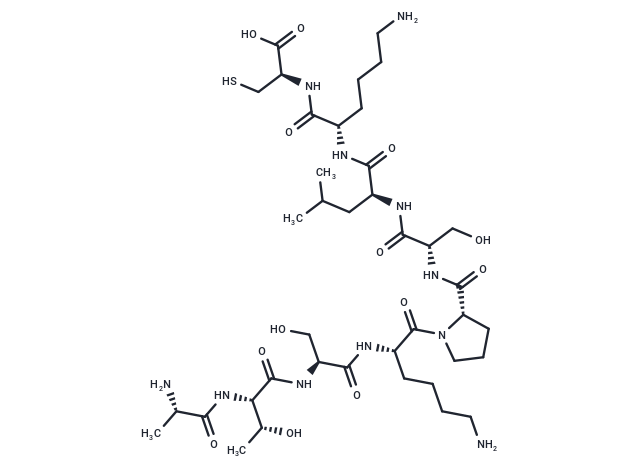
| Description | Hydrostatin-TL1 (H-TL1) is a nonapeptide that acts as a TNF-α antagonist. This compound can be isolated from the venom glands of the sea snake Hydrophis cyanocinctus. H-TL1 competitively inhibits the interaction between TNF-α and TNFR1, thus reducing TNF-α cytotoxicity and inflammatory responses. It is applicable for research into TNF-α-related inflammatory diseases such as rheumatoid arthritis, osteoporosis, and inflammatory bowel disease (IBD). |
| In vitro | Hydrostatin-TL1 (1-1000 nM, 18-20 hours) inhibits TNF-α induced L929 cell death in a concentration-dependent manner. Additionally, Hydrostatin-TL1 (0.2-1.6 μM) significantly suppresses the phosphorylation of p38, ERK, JNK, and IκB proteins in the TNF-α induced NF-κB and MAPKs signaling pathways in HEK-293 cells. However, it does not inhibit the IL-1β induced phosphorylation of IκB in HEK-293 cells. Furthermore, Hydrostatin-TL1 (0.1-0.8 nM) decreases TNF-α mediated pro-inflammatory factor mRNA expression (IL-8, TNF-α, ICAM-1, and VCAM-1) in HEK-293 cells in a dose-dependent manner. |
| In vivo | Hydrostatin-TL1 administered intraperitoneally at a dosage of 0.5-1 mg/kg once daily for 7-8 consecutive days exhibits significant anti-inflammatory effects in a DSS-induced acute colitis mouse model. Additionally, Hydrostatin-TL1, given at doses of 20-80 μg/kg at 1, 3, and 5 hours, dose-dependently decreases mortality rates in a mouse model of LPS-induced acute shock. |
| Synonyms | H-TL1 |
| Molecular Weight | 934.11 |
| Formula | C39H71N11O13S |
| Cas No. | 2243975-43-9 |
| Smiles | C([C@@H](NC([C@@H](NC([C@@H](NC([C@H](C)N)=O)[C@@H](C)O)=O)CO)=O)CCCCN)(=O)N1[C@H](C(N[C@H](C(N[C@H](C(N[C@H](C(N[C@H](C(O)=O)CS)=O)CCCCN)=O)CC(C)C)=O)CO)=O)CCC1 |
| Sequence | Ala-Thr-Ser-Lys-Pro-Ser-Leu-Lys-Cys |
| Sequence Short | ATSKPSLKC |
| Storage | Keep away from moisture Powder: -20°C for 3 years | In solvent: -80°C for 1 year Shipping with blue ice/Shipping at ambient temperature. |
 For example, if the intended dosage is 10 mg/kg for animals weighing 20 g , with a dosing volume of 100 μL per animal, and a total of 10 animals are to be administered, using a formulation of
  10% DMSO+ 40% PEG300+ 5% Tween 80+ 45% Saline/PBS/ddH2O , the resulting working solution concentration would be 2 mg/mL.
Dissolve 2 mg of the compound in 100 μL DMSO to obtain a stock solution at a concentration of 20 mg/mL . If the required concentration exceeds the compound's known solubility, please contact us for technical support before proceeding.
1) Add 100 μL of the DMSO stock solution to 400 µL PEG300 and mix thoroughly until the solution becomes clear.
2) Add 50 µL Tween 80 and mix well until fully clarified.
3) Add 450 µL Saline,PBS or ddH2O and mix thoroughly until a homogeneous solution is obtained.
| Size | Quantity | Unit Price | Amount | Operation |
|---|
 Feedback
 Hello! How can I help you today?
Copyright © 2015-2026 TargetMol Chemicals Inc. All Rights Reserved.
