


Shopping Cart
Remove All Your shopping cart is currently empty

Synonyms:

| Pack Size | Price | USA Stock | Global Stock | Quantity |
|---|---|---|---|---|
| 1 mg | $45 | In Stock | In Stock | |
| 2 mg | $63 | In Stock | In Stock | |
| 5 mg | $93 | In Stock | In Stock | |
| 10 mg | $129 | In Stock | In Stock | |
| 25 mg | $228 | In Stock | In Stock | |
| 50 mg | $318 | In Stock | In Stock | |
| 100 mg | $438 | - | In Stock | |
| 200 mg | $637 | - | In Stock | |
| 1 mL x 10 mM (in DMSO) | $98 | In Stock | In Stock |
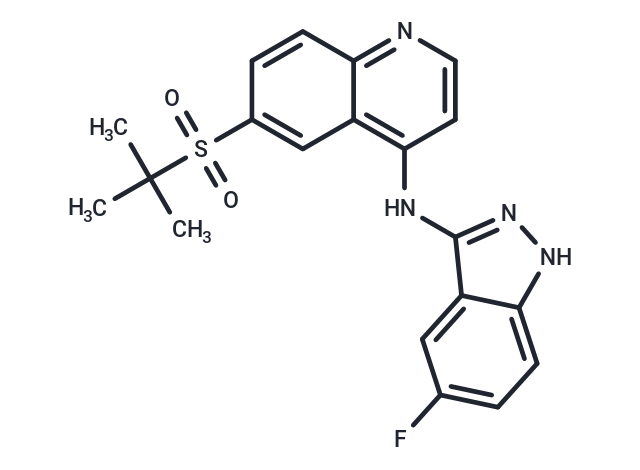
| Description | GSK583 is a highly effective and specific RIP2 kinase inhibitor (IC50: 5 nM). |
| Targets & IC50 | RIP2:5 nM |
| In vitro | GSK583 possesses a comparable binding affinity for RIP3 kinase similarly to the RIP2 (RIP2/3 FP IC50: 5/16 nM) by an in-house FP binding assay configured. But GSK583 (10 μM) shows little or no inhibition of RIP3-dependent necroptotic cell death in a cellular assay. GSK583 effectively and dose-dependently inhibits MDP-stimulated TNFα production (IC50: 8 nM) in primary human monocytes. Following treatment with GSK583 at 1 μM, little inhibition of pro-inflammatory signaling is observed upon activation of cytokine receptors (IL-1R, TNFR) or Toll-like receptors (TLR2, TLR4, TLR7) but complete inhibition is observed upon activation of NOD1/2 receptors, which signal in a RIP2-dependent manner. Although it has excellent kinase selectivity, GSK583 does inhibit both the hERG channel and CYP3A4. |
| In vivo | GSK583 has moderate volumes of distribution, low clearance, and moderate oral bioavailability (in rat and mouse). Although GSK583 would not produce a human pharmacodynamic response within an acceptable dose range, the oral PK in mouse and rat supplies enough systemic exposure for use as a preclinical in vivo tool molecule in an acute inflammation challenge model. |
| Kinase Assay | A fluorescent polarization based binding assay is developed to quantitate interaction of novel test compounds at the ATP binding pocket of RIP2K by competition with a fluorescently labeled ATP competitive ligand. Full length FLAG His tagged RIP2K is purified from a baculovirus expression system and is used at a final assay concentration of twice the KD apparent. A fluorescent labeled ligand that is reversible and competitive with the inhibitors is used at a final assay concentration of 5 nM. Both the enzyme and ligand are prepared in solutions in 50 mM HEPES pH 7.5, 150 mM NaCl, 10 mM MgCl2, 1 mM DTT, and 1 mM CHAPS. Test compounds are prepared in 100% DMSO, and 100 nL is dispensed to individual wells of a multiwell plate. Next, 5 μL of RIP2K is added to the test compounds at twice the final assay concentration and incubated at room temperature for 10 min. Following the incubation, 5 μL of the fluorescent labeled ligand solution is added to each reaction at twice the final assay concentration and incubated at room temperature for at least 10 min. Finally, samples are read on an instrument capable of measuring fluorescent polarization. Test compound inhibition is expressed as percent (%) inhibition of internal assay controls. For concentration response experiments, normalized data are fit using the following four parameter logistic equation: y = A + ((B-C))/(1+(10x)/(10C)D), where y is the % activity (% inhibition) at a specified compound concentration, A is the minimum % activity, B is the maximum % activity, C = log10(IC50), D = Hill slope, x = log10(compound concentration [M]), and pIC50 = (?C). |
| Cell Research | To assess cellular selectivity, monocytes are pretreated with inhibitor for 30 min, then stimulated for 6 h with ligands which selectively agonize NLRs NOD1, NOD2; Toll-like receptors TLR, TLR4, TLR7, or cytokine receptors IL-1R, TNFR. Release of pro-inflammatory cytokines, either TNFα (NOD2, TLR2, TLR4, IL1R) or IL-8 (NOD1, TLR7, TNFR), is measured by immunoassay. Percent inhibition and/or IC50 values are calculated. (Only for Reference) |
| Molecular Weight | 398.45 |
| Formula | C20H19FN4O2S |
| Cas No. | 1346547-00-9 |
| Smiles | CC(C)(C)S(=O)(=O)c1ccc2nccc(Nc3n[nH]c4ccc(F)cc34)c2c1 |
| Relative Density. | 1.402 g/cm3 (Predicted) |
| Storage | Powder: -20°C for 3 years | In solvent: -80°C for 1 year Shipping with blue ice/Shipping at ambient temperature. | ||||||||||||||||||||||||||||||||||||||||
| Solubility Information | DMSO: 45 mg/mL (112.94 mM), Sonication is recommended.  H2O: < 1 mg/mL (insoluble or slightly soluble) Ethanol: 27 mg/mL (67.76 mM), Sonication is recommended. | ||||||||||||||||||||||||||||||||||||||||
| In Vivo Formulation | 10% DMSO+40% PEG300+5% Tween 80+45% Saline: 2 mg/mL (5.02 mM), Sonication is recommended. Please add the solvents sequentially, clarifying the solution as much as possible before adding the next one. Dissolve by heating and/or sonication if necessary. Working solution is recommended to be prepared and used immediately. The formulation provided above is for reference purposes only. In vivo formulations may vary and should be modified based on specific experimental conditions. | ||||||||||||||||||||||||||||||||||||||||
Solution Preparation Table | |||||||||||||||||||||||||||||||||||||||||
Ethanol/DMSO
DMSO
Note : The dilution table applies only to solid products. For liquid products, please calculate the stock solution based on the stated concentration and/or density. | |||||||||||||||||||||||||||||||||||||||||
 For example, if the intended dosage is 10 mg/kg for animals weighing 20 g , with a dosing volume of 100 μL per animal, and a total of 10 animals are to be administered, using a formulation of
  10% DMSO+ 40% PEG300+ 5% Tween 80+ 45% Saline/PBS/ddH2O , the resulting working solution concentration would be 2 mg/mL.
Dissolve 2 mg of the compound in 100 μL DMSO to obtain a stock solution at a concentration of 20 mg/mL . If the required concentration exceeds the compound's known solubility, please contact us for technical support before proceeding.
1) Add 100 μL of the DMSO stock solution to 400 µL PEG300 and mix thoroughly until the solution becomes clear.
2) Add 50 µL Tween 80 and mix well until fully clarified.
3) Add 450 µL Saline,PBS or ddH2O and mix thoroughly until a homogeneous solution is obtained.
| Size | Quantity | Unit Price | Amount | Operation |
|---|
 Feedback
 Hello! How can I help you today?
Copyright © 2015-2026 TargetMol Chemicals Inc. All Rights Reserved.
