


Shopping Cart
Remove All Your shopping cart is currently empty


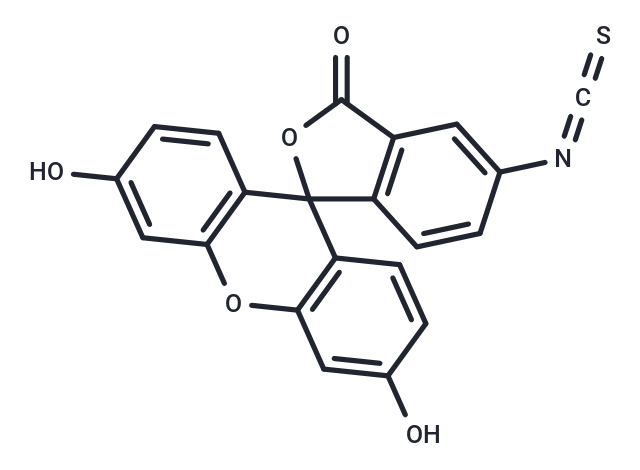
Synonyms: Fluorescein 5-isothiocyanate
| Pack Size | Price | USA Stock | Global Stock | Quantity |
|---|---|---|---|---|
| 50 mg | $31 | In Stock | In Stock | |
| 100 mg | $42 | In Stock | In Stock | |
| 1 mL x 10 mM (in DMSO) | $46 | In Stock | In Stock |
| Description | FITC is a green fluorescein derivative. FITC is commonly used to label biomolecules such as antibodies, proteins, and nucleic acids. It can serve as a fluorescent probe for detecting cell viability, apoptosis, and other cellular processes. FITC has a maximum excitation wavelength of 494 nm and emits yellow-green fluorescence at its maximum emission wavelength of 520 nm. |
| In vivo | Methods: P17 oxygen-induced retinal disease (OIR) mice received retro-orbital injections of FITC-dextran: 0.05 ml (50 mg/ml). Specimens were collected immediately post-injection. Fluorescence microscopy examined orbital tissues and retinas of the injected eye and contralateral eye. Results: FITC-dextran was absorbed systemically, as demonstrated by bilateral retinal visualization following entry into the bloodstream via the orbital venous sinus.[1] |
| Synonyms | Fluorescein 5-isothiocyanate |
| Cell Research | I. Amine labeling 1. Binding: Dilute FITC in an appropriate solvent (usually dimethylsulfonamide DMSO) and mix it with the target biomolecule solution. The reaction is usually carried out under slightly alkaline conditions (pH 8.0-9.0) to ensure effective binding of FITC. 2. Incubation: Incubate the mixture at room temperature or 4°C for 1-2 hours. Since FITC is light-sensitive, it needs to be protected from light. 3. Purification: After the reaction is completed, excess FITC is removed by purification techniques such as dialysis and gel filtration to obtain labeled biomolecules. II. Cell imaging 1. Cell staining: Apply FITC-labeled antibodies or proteins to cells or tissues and incubate for a certain period of time (usually 30 minutes to 1 hour) at room temperature or 4°C. 2. Fluorescence microscopy: After washing away unbound antibodies, use a fluorescence microscope to observe cells or tissues. FITC can be excited at a wavelength of about 495 nm and emit at a wavelength of 519 nm. III. pH and Cu2+ sensitivity 1. pH sensitivity: When FITC-labeled molecules are placed in solutions of different pH values, the fluorescence intensity will change with the change of pH and can be quantitatively measured. 2. Cu2+ detection: The fluorescence of FITC is also affected by Cu2+, so it can be used to determine the concentration of Cu2+ in the sample by observing the change of fluorescence intensity. The above information is based on published literature. Experimental procedures should be appropriately modified to meet specific research demands. |
| Molecular Weight | 389.38 |
| Formula | C21H11NO5S |
| Cas No. | 3326-32-7 |
| Smiles | OC1=CC2=C(C=C1)C1(OC(=O)C3=C1C=CC(=C3)N=C=S)C1=C(O2)C=C(O)C=C1 |
| Relative Density. | 1.3423 g/cm3 (Estimated) |
| Storage | Keep away from direct sunlight Powder: -20°C for 3 years | In solvent: -80°C for 1 year Shipping with blue ice/Shipping at ambient temperature. | |||||||||||||||||||||||||||||||||||
| Solubility Information | DMSO: 250 mg/mL (642.05 mM), Sonication is recommended.  | |||||||||||||||||||||||||||||||||||
Solution Preparation Table | ||||||||||||||||||||||||||||||||||||
DMSO
Note : The dilution table applies only to solid products. For liquid products, please calculate the stock solution based on the stated concentration and/or density. | ||||||||||||||||||||||||||||||||||||
 For example, if the intended dosage is 10 mg/kg for animals weighing 20 g , with a dosing volume of 100 μL per animal, and a total of 10 animals are to be administered, using a formulation of
  10% DMSO+ 40% PEG300+ 5% Tween 80+ 45% Saline/PBS/ddH2O , the resulting working solution concentration would be 2 mg/mL.
Dissolve 2 mg of the compound in 100 μL DMSO to obtain a stock solution at a concentration of 20 mg/mL . If the required concentration exceeds the compound's known solubility, please contact us for technical support before proceeding.
1) Add 100 μL of the DMSO stock solution to 400 µL PEG300 and mix thoroughly until the solution becomes clear.
2) Add 50 µL Tween 80 and mix well until fully clarified.
3) Add 450 µL Saline,PBS or ddH2O and mix thoroughly until a homogeneous solution is obtained.
| Size | Quantity | Unit Price | Amount | Operation |
|---|
 Feedback
 Hello! How can I help you today?
Copyright © 2015-2026 TargetMol Chemicals Inc. All Rights Reserved.
