


Shopping Cart
Remove All Your shopping cart is currently empty

Synonyms:
| Pack Size | Price | USA Stock | Global Stock | Quantity |
|---|---|---|---|---|
| 5 mg | $797 | 10-14 weeks | 10-14 weeks |
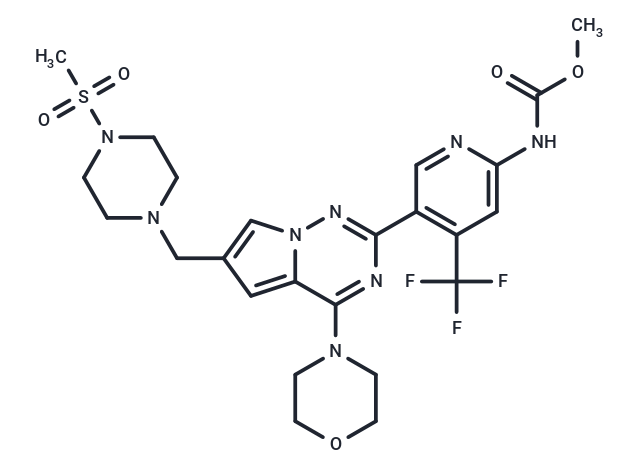
| Description | CYH33, an orally active and highly selective PI3Kα inhibitor, demonstrates specificity with IC50 values of 5.9 nM for the α isoform, 598 nM for β, 78.7 nM for δ, and 225 nM for γ. It effectively inhibits Akt and ERK phosphorylation and induces substantial G1 phase arrest in breast cancer and non-small cell lung cancer (NSCLC) cells, showcasing potent activity against solid tumors. |
| Targets & IC50 | PI3Kγ:225 nM (IC50), PI3Kα:5.9 nM (IC50), PI3Kβ:598 nM (IC50), PI3Kδ:78.7 nM (IC50) |
| In vitro | CYH33 exhibits potent anti-proliferative effects on breast cancer cells, inhibiting cell growth in 56% (18/32) of the lines tested with IC50 values below 1?μM. It significantly halts the cell cycle of T47D and MCF7 cells in the G1 phase in a dose-dependent manner when administered at concentrations ranging from 0.012-1 μM over 24 hours. Furthermore, exposure to CYH33 (4-1000 nM) for one hour notably suppresses the phosphorylation of ERK and Akt proteins in these cells, indicating an inhibition of key signaling pathways involved in cell proliferation and survival. However, CYH33 (0.11-1 μM) does not provoke apoptosis in MCF7 and MDA-MB-231 cells after 24 hours of treatment. Detailed cell cycle analysis revealed that CYH33 effectively induces G1 phase arrest in T47D and MCF7 cells, reducing the S phase cell population in a concentration-dependent manner, with negligible impact on the cell cycle of MDA-MB-231 cells. Western blotting confirms that CYH33 concurrently attenuates ERK and Akt phosphorylation in sensitive T47D and MCF7 cells but has minimal effect on ERK phosphorylation in resistant MDA-MB-231 cells. |
| In vivo | CYH33, administered orally at doses ranging from 2 to 20 mg/kg once daily for 21 days, significantly inhibits tumor growth in SCID mice implanted with human breast cancer T47D xenografts. At dosages of 10 and 20 mg/kg, CYH33 markedly reduces tumor size, achieving tumor/control (T/C) percentages of 58.36% and 49.42%, respectively. In addition, a single dose of CYH33 at 20 mg/kg notably diminishes the level of phosphorylated Akt in tumor tissues, indicating the inhibition of PI3K signaling in the nude mice. Moreover, CYH33 at a dosage of 10 mg/kg when administered once daily for either 18 or 20 days, prolongs the recovery of blood glucose levels and increases the area under the curve (AUC) for blood glucose in both T47D xenografts and R26-Pik3ca H1047R;MMTV-Cre mice models, demonstrating the compound's effect on glucose metabolism. These results highlight the potential of CYH33 as a therapeutic agent in managing breast cancer by targeting tumor growth and signaling pathways. |
| Molecular Weight | 598.6 |
| Formula | C24H29F3N8O5S |
| Cas No. | 1494684-28-4 |
| Smiles | COC(=O)Nc1cc(c(cn1)-c1nc(N2CCOCC2)c2cc(CN3CCN(CC3)S(C)(=O)=O)cn2n1)C(F)(F)F |
| Relative Density. | 1.57 g/cm3 (Predicted) |
| Storage | Powder: -20°C for 3 years | In solvent: -80°C for 1 year Shipping with blue ice/Shipping at ambient temperature. |
 For example, if the intended dosage is 10 mg/kg for animals weighing 20 g , with a dosing volume of 100 μL per animal, and a total of 10 animals are to be administered, using a formulation of
  10% DMSO+ 40% PEG300+ 5% Tween 80+ 45% Saline/PBS/ddH2O , the resulting working solution concentration would be 2 mg/mL.
Dissolve 2 mg of the compound in 100 μL DMSO to obtain a stock solution at a concentration of 20 mg/mL . If the required concentration exceeds the compound's known solubility, please contact us for technical support before proceeding.
1) Add 100 μL of the DMSO stock solution to 400 µL PEG300 and mix thoroughly until the solution becomes clear.
2) Add 50 µL Tween 80 and mix well until fully clarified.
3) Add 450 µL Saline,PBS or ddH2O and mix thoroughly until a homogeneous solution is obtained.
| Size | Quantity | Unit Price | Amount | Operation |
|---|
 Feedback
 Hello! How can I help you today?
Copyright © 2015-2026 TargetMol Chemicals Inc. All Rights Reserved.
