Shopping Cart
Remove All
  • TargetMol
    Your shopping cart is currently empty

Azoxymethane

Copy Product Info
😃Good
Hot
Catalog No. T73719Cas No. 25843-45-2
Alias AOM

Azoxymethane (AOM) is a colon-specific carcinogen that induces DNA damage and forms DNA adducts, and is commonly used to establish mouse models of colorectal cancer.

Azoxymethane

Azoxymethane

Copy Product Info
😃Good
Hot
Catalog No. T73719Alias AOMCas No. 25843-45-2
Azoxymethane (AOM) is a colon-specific carcinogen that induces DNA damage and forms DNA adducts, and is commonly used to establish mouse models of colorectal cancer.
Pack SizePriceUSA WarehouseGlobal WarehouseQuantity
1 mg (135 mM * 100 μL in Water)$169-In Stock
5 mg (135 mM * 500 μL in Water)Inquiry-In Stock
Add to Cart
Add to Quotation
In Stock Estimated shipping dateUSA Warehouse[1-2 days] Global Warehouse[5-7 days]
All TargetMol products are for research purposes only and cannot be used for human consumption. We do not provide products or services to individuals. Please comply with the intended use and do not use TargetMol products for any other purpose.
Questions
TargetMol
View More

Batch Information

Select Batch
Color:Transparent
Contact us for more batch information

Resource Download

Product Introduction

Bioactivity
Description
Azoxymethane (AOM) is a colon-specific carcinogen that induces DNA damage and forms DNA adducts, and is commonly used to establish mouse models of colorectal cancer.
Disease Modeling Protocol
Colorectal cancer model
  • Modeling Mechanism:

    Azoxymethane (AOM), a colon-specific procarcinogen, is metabolized and activated in the liver to produce an alkylating intermediate. This intermediate alkylates the DNA of colonic mucosal epithelial cells, inducing gene mutations and initiating tumorigenesis.

  • Related Products:

    Azoxymethane (T73719)

  • Modeling Method:

    Experimental Subject:

    Rats, Wistar Albino rats, Female, 35 days old

    Dosage and Administration Route:

    ① Core modelling: Intraperitoneal injection of AOM at 7.4 mg/kg at 7 weeks of age;
    ② Control treatment: intraperitoneal injection of equal volume saline solution, with all other housing conditions identical

    Dosing Frequency and Duration Model:

    Single dose

  • Validation:

    1. Tumor Characteristics: - Incidence: No significant colorectal tumor formation was observed in the AOM-only treatment group (significant tumors only appear with long-term modeling or combined intervention; single administration mainly targets the tumor initiation stage); - Pathological Basis: Increased epithelial cell proliferation activity was observed in the colonic mucosa, laying the foundation for subsequent tumor progression; 2. Proliferation Indicators: - With prolonged modeling period or combined with other promoting factors, an increase in bromodeoxyuridine (BrdU)-labeled positive cells and increased thymidylate synthase (TS) and thymidine kinase (TK) activities were detected; 3. Molecular Indicators: - DNA alkylation damage-related markers and abnormal expression of oncogenes/tumor suppressor genes were detected in the colonic mucosal tissue.

*Precautions: At the end of the 11th week, the surviving animals were euthanized under ether anesthesia.

*References:Okayasu I,et,al. Promotion of colorectal neoplasia in experimental murine ulcerative colitis. Gut. 1996 Jul;39(1):87-92.

SynonymsAOM
Chemical Properties
Molecular Weight74.08
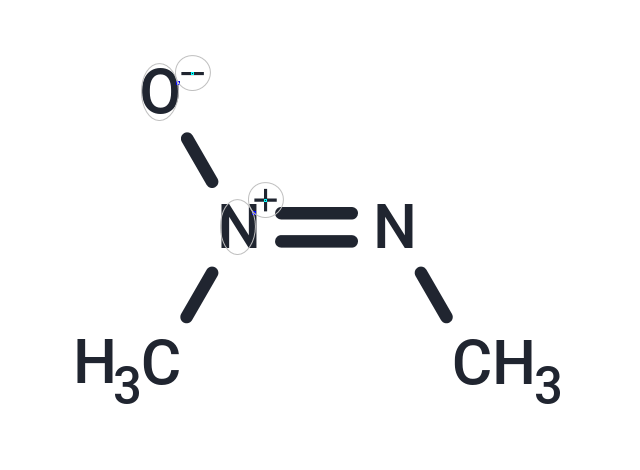
FormulaC2H6N2O
Cas No.25843-45-2
SmilesC\N=[N+](/C)[O-]
Storage & Solubility Information
Storagestore at low temperature,keep away from direct sunlight,keep away from moisture | Pure form: -20°C for 3 years | In solvent: -80°C for 1 year | Shipping with blue ice/Shipping at ambient temperature.

Calculator

  • Molarity Calculator
  • Dilution Calculator
  • Reconstitution Calculator
  • Molecular Weight Calculator

In Vivo Formulation Calculator (Clear solution)

Please enter your animal experiment information in the following box and click Calculate to obtain the stock solution preparation method and in vivo formula preparation method:
TargetMol | Animal experiments For example, if the intended dosage is 10 mg/kg for animals weighing 20 g , with a dosing volume of 100 μL per animal, TargetMol | Animal experiments and a total of 10 animals are to be administered, using a formulation of TargetMol | reagent 10% DMSO+ 40% PEG300+ 5% Tween 80+ 45% Saline/PBS/ddH2O , the resulting working solution concentration would be 2 mg/mL.

Stock Solution Preparation:

Dissolve 2 mg of the compound in 100 μL DMSOTargetMol | reagent to obtain a stock solution at a concentration of 20 mg/mL . If the required concentration exceeds the compound's known solubility, please contact us for technical support before proceeding.

Preparation of the In Vivo Formulation:

1) Add 100 μL of the DMSOTargetMol | reagent stock solution to 400 μL PEG300TargetMol | reagent and mix thoroughly until the solution becomes clear.

2) Add 50 μL Tween 80 and mix well until fully clarified.

3) Add 450 μL Saline,PBS or ddH2OTargetMol | reagent and mix thoroughly until a homogeneous solution is obtained.

This example is provided solely to demonstrate the use of the In Vivo Formulation Calculator and does not constitute a recommended formulation for any specific compound. Please select an appropriate dissolution and formulation strategy based on your experimental model and route of administration.
All co-solvents required for this protocol, includingDMSO, PEG300/PEG400, Tween 80, SBE-β-CD, and Corn oil, are available for purchase on the TargetMol website.
1 Enter information below:
mg/kg
g
μL
2 Enter the in vivo formulation:
% DMSO
%
% Tween 80
% Saline/PBS/ddH2O

Dose Conversion

You can also refer to dose conversion for different animals. More Dose Conversion

Tech Support

Please see Inhibitor Handling Instructions for more frequently ask questions. Topics include: how to prepare stock solutions, how to store products, and cautions on cell-based assays & animal experiments, etc
Related Tags: buy Azoxymethane | purchase Azoxymethane | Azoxymethane cost | order Azoxymethane | Azoxymethane chemical structure | Azoxymethane formula | Azoxymethane molecular weight