


Shopping Cart
Remove All Your shopping cart is currently empty

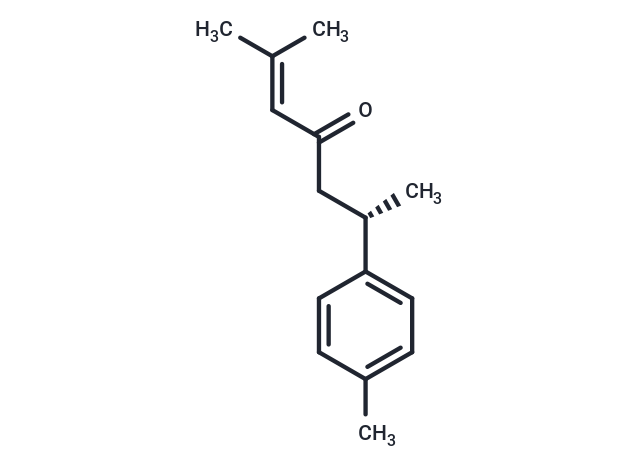
Synonyms: (+)-ar-Turmerone
| Pack Size | Price | USA Stock | Global Stock | Quantity |
|---|---|---|---|---|
| 1 mg | $88 | - | In Stock | |
| 5 mg | $213 | - | In Stock | |
| 10 mg | $372 | - | In Stock | |
| 25 mg | $613 | - | In Stock | |
| 50 mg | $869 | - | In Stock |
| Description | ar-Turmerone is a natural volatile organic compound extracted from the rhizomes of turmeric (Curcuma longa). ar-Turmerone exhibits oral bioavailability and possesses biological activities such as antitumor, anti-inflammatory, antioxidant, and neuroprotective effects. ar-Turmerone exerts a positive regulatory effect on dendritic cells in mice. Ar-turmerone can induce neural stem cell proliferation both in vitro and in vivo, making it useful for research on neurological disorders. Ar-turmerone induces apoptosis in U937 cells. |
| In vitro | Methods: ar-Turmerone (0, 50, 100, 200 μM) was added to U251, U87, and LN229 glioma cells, which were incubated for 48 hours; cell viability was assessed using the CCK-8 assay. Results: ar-Turmerone inhibited cell viability in a dose-dependent manner. [1] Methods: Primary rat hippocampal neurons were treated with ar-Turmerone (30, 100, 300 μM) for 1 hour, followed by treatment with Aβ25-35 (50 μM) for 24 hours. Cell viability was assessed using the MTT assay, and TNF-α, IFN-β, and iNOS levels were measured by ELISA. Results: ar-Turmerone restored cell viability in a dose-dependent manner and reduced TNF-α, IFN-β, and iNOS levels in a dose-dependent manner. [2] Methods: Primary fetal mouse (E14.5) cortical neural stem cells (containing FGF2) were treated with ar-Turmerone (1.56–25 μg/mL) for 72 h. Photographs were taken using a phase-contrast microscope, and cell proliferation was assessed by counting with ImageJ. Results: ar-Turmerone treatment significantly promoted neural stem cell proliferation, with a significant increase in cell numbers observed at concentrations ranging from 3.125 to 25 μg/mL, reaching a peak at 6.25 μg/mL. [3] |
| In vivo | Methods: BALB/c nude mice were inoculated with U251 cells in the right axilla. Once the tumor volume reached 40–60 mm³, intraperitoneal injections of ar-Turmerone (40 mg/kg/day) were initiated and continued for 25 days. Results: ar-Turmerone significantly inhibited tumor growth, reduced tumor weight, and downregulated KI67/PCNA expression, with no significant hepatotoxicity or nephrotoxicity. [1] Methods: Male ICR mice received stereotaxic injections of Aβ1-42 into the hippocampus. ar-Turmerone (5, 10 mg/kg) was administered orally via gavage once daily for a total of 28 days, including 21 days prior to and 7 days following Aβ1-42 injection. Results: Oral administration of ar-Turmerone (5, 10 mg/kg) significantly improved learning and memory abilities, enhanced cholinergic function, and reduced hippocampal neuronal apoptosis. [2] Methods: To investigate the effects of ar-Turmerone on neurogenesis, adult male Wistar rats received a single intracerebroventricular injection of 3 mg ar-Turmerone (1 mg/μL dissolved in saline) into the right lateral ventricle, and brain tissue was harvested 7 days post-injection. Results: In vivo, a single intraventricular injection of ar-Turmerone activated endogenous neural stem cells, resulting in a significant increase in the number of DCX⁺ cells in the SVZ region of the rat brain.[3] |
| Synonyms | (+)-ar-Turmerone |
| Molecular Weight | 216.32 |
| Formula | C15H20O |
| Cas No. | 532-65-0 |
| Smiles | [C@@H](CC(C=C(C)C)=O)(C)C1=CC=C(C)C=C1 |
| Relative Density. | 0.945 g/cm3 |
| Storage | Keep away from direct sunlight Powder: -20°C for 3 years | In solvent: -80°C for 1 year Shipping with blue ice/Shipping at ambient temperature. | |||||||||||||||||||||||||||||||||||
| Solubility Information | Ethanol: 40 mg/mL (184.91 mM), Sonication is recommended. | |||||||||||||||||||||||||||||||||||
Solution Preparation Table | ||||||||||||||||||||||||||||||||||||
Ethanol
Note : The dilution table applies only to solid products. For liquid products, please calculate the stock solution based on the stated concentration and/or density. | ||||||||||||||||||||||||||||||||||||
 For example, if the intended dosage is 10 mg/kg for animals weighing 20 g , with a dosing volume of 100 μL per animal, and a total of 10 animals are to be administered, using a formulation of
  10% DMSO+ 40% PEG300+ 5% Tween 80+ 45% Saline/PBS/ddH2O , the resulting working solution concentration would be 2 mg/mL.
Dissolve 2 mg of the compound in 100 μL DMSO to obtain a stock solution at a concentration of 20 mg/mL . If the required concentration exceeds the compound's known solubility, please contact us for technical support before proceeding.
1) Add 100 μL of the DMSO stock solution to 400 µL PEG300 and mix thoroughly until the solution becomes clear.
2) Add 50 µL Tween 80 and mix well until fully clarified.
3) Add 450 µL Saline,PBS or ddH2O and mix thoroughly until a homogeneous solution is obtained.
| Size | Quantity | Unit Price | Amount | Operation |
|---|
 Feedback
 Hello! How can I help you today?
Copyright © 2015-2026 TargetMol Chemicals Inc. All Rights Reserved.
