


Shopping Cart
Remove All Your shopping cart is currently empty


Synonyms: Aminaphthone
| Pack Size | Price | USA Stock | Global Stock | Quantity |
|---|---|---|---|---|
| 1 mg | $200 | In Stock | In Stock | |
| 5 mg | $560 | In Stock | In Stock | |
| 10 mg | $1,020 | In Stock | In Stock | |
| 25 mg | $1,820 | In Stock | In Stock |
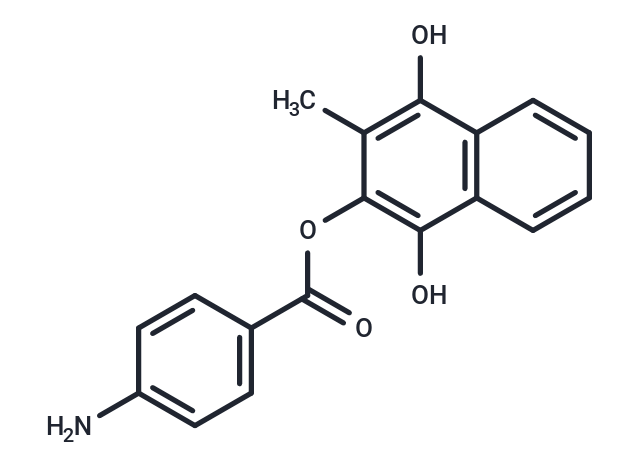
| Description | Aminaftone, a derivative of 4-aminobenzoic acid, inhibits endothelin-1 (ET-1) production and is used to study hypertension and systemic sclerosis. |
| In vitro | In cell cultures, Aminaftone inhibits the production of Endothelin-1 (ET-1) by interfering with the transcription of the pre-pro-endothelin-1 (PPET-1) gene. Concentrations of ET-1 and PPET-1 relative gene expression increase upon incubation with IL-1beta. Aminaftone, when incubated in a concentration-dependent manner, significantly reduces the production of ET-1. A strong direct correlation is observed between ET-1 concentrations and PPET-1 relative gene expression. It is noteworthy that Aminaftone does not influence the activity of endothelin-converting enzyme (ECE)[2]. |
| In vivo | After 5 weeks, rats are randomly assigned to the following experimental groups: Control; Monocrotaline; Aminaftone 30 mg/kg/day; Aminaftone 150 mg/kg/day. In animals treated with Aminaftone at both doses, mortality is significantly lower compared to those treated with Monocrotaline alone. Aminaftone, especially at the highest dose, reduces the plasma concentration of ET-1 and appears to decrease right heart hypertrophy and the wall thickness of the pulmonary arteries. At the end of the experiment, no rats die in the control and Aminaftone 150 groups, while mortality is 38% in the Monocrotaline group and 13% in the Aminaftone 30 group. Overall, rats treated with Aminaftone show a significantly lower mortality compared to rats in the Monocrotaline group (P=0.044)[1]. |
| Synonyms | Aminaphthone |
| Molecular Weight | 309.32 |
| Formula | C18H15NO4 |
| Cas No. | 14748-94-8 |
| Smiles | OC=1C2=C(C(O)=C(C)C1OC(=O)C3=CC=C(N)C=C3)C=CC=C2 |
| Relative Density. | 1.39g/cm3 |
| Storage | Store at low temperature,Keep away from direct sunlight,The compound is unstable in solution. Please use soon Powder: -20°C for 3 years | In solvent: -80°C for 1 year Shipping with blue ice/Shipping at ambient temperature. | |||||||||||||||||||||||||||||||||||
| Solubility Information | DMSO: 60 mg/mL (193.97 mM), Sonication is recommended.  | |||||||||||||||||||||||||||||||||||
Solution Preparation Table | ||||||||||||||||||||||||||||||||||||
DMSO
Note : The dilution table applies only to solid products. For liquid products, please calculate the stock solution based on the stated concentration and/or density. | ||||||||||||||||||||||||||||||||||||
 For example, if the intended dosage is 10 mg/kg for animals weighing 20 g , with a dosing volume of 100 μL per animal, and a total of 10 animals are to be administered, using a formulation of
  10% DMSO+ 40% PEG300+ 5% Tween 80+ 45% Saline/PBS/ddH2O , the resulting working solution concentration would be 2 mg/mL.
Dissolve 2 mg of the compound in 100 μL DMSO to obtain a stock solution at a concentration of 20 mg/mL . If the required concentration exceeds the compound's known solubility, please contact us for technical support before proceeding.
1) Add 100 μL of the DMSO stock solution to 400 µL PEG300 and mix thoroughly until the solution becomes clear.
2) Add 50 µL Tween 80 and mix well until fully clarified.
3) Add 450 µL Saline,PBS or ddH2O and mix thoroughly until a homogeneous solution is obtained.
| Size | Quantity | Unit Price | Amount | Operation |
|---|
 Feedback
 Hello! How can I help you today?
Copyright © 2015-2026 TargetMol Chemicals Inc. All Rights Reserved.
