


Shopping Cart
Remove All Your shopping cart is currently empty

Synonyms:
| Pack Size | Price | USA Stock | Global Stock | Quantity |
|---|---|---|---|---|
| 2 mg | $33 | - | In Stock | |
| 5 mg | $48 | - | In Stock | |
| 10 mg | $75 | - | In Stock | |
| 25 mg | $148 | - | In Stock | |
| 50 mg | $223 | - | In Stock | |
| 100 mg | $323 | - | In Stock | |
| 200 mg | $451 | - | In Stock |
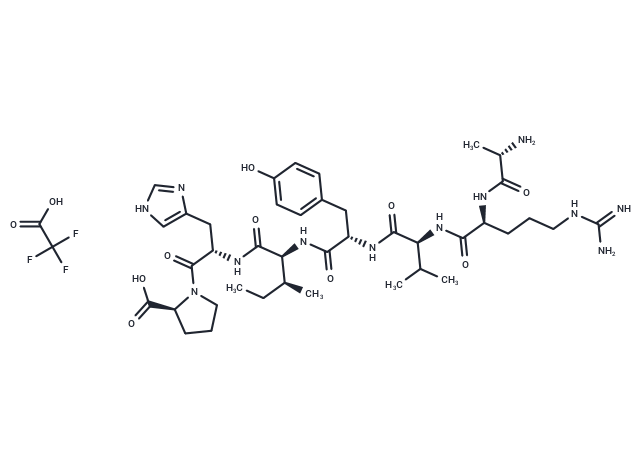
| Description | Alamandine TFA , a member of the renin-angiotensin system (RAS), a vasoactive peptide, is an endogenous ligand of the G protein-coupled receptor MrgD. Alamandine TFA targets to protect the kidney and heart through anti-hypertensive actions[1][2]. |
| In vitro | Alamandine TFA is generated by catalysis of Ang A via ACE2 or directly from Angiotensin 1-7 (Ang-(1-7)). Derived from angiotensin II (Ang II) by Ang II-converting enzyme 2 (ACE2), it shows vasodilating (thus protective) properties. Ang (1-7) can be decarboxylated to a peptide called Alamandine TFA. Alamandine TFA is also an endogenous peptide identified in human blood[1]. Alamandine TFA elevates cAMP concentration in primary endothelial and mesangial cells, also suggesting Gs coupling[2]. Alamandine TFA decreases secretion, expression, and blood levels of leptin. Alamandine TFA induced expression of iNOS and plasminogen activator inhibitor-1 (PAI-1) in adipose tissue and isolated adipocytes[2]. |
| In vivo | Alamandine TFA (0.15 ?μL/h; administered by mini-osmotic pumps; for 6 weeks) treatment ameliorates hypertension and impaires left ventricle (LV) function in SHRs. Also decreases the mass gains of heart and lung in SHRs, suppresses cardiomyocyte cross-sectional area expansion, and inhibits the mRNA levels of atrial natriuretic peptide and brain natriuretic peptide[3]. heart and lung in SHRs, suppresses cardiomyocyte cross-sectional area expansion, and inhibits the mRNA levels of atrial natriuretic peptide and brain natriuretic peptide[3]. |
| Molecular Weight | 969.02 |
| Formula | C42H63F3N12O11 |
| Smiles | OC(C(F)(F)F)=O.O=C(O)[C@H]1N(C([C@H](CC2=CNC=N2)NC([C@H]([C@@H](C)CC)NC([C@H](CC3=CC=C(O)C=C3)NC([C@H](C(C)C)NC([C@H](CCCNC(N)=N)NC([C@H](C)N)=O)=O)=O)=O)=O)=O)CCC1 |
| Relative Density. | no data available |
| Sequence | H-Ala-Arg-Val-Tyr-Ile-His-Pro-OH |
| Sequence Short | ARVYIHP |
| Storage | Keep away from moisture Powder: -20°C for 3 years | In solvent: -80°C for 1 year Shipping with blue ice/Shipping at ambient temperature. |
 For example, if the intended dosage is 10 mg/kg for animals weighing 20 g , with a dosing volume of 100 μL per animal, and a total of 10 animals are to be administered, using a formulation of
  10% DMSO+ 40% PEG300+ 5% Tween 80+ 45% Saline/PBS/ddH2O , the resulting working solution concentration would be 2 mg/mL.
Dissolve 2 mg of the compound in 100 μL DMSO to obtain a stock solution at a concentration of 20 mg/mL . If the required concentration exceeds the compound's known solubility, please contact us for technical support before proceeding.
1) Add 100 μL of the DMSO stock solution to 400 µL PEG300 and mix thoroughly until the solution becomes clear.
2) Add 50 µL Tween 80 and mix well until fully clarified.
3) Add 450 µL Saline,PBS or ddH2O and mix thoroughly until a homogeneous solution is obtained.
| Size | Quantity | Unit Price | Amount | Operation |
|---|
 Feedback
 Hello! How can I help you today?
Copyright © 2015-2026 TargetMol Chemicals Inc. All Rights Reserved.
