


Shopping Cart
Remove All Your shopping cart is currently empty

Synonyms:
| Pack Size | Price | USA Stock | Global Stock | Quantity |
|---|---|---|---|---|
| 2 mg | Inquiry | Inquiry | Inquiry | |
| 5 mg | Inquiry | Inquiry | Inquiry | |
| 10 mg | Inquiry | Inquiry | Inquiry | |
| 25 mg | Inquiry | Inquiry | Inquiry | |
| 50 mg | Inquiry | Inquiry | Inquiry | |
| 1 mL x 10 mM (in DMSO) | Inquiry | Inquiry | Inquiry |
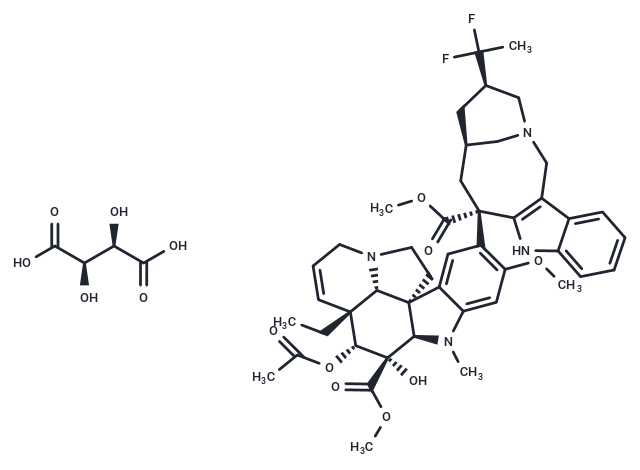
| Description | Vinflunine Tartrate, a uniquely fluorinated vinca alkaloid, exhibits mitotic-arresting and tubulin-interacting properties. |
| In vitro | The major effects of Vinflunine on dynamic instability are a slowing of the microtubule growth rate, an increase in growth duration, and a reduction in shortening duration. The effects of Vinflunine on the readmilling rate is examined by following [3H]GTP incorporation into MAP-rich microtubules, and the IC50 is 0.42 μM. [1] Vinflunine induced mitotic accumulation with IC50 with 18.8 nM, which decreases the centromere dynamicity by 44% and increases the time centromeres spent ina paused state by 63%. [2] Vinflunine ditartrate exhibits microtubule inhibition (purified tubulin and MTP) and cytotoxicity in L1210 cells with IC50 of (0.49 μM and 3.5 μM) and 97 nM, respectively. [3] Vinflunine induces apoptosis in neuroblastoma SK-N-SH cells through a postmitotic G1 arrest and a mitochondrial pathway in a concentration-dependent manner with an IC50 with 50 nM. sup>[4] Treatment of Vinflunine induces a rapid change in endothelial cell shape: cells retracts and assumes a rounded morphology. Mean IC50 values are 9.9 x 10-5 M x 10-5 M for fibronectin and 5.0x 10-5 M x 10-5 M for type IV collagen. A short 4 hours exposure of endothelial cells to Vinflunine at 10-8 |
| In vivo | Intravenous treatment of mice with Vinflunine, immediately before and 2 day after Matrigel implantation, results in a dose-dependent inhibition of the bFGF-induced angiogenic response, compared with vehicle-treated animals. Inhibition of haemoglobin content is significant at 1.25, 2.5 and 5 mg/kg, with no effect at 0.63 mg/kg (P > 0.05). An ID50 value (dose which inhibits 50% of bFGF-induced neovascularisation) is calculated as 1 mg/kg. Low doses of Vinflunine reduce the number of experimental liver metastases by human LS174T colon cancer cell. A slight overall decrease in liver metastatic foci is already observed at the very low dose of 0.16 mg/kg Vinflunine, although maximal overall inhibition is reached at the maximal tolerated dose (MTD) of 20 mg/kg. [5] |
| Kinase Assay | Determination of Microtubule Polymer Mass: Purified tubulin (17 μM) is polymerized into microtubules in the abence or presence of a range of vnflunine concentrations (35 minutes; 37 °C) in 75 mM PIPES, 1.8 mM MgCl2, 1.0 mM EGTA, and 1.5 mM GTP (pH 6.8) using sea urchin (Strongylocentrotus purpuratus) axonemes as seeds for assembly initiation. After incubation, polymerized microtubules are separated from unpolymerized tubulin by centrifugation (150,000 × g; 1 hour; 35 °C). The supernatant is aspirated, the sedimented microtubules are depolymerized in assembly buffer by incubation on ice (2 hours), and the protein content is determined. |
| Cell Research | Effects of Vinflunine on L1210 cell proliferation are determined using a standard growth inhibition assay. Exponentially growing L1210 cells (1.5 × 10⁵ cells/well) in a 24-well plate are exposed to a range of concentrations of test compounds for 48 hours, prior to determining cell numbers using an electronic particle counter based on linear interpolation between data points.(Only for Reference) |
| Molecular Weight | 967.02 |
| Formula | C45H54F2N4O8·xC4H6O6 |
| Cas No. | 1201898-17-0 |
| Smiles | O[C@H]([C@@H](O)C(O)=O)C(O)=O.CC[C@@]12C=CCN3CC[C@@]4([C@H]13)[C@@H](N(C)c1cc(OC)c(cc41)[C@]1(C[C@H]3C[C@H](CN(C3)Cc3c1[nH]c1ccccc31)C(C)(F)F)C(=O)OC)[C@](O)([C@@H]2OC(C)=O)C(=O)OC |
| Relative Density. | no data available |
| Storage | Powder: -20°C for 3 years | In solvent: -80°C for 1 year Shipping with blue ice/Shipping at ambient temperature. | |||||||||||||||||||||||||
| Solubility Information | DMSO: 45 mg/mL (46.53 mM), Sonication is recommended. | |||||||||||||||||||||||||
Solution Preparation Table | ||||||||||||||||||||||||||
DMSO
Note : The dilution table applies only to solid products. For liquid products, please calculate the stock solution based on the stated concentration and/or density. | ||||||||||||||||||||||||||
 For example, if the intended dosage is 10 mg/kg for animals weighing 20 g , with a dosing volume of 100 μL per animal, and a total of 10 animals are to be administered, using a formulation of
  10% DMSO+ 40% PEG300+ 5% Tween 80+ 45% Saline/PBS/ddH2O , the resulting working solution concentration would be 2 mg/mL.
Dissolve 2 mg of the compound in 100 μL DMSO to obtain a stock solution at a concentration of 20 mg/mL . If the required concentration exceeds the compound's known solubility, please contact us for technical support before proceeding.
1) Add 100 μL of the DMSO stock solution to 400 µL PEG300 and mix thoroughly until the solution becomes clear.
2) Add 50 µL Tween 80 and mix well until fully clarified.
3) Add 450 µL Saline,PBS or ddH2O and mix thoroughly until a homogeneous solution is obtained.
| Size | Quantity | Unit Price | Amount | Operation |
|---|
 Feedback
 Hello! How can I help you today?
Copyright © 2015-2026 TargetMol Chemicals Inc. All Rights Reserved.
