


Shopping Cart
Remove All Your shopping cart is currently empty

Synonyms:
| Pack Size | Price | USA Stock | Global Stock | Quantity |
|---|---|---|---|---|
| 25 mg | $1,640 | 4-6 weeks | 4-6 weeks | |
| 50 mg | $2,220 | 4-6 weeks | 4-6 weeks | |
| 100 mg | $2,740 | 4-6 weeks | 4-6 weeks |
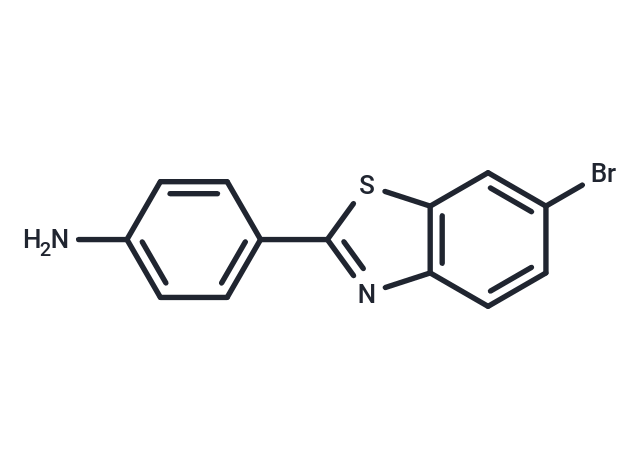
| Description | 4-(6-Bromo-2-benzothiazolyl)benzenamine is a β-amyloid PET tracer used in the diagnosis of neurological diseases. |
| In vitro | Exposure of A375 cells to 4-(6-Bromo-2-benzothiazolyl)benzenamine (compound 6l) in conjunction with ultraviolet A (UVA) radiation activates caspase-3, initiates poly(ADP-ribose)polymerase cleavage, and causes M30 positive CytoDeath staining, leading to apoptotic cell death. This treatment also leads to a reduction in mitochondrial membrane potential (ΔΨmt), components of the oxidative phosphorylation system (OXPHOS), and adenosine triphosphate (ATP) levels, while increasing mitochondrial DNA 4977-bp deletions through the generation of reactive oxygen species (ROS) [2]. |
| In vivo | The combination of 4-(6-Bromo-2-benzothiazolyl)benzenamine and UVA exposure has been demonstrated to decrease the size of murine melanoma in a mouse model. This suggests that 4-(6-Bromo-2-benzothiazolyl)benzenamine-PDT could potentially act as an adjunctive treatment approach for melanoma [2]. |
| Cell Research | For fluorescence Measurement of Uptake of 4-(6-Bromo-2-benzothiazolyl)benzenamine, cultured A375 cells are seeded on glass coverslips with a density of 2×10^4 cells/well in 24-well plate for 24 h until cell attachment. Then the cells are exposed to 4-(6-Bromo-2-benzothiazolyl)benzenamine at 5 μM for indicated times in the dark. The cells are washed twice with PBS and are then fixed with 4% paraformaldehyde at 4°C for 30 min. The qualitative expression of cell fluorescence is determined using a Leica inverted microscope [2]. |
| Animal Research | A total of 5×10^6 B16 cells are inoculated into female ICR mice (about 19-21 g, 7 weeks). The subcutaneous inoculation of tumor cells resulted in tumor generation at the injection site. When tumors reached about 4×4 mm2 in diameter, mice are separated into groups. Each group had four mice in each experiment; 4 mg/kg of 4-(6-Bromo-2-benzothiazolyl)benzenamine is injected into the tumor site, and then the tumor is exposed to different doses of UVA on the day after injection. Tumor volume is measured by calipers every 5 days after agent injection, and tumor volume is calculated [2]. |
| Molecular Weight | 305.19 |
| Formula | C13H9BrN2S |
| Cas No. | 566169-97-9 |
| Smiles | BrC=1C=CC=2N=C(SC2C1)C3=CC=C(N)C=C3 |
| Relative Density. | no data available |
| Storage | Powder: -20°C for 3 years | In solvent: -80°C for 1 year Shipping with blue ice/Shipping at ambient temperature. |
 For example, if the intended dosage is 10 mg/kg for animals weighing 20 g , with a dosing volume of 100 μL per animal, and a total of 10 animals are to be administered, using a formulation of
  10% DMSO+ 40% PEG300+ 5% Tween 80+ 45% Saline/PBS/ddH2O , the resulting working solution concentration would be 2 mg/mL.
Dissolve 2 mg of the compound in 100 μL DMSO to obtain a stock solution at a concentration of 20 mg/mL . If the required concentration exceeds the compound's known solubility, please contact us for technical support before proceeding.
1) Add 100 μL of the DMSO stock solution to 400 µL PEG300 and mix thoroughly until the solution becomes clear.
2) Add 50 µL Tween 80 and mix well until fully clarified.
3) Add 450 µL Saline,PBS or ddH2O and mix thoroughly until a homogeneous solution is obtained.
| Size | Quantity | Unit Price | Amount | Operation |
|---|
 Feedback
 Hello! How can I help you today?
Copyright © 2015-2026 TargetMol Chemicals Inc. All Rights Reserved.
