


Shopping Cart
Remove All Your shopping cart is currently empty

Synonyms:
| Pack Size | Price | USA Stock | Global Stock | Quantity |
|---|---|---|---|---|
| 10 mg | Inquiry | Inquiry | Inquiry | |
| 50 mg | Inquiry | Inquiry | Inquiry |
| Description | β-Amyloid (1-40), HFIP-treated, refers to the β-Amyloid (1-40) peptide that has been processed with HFIP. This peptide is a key protein fragment found in the brain plaques of individuals with Alzheimer's disease. |
| In vivo | Before conducting formal experiments, it is advisable to determine optimal conditions (such as animal strain, age, dosage, frequency, duration, test times, and parameters) through preliminary tests. β-Amyloid (1-40) can be utilized in animal models to develop Alzheimer's disease models. The pathogenic mechanism involves β-Amyloid (1-40) accumulating in the brain with neurotoxic properties, thereby inducing Alzheimer's disease. Specific modeling method: Rats: Wistar • Male • 280-320 g Administration: 0, 3, 30, 300 pmol • Infusion using a cannula attached to a modified micro-osmotic pump • Duration: 2 weeks. Note: (1) Dissolve β-Amyloid (1-40) in 35% acetonitrile/0.1% trifluoroacetic acid (TFA). (2) Each group consists of 7 rats. On Day 1, insert the catheter into the left ventricle. Conduct the water maze task between days 9 and 13 after infusion begins. Post-behavioral experiments, decapitate 4 rats per group to measure ChAT activity, and use 3 rats for histochemical analysis. (3) For histochemical studies, anesthetize rats and euthanize them via transaortic perfusion fixation using cold saline followed by 4% paraformaldehyde and 0.1 M phosphate buffer. Extract and fix brains in the same fixative for 12 hours. Slice frozen brain tissue at 20 μm using a cryostat, collecting the periventricular region. Indicators of successful modeling include molecular changes: decreased acetylcholine transferase (ChAT) activity in the frontal cortex and hippocampus, leading to cholinergic neuron dysfunction; tissue changes: β-Amyloid accumulation in the hippocampus and cerebral cortex; and phenotypic observation: memory impairment. |
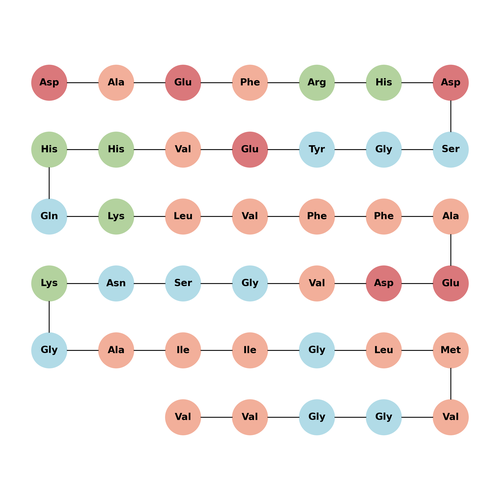
| Sequence | Asp-Ala-Glu-Phe-Arg-His-Asp-Ser-Gly-Tyr-Glu-Val-His-His-Gln-Lys-Leu-Val-Phe-Phe-Ala-Glu-Asp-Val-Gly-Ser-Asn-Lys-Gly-Ala-Ile-Ile-Gly-Leu-Met-Val-Gly-Gly-Val-Val |
| Sequence Short | DAEFRHDSGYEVHHQKLVFFAEDVGSNKGAIIGLMVGGVV |
| Storage | Keep away from moisture Powder: -20°C for 3 years | In solvent: -80°C for 1 year Shipping with blue ice/Shipping at ambient temperature. |
 For example, if the intended dosage is 10 mg/kg for animals weighing 20 g , with a dosing volume of 100 μL per animal, and a total of 10 animals are to be administered, using a formulation of
  10% DMSO+ 40% PEG300+ 5% Tween 80+ 45% Saline/PBS/ddH2O , the resulting working solution concentration would be 2 mg/mL.
Dissolve 2 mg of the compound in 100 μL DMSO to obtain a stock solution at a concentration of 20 mg/mL . If the required concentration exceeds the compound's known solubility, please contact us for technical support before proceeding.
1) Add 100 μL of the DMSO stock solution to 400 µL PEG300 and mix thoroughly until the solution becomes clear.
2) Add 50 µL Tween 80 and mix well until fully clarified.
3) Add 450 µL Saline,PBS or ddH2O and mix thoroughly until a homogeneous solution is obtained.
| Size | Quantity | Unit Price | Amount | Operation |
|---|
 Feedback
 Hello! How can I help you today?
Copyright © 2015-2026 TargetMol Chemicals Inc. All Rights Reserved.
