


Shopping Cart
Remove All Your shopping cart is currently empty

Synonyms:
| Pack Size | Price | USA Stock | Global Stock | Quantity |
|---|---|---|---|---|
| 25 mg | $1,520 | 6-8 weeks | 6-8 weeks | |
| 50 mg | $1,980 | 6-8 weeks | 6-8 weeks | |
| 100 mg | $2,500 | 6-8 weeks | 6-8 weeks |
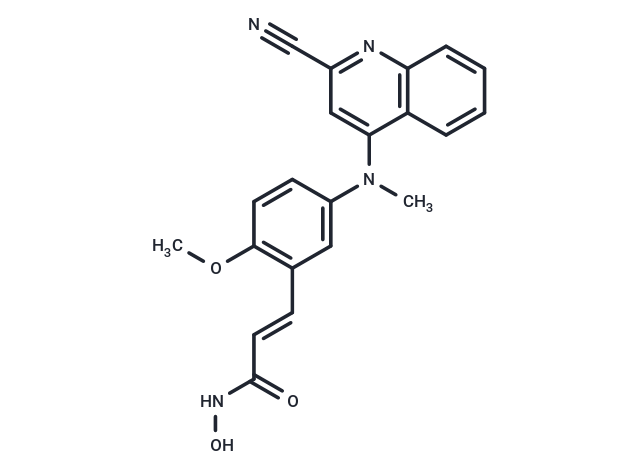
| Description | Tubulin/HDAC-IN-1 is a dual inhibitor of tubulin and HDAC8, interacting with tubulin via CH/π interactions and with HDAC8 through hydrogen bonds. It effectively inhibits tubulin polymerization and selectively targets HDAC8 with an IC50 of 150 nM. Additionally, Tubulin/HDAC-IN-1 demonstrates cytotoxicity against various human cancer cells, induces cell cycle arrest in the G2/M phase, and triggers cell apoptosis, making it valuable for studying hematologic and solid tumors, including neuroblastoma and leukemia [1]. |
| Targets & IC50 | HDAC11:1.9 μM, HDAC8:150 nM, HDAC6:1 μM |
| In vitro | Tubulin/HDAC-IN-1 (Compound 12a) exhibits pronounced cytotoxicity with an average IC50 of 0.6 nM across various human cancer cell lines. In HT29 cells, 2 nM application induces G2/M phase arrest and caspase-mediated apoptosis via mitochondrial dysfunction over 24 hours. The compound selectively inhibits HDAC8 with an IC50 of 150 nM, and also inhibits HDAC6 and HDAC11 at higher concentrations (1 μM and 1.9 μM, respectively). It increases γH2AX and acetylated SMC3 levels in a dose-dependent manner at 0.5-100 nM, indicating DNA damage and cell stress. Tubulin polymerization is impeded dose-dependently, particularly notable at 5-15 μΜ, and at 250 nM, it disrupts the microtubule network non-specifically. The compound shows good in vitro metabolic stability, observed in intrinsic clearance rates for rat and human liver microsomes. Comprehensive evaluation through cell proliferation assays and western blot analysis in HT-29 cells underscores its potential as a cancer therapeutic agent. |
| In vivo | Tubulin/HDAC-IN-1 (Compound 12a), administered intratumorally at 0.25 mg/kg three times weekly for two weeks, significantly reduced MCA205 tumor growth and improved overall survival in a C57BL/6 allogeneic sarcoma mouse model. The study [1] also evaluated 0.1 and 0.50 mg/kg dosages, showing decreased tumor growth and extended survival without evident adverse effects. |
| Molecular Weight | 374.39 |
| Formula | C21H18N4O3 |
| Cas No. | 2413587-26-3 |
| Smiles | N(C)(C=1C2=C(N=C(C#N)C1)C=CC=C2)C3=CC(/C=C/C(NO)=O)=C(OC)C=C3 |
| Storage | Powder: -20°C for 3 years | In solvent: -80°C for 1 year Shipping with blue ice/Shipping at ambient temperature. |
 For example, if the intended dosage is 10 mg/kg for animals weighing 20 g , with a dosing volume of 100 μL per animal, and a total of 10 animals are to be administered, using a formulation of
  10% DMSO+ 40% PEG300+ 5% Tween 80+ 45% Saline/PBS/ddH2O , the resulting working solution concentration would be 2 mg/mL.
Dissolve 2 mg of the compound in 100 μL DMSO to obtain a stock solution at a concentration of 20 mg/mL . If the required concentration exceeds the compound's known solubility, please contact us for technical support before proceeding.
1) Add 100 μL of the DMSO stock solution to 400 µL PEG300 and mix thoroughly until the solution becomes clear.
2) Add 50 µL Tween 80 and mix well until fully clarified.
3) Add 450 µL Saline,PBS or ddH2O and mix thoroughly until a homogeneous solution is obtained.
| Size | Quantity | Unit Price | Amount | Operation |
|---|
 Feedback
 Hello! How can I help you today?
Copyright © 2015-2026 TargetMol Chemicals Inc. All Rights Reserved.
