


Shopping Cart
Remove All Your shopping cart is currently empty

Synonyms: RU66647, RU 66647, HMR3647, HMR 3647
| Pack Size | Price | USA Stock | Global Stock | Quantity |
|---|---|---|---|---|
| 1 mg | $49 | - | In Stock | |
| 5 mg | Preferential | - | In Stock |
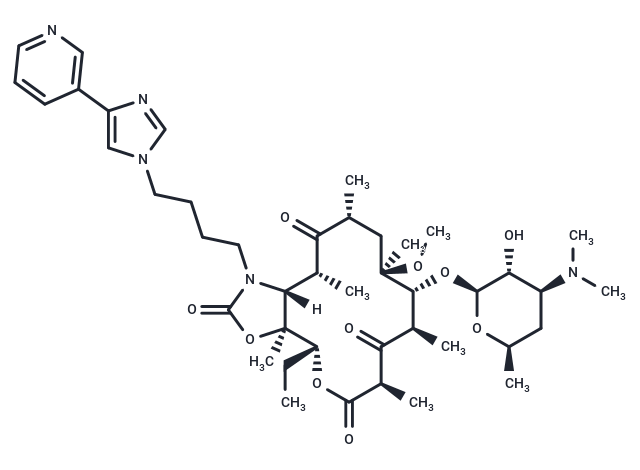
| Description | Telithromycin is a semisynthetic 14-membered macrolide antibiotic and erythromycin derivative that binds to the 50S subunit of the 70S bacterial ribosome, inhibits bacterial protein synthesis, and exhibits antimicrobial activity against a wide range of gram-positive and gram-negative bacteria for the treatment of mild to moderate respiratory infections. |
| In vitro | The in vitro antimicrobial activity of Telithromycin was determined using Methods such as broth microdilution, agar dilution, and E-test Methods. MIC distribution was homogeneous (MIC range, 0.003 to 0.25 μg/ml)[1]. However, its MIC50 and MIC90 against Mycobacterium avium complex were both greater than 16 μg/ml, indicating weaker in vitro antimicrobial activity [2]. |
| In vivo | In mouse models, oral Telithromycin (3-26 mg/kg) demonstrated excellent efficacy against erythromycin-resistant sepsis and significant antibacterial activity against a range of pathogens. In the erythromycin-resistant *Streptococcus pneumoniae* model, the ED50 of Telithromycin was 6.5 mg/kg, comparable to the efficacy of azithromycin. At a dose of 100 mg/kg, the plasma Cmax reached 8.5 mg/L, with lung concentrations of 13.3 μg/g. The volume of distribution was similar to that in humans, with plasma and lung tissue half-lives of 2.5 hours and 2.8 hours, respectively[3]. |
| Synonyms | RU66647, RU 66647, HMR3647, HMR 3647 |
| Molecular Weight | 812 |
| Formula | C43H65N5O10 |
| Cas No. | 191114-48-4 |
| Smiles | C[C@@]12[C@](N(CCCCN3C=C(N=C3)C=4C=CC=NC4)C(=O)O1)([C@@H](C)C(=O)[C@H](C)C[C@](OC)(C)[C@H](O[C@H]5[C@H](O)[C@@H](N(C)C)C[C@@H](C)O5)[C@@H](C)C(=O)[C@@H](C)C(=O)O[C@@H]2CC)[H] |
| Relative Density. | 1.26 g/cm3 (Predicted) |
| Storage | Keep away from moisture,Store at low temperature,Store under nitrogen Powder: -20°C for 3 years | In solvent: -80°C for 1 year Shipping with blue ice/Shipping at ambient temperature. | |||||||||||||||||||||||||||||||||||
| Solubility Information | H2O: Insoluble Ethanol: 30 mg/mL (36.95 mM), Sonication is recommended. DMSO: 80 mg/mL (98.52 mM), Sonication is recommended. | |||||||||||||||||||||||||||||||||||
| In Vivo Formulation | 10% DMSO+40% PEG300+5% Tween-80+45% Saline: 3.3 mg/mL (4.06 mM), Sonication is recommended. Please add the solvents sequentially, clarifying the solution as much as possible before adding the next one. Dissolve by heating and/or sonication if necessary. Working solution is recommended to be prepared and used immediately. The formulation provided above is for reference purposes only. In vivo formulations may vary and should be modified based on specific experimental conditions. | |||||||||||||||||||||||||||||||||||
Solution Preparation Table | ||||||||||||||||||||||||||||||||||||
Ethanol/DMSO
DMSO
Note : The dilution table applies only to solid products. For liquid products, please calculate the stock solution based on the stated concentration and/or density. | ||||||||||||||||||||||||||||||||||||
 For example, if the intended dosage is 10 mg/kg for animals weighing 20 g , with a dosing volume of 100 μL per animal, and a total of 10 animals are to be administered, using a formulation of
  10% DMSO+ 40% PEG300+ 5% Tween 80+ 45% Saline/PBS/ddH2O , the resulting working solution concentration would be 2 mg/mL.
Dissolve 2 mg of the compound in 100 μL DMSO to obtain a stock solution at a concentration of 20 mg/mL . If the required concentration exceeds the compound's known solubility, please contact us for technical support before proceeding.
1) Add 100 μL of the DMSO stock solution to 400 µL PEG300 and mix thoroughly until the solution becomes clear.
2) Add 50 µL Tween 80 and mix well until fully clarified.
3) Add 450 µL Saline,PBS or ddH2O and mix thoroughly until a homogeneous solution is obtained.
| Size | Quantity | Unit Price | Amount | Operation |
|---|
 Feedback
 Hello! How can I help you today?
Copyright © 2015-2026 TargetMol Chemicals Inc. All Rights Reserved.
