


Shopping Cart
Remove All Your shopping cart is currently empty

Synonyms:
| Pack Size | Price | USA Stock | Global Stock | Quantity |
|---|---|---|---|---|
| 10 mg | Inquiry | 10-14 weeks | 10-14 weeks | |
| 50 mg | Inquiry | 10-14 weeks | 10-14 weeks |
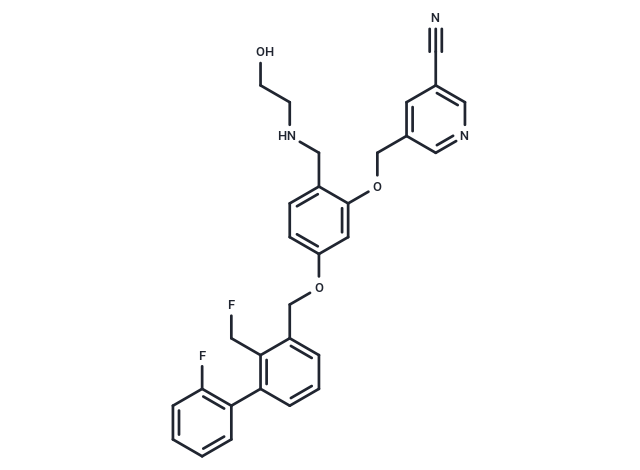
| Description | SF-9-2 is a PD-L1/PD-1 binding inhibitor with an IC50 of 24.9 nM. It suppresses epithelial-mesenchymal transition, migration, invasion, and proliferation of SK-N-SH cells, while also inducing apoptosis and causing cell cycle arrest. SF-9-2 blocks PD-L1-induced growth of SK-N-SH cells via the MAPK signaling pathway. It restores GSK-3β activity and enhances PD-L1 degradation through the ubiquitin-proteasome pathway. In the SK-N-SH NOG mouse model, SF-9-2 inhibits tumor growth without notable toxicity. Additionally, SF-9-2 acts as an immune checkpoint inhibitor, blocking PD-L1 to restore T cell function and is applicable to neuroblastoma research. |
| In vitro | SF-9-2 exhibits significant inhibitory activity against SK-N-SH (IC 50 = 5.9 μM) and SK-N-AS cells (IC 50 = 8.67 μM) in a concentration range of 0.5-16 μM over 48 hours, but shows less inhibition of SH-SY5Y and SK-N-BE (2) cells and low cytotoxicity to normal MRC-5 cells (IC 50 = 12.15 μM). At concentrations of 1-6 μM for 24 hours, SF-9-2 suppresses the proliferation, migration, invasion, and epithelial-mesenchymal transition (EMT) of SK-N-SH cells, and induces mitochondrial-dependent apoptosis and cell cycle arrest. It also inhibits the MAPK pathway and downregulates PD-L1 levels in SK-N-SH cells by targeting the ERK signaling pathway, at concentrations of 2.5-8 μM for 24-48 hours. SF-9-2 induces GSK-3β-mediated PD-L1 internalization and proteasomal degradation in SK-N-SH cells within a range of 2.5-5 μM for 24 hours. With concentrations from 2.25-200 nM, SF-9-2 reduces fluorescence signals in 293T cells overexpressing PD-1 and Fc-PD-L1 proteins, effectively blocking the PD-1/PD-L1 immune checkpoint. It enhances IFN-γ secretion levels in PBMCs at concentrations of 1-16 μM over 48 hours, with no significant toxicity at 1, 2, and 4 μM. Furthermore, SF-9-2 exhibits direct tumor-killing activity and T-cell-mediated cytotoxicity against SK-N-SH cells at concentrations of 1-8 μM for 48 hours. |
| In vivo | SF-9-2 (20-40 mg/kg, administered via intraperitoneal injection, once daily for 21 days) inhibits the growth of SK-N-SH tumors in the NOG mouse model. |
| Molecular Weight | 515.55 |
| Formula | C30H27F2N3O3 |
| Cas No. | 3053768-78-5 |
| Smiles | N#CC1=CN=CC(=C1)COC2=CC(OCC3=CC=CC(C=4C=CC=CC4F)=C3CF)=CC=C2CNCCO |
| Storage | Powder: -20°C for 3 years | In solvent: -80°C for 1 year Shipping with blue ice/Shipping at ambient temperature. |
 For example, if the intended dosage is 10 mg/kg for animals weighing 20 g , with a dosing volume of 100 μL per animal, and a total of 10 animals are to be administered, using a formulation of
  10% DMSO+ 40% PEG300+ 5% Tween 80+ 45% Saline/PBS/ddH2O , the resulting working solution concentration would be 2 mg/mL.
Dissolve 2 mg of the compound in 100 μL DMSO to obtain a stock solution at a concentration of 20 mg/mL . If the required concentration exceeds the compound's known solubility, please contact us for technical support before proceeding.
1) Add 100 μL of the DMSO stock solution to 400 µL PEG300 and mix thoroughly until the solution becomes clear.
2) Add 50 µL Tween 80 and mix well until fully clarified.
3) Add 450 µL Saline,PBS or ddH2O and mix thoroughly until a homogeneous solution is obtained.
| Size | Quantity | Unit Price | Amount | Operation |
|---|
 Feedback
 Hello! How can I help you today?
Copyright © 2015-2026 TargetMol Chemicals Inc. All Rights Reserved.
