


Shopping Cart
Remove All Your shopping cart is currently empty

Synonyms:
| Pack Size | Price | USA Stock | Global Stock | Quantity |
|---|---|---|---|---|
| 10 mg | Inquiry | 10-14 weeks | 10-14 weeks | |
| 50 mg | Inquiry | 10-14 weeks | 10-14 weeks |
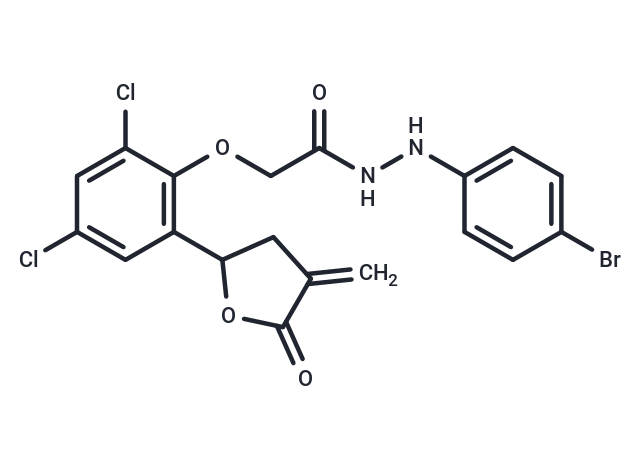
| Description | SDH-IN-25 is an SDH inhibitor with an IC50 of 4.82 mg/L, demonstrating broad-spectrum and potent antifungal activity. By binding to SDH amino acid residues (TRP173, TYR58, and ARG43), it mimics the action mode of the commercial fungicide flutolanil. SDH-IN-25 induces changes in hyphal morphology, disrupts respiratory metabolism by binding to complex II, generates reactive oxygen species (ROS), and affects mitochondrial membrane potential (MMP) in hyphae. This compound is utilized in agricultural disease control research. |
| In vitro | SDH-IN-25 (Compound 7IIj) demonstrates exceptional broad-spectrum fungicidal activity against eight plant pathogenic strains, including R. solani (EC 50 = 0.179 mg/L), P. piricola (EC 50 = 0.301 mg/L), S. sclerotiorum (EC 50 = 3.47 mg/L), V. mali (EC 50 = 0.789 mg/L), F. graminearum (EC 50 = 6.29 mg/L), B. cinerea (EC 50 = 0.647 mg/L), P. capsici (EC 50 = 5.78 mg/L), and G. graminis (EC 50 = 0.549 mg/L). At concentrations of 5-20 mg/L for durations of 1-9 hours, SDH-IN-25 can inhibit the respiratory metabolism of R. solani. Additionally, at 0-20 mg/L for 2 days, SDH-IN-25 shows outstanding SDH inhibitory activity against R. solani, with an IC 50 value of 4.82 mg/L. |
| In vivo | SDH-IN-25 (Compound 7IIj) at a concentration of 200 mg/L for 24 hours exhibits significant protective effects on apple twigs infected with V. mali, achieving a 69.7% control rate. When applied at 100 mg/L for 10 minutes, SDH-IN-25 shows marked efficacy against rice leaves and plants infected with rice blast fungus, with control effects of 88.7% and 69.8%, respectively, and has confirmed safety for rice. At a concentration of 1 mg/L for 72 hours, SDH-IN-25 causes abnormal growth in R. solani mycelia, resulting in a dry, collapsed, and wrinkled surface. Additionally, at 0.179 mg/L, it increases ROS levels and disrupts MMP in the mycelia. |
| Molecular Weight | 486.143 |
| Formula | C19H15BrCl2N2O4 |
| Cas No. | 3052432-15-9 |
| Smiles | O=C1OC(C=2C=C(Cl)C=C(Cl)C2OCC(=O)NNC3=CC=C(Br)C=C3)CC1=C |
| Storage | Powder: -20°C for 3 years | In solvent: -80°C for 1 year Shipping with blue ice/Shipping at ambient temperature. |
 For example, if the intended dosage is 10 mg/kg for animals weighing 20 g , with a dosing volume of 100 μL per animal, and a total of 10 animals are to be administered, using a formulation of
  10% DMSO+ 40% PEG300+ 5% Tween 80+ 45% Saline/PBS/ddH2O , the resulting working solution concentration would be 2 mg/mL.
Dissolve 2 mg of the compound in 100 μL DMSO to obtain a stock solution at a concentration of 20 mg/mL . If the required concentration exceeds the compound's known solubility, please contact us for technical support before proceeding.
1) Add 100 μL of the DMSO stock solution to 400 µL PEG300 and mix thoroughly until the solution becomes clear.
2) Add 50 µL Tween 80 and mix well until fully clarified.
3) Add 450 µL Saline,PBS or ddH2O and mix thoroughly until a homogeneous solution is obtained.
| Size | Quantity | Unit Price | Amount | Operation |
|---|
 Feedback
 Hello! How can I help you today?
Copyright © 2015-2026 TargetMol Chemicals Inc. All Rights Reserved.
