


Shopping Cart
Remove All Your shopping cart is currently empty

Synonyms:
| Pack Size | Price | USA Stock | Global Stock | Quantity |
|---|---|---|---|---|
| 50 mg | $31 | - | In Stock | |
| 100 mg | $52 | - | In Stock |
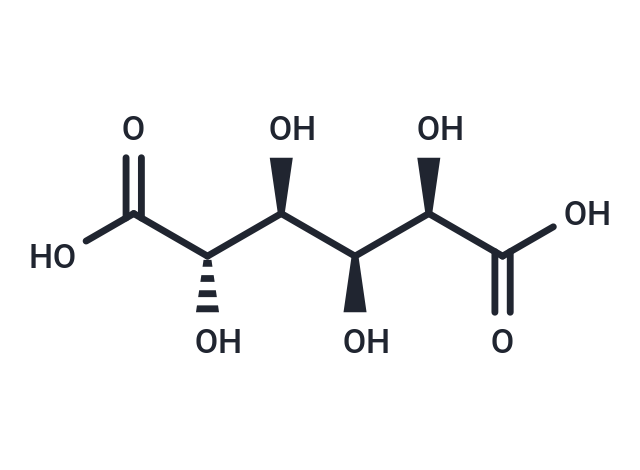
| Description | Saccharic acid (also known as glucaric acid) is a dicarboxylic acid formed by the oxidation of glucose, and it is an important intermediate in the study of sugar metabolism and carbohydrate oxidation. It acts as a competitive inhibitor of β-glucuronidase, preventing the hydrolysis of glucuronides that have already bound to toxins, thereby blocking the regeneration of toxic complexes. |
| In vitro | Saccharic acid (50 µM Fe(III)-saccharic acid + 90 min UV-C irradiation) enhances the photofenton degradation of methylene blue [1]. Saccharic acid (50–150 × 10^(−4) M; 1 h) potently, competitively, and reversibly inhibits β-glucuronidase activity in mouse liver and kidney [2]. Saccharic acid (1 × 10^(−3) M; 2 h) strongly inhibits the hydrolysis of o-aminophenyl-glucuronide by mouse liver β-glucuronidase preparations [2]. Saccharic acid (0.01 M; 90 min) reduces β-glucuronidase activity in intact mouse liver sections [2]. |
| In vivo | Saccharic acid (5 g/kg; subcutaneous injection; administered daily; continued until day 8) does not alter the liver regeneration process following carbon tetrachloride-induced injury or partial hepatectomy [2]. Saccharic acid (2 g/kg; intraperitoneal injection; daily; 3 weeks) or (3%; dietary supplementation; ad libitum; 3 weeks) does not alter normal growth in young mice [2]. |
| Molecular Weight | 210.139 |
| Formula | C6H10O8 |
| Cas No. | 87-73-0 |
| Smiles | OC([C@@H](O)[C@@H](O)[C@H](O)[C@@H](O)C(O)=O)=O |
| Storage | Powder: -20°C for 3 years | In solvent: -80°C for 1 year Shipping with blue ice/Shipping at ambient temperature. | |||||||||||||||||||||||||||||||||||
| Solubility Information | H2O: 200.00 mg/mL (951.75 mM), Sonication is recommended. | |||||||||||||||||||||||||||||||||||
Solution Preparation Table | ||||||||||||||||||||||||||||||||||||
H2O
Note : The dilution table applies only to solid products. For liquid products, please calculate the stock solution based on the stated concentration and/or density. | ||||||||||||||||||||||||||||||||||||
 For example, if the intended dosage is 10 mg/kg for animals weighing 20 g , with a dosing volume of 100 μL per animal, and a total of 10 animals are to be administered, using a formulation of
  10% DMSO+ 40% PEG300+ 5% Tween 80+ 45% Saline/PBS/ddH2O , the resulting working solution concentration would be 2 mg/mL.
Dissolve 2 mg of the compound in 100 μL DMSO to obtain a stock solution at a concentration of 20 mg/mL . If the required concentration exceeds the compound's known solubility, please contact us for technical support before proceeding.
1) Add 100 μL of the DMSO stock solution to 400 µL PEG300 and mix thoroughly until the solution becomes clear.
2) Add 50 µL Tween 80 and mix well until fully clarified.
3) Add 450 µL Saline,PBS or ddH2O and mix thoroughly until a homogeneous solution is obtained.
| Size | Quantity | Unit Price | Amount | Operation |
|---|
 Feedback
 Hello! How can I help you today?
Copyright © 2015-2026 TargetMol Chemicals Inc. All Rights Reserved.
