


Shopping Cart
Remove All Your shopping cart is currently empty

Synonyms: β-propiolactone, Betaprone, 2-Oxetanone
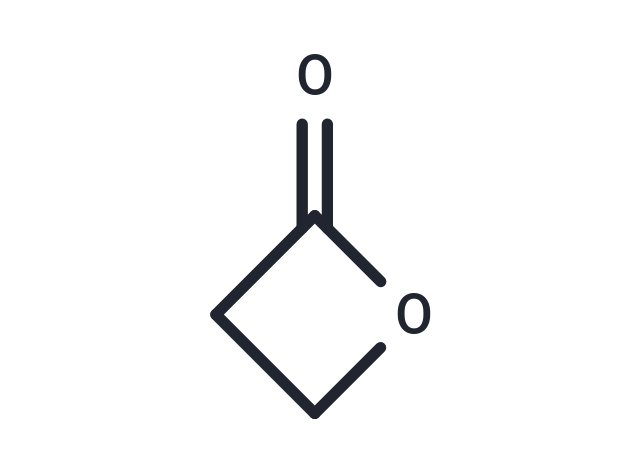
| Pack Size | Price | USA Stock | Global Stock | Quantity |
|---|---|---|---|---|
| 500 mg | $48 | - | In Stock | |
| 1 g | $78 | - | In Stock | |
| 1 mL x 10 mM (in DMSO) | $29 | - | In Stock |
| Description | Propiolactone (β-propiolactone; 2-Oxetanone), as a viral chemical inactivator, eliminates viral infectivity. After being co-incubated with SARS-CoV at a ratio of 1:1000 (v:v), Propiolactone can be used as a bacteriostatic agent in the preparation of influenza virus vaccines (Flu-BPL). |
| In vitro | Method: A SARS-CoV virus suspension cultured in Vero cells was treated with Propiolactone (1:1000, v:v) and incubated at 4°C for 24 hours, followed by an additional 24-hour incubation at room temperature to hydrolyze residual Propiolactone. To verify the inactivation efficacy, the Propiolactone-treated samples were subjected to two consecutive passages in Vero cells, and virus inactivation was assessed by observing cytopathic effects (CPE) and detecting viral genome amplification using quantitative PCR (Q-PCR). Result: After two passages of the Propiolactone-treated SARS-CoV samples in Vero cells, no CPE was observed, and Q-PCR did not detect any viral genome amplification, indicating that Propiolactone completely inactivated SARS-CoV and that the inactivated virus had no residual infectivity [1]. |
| In vivo | Method: BALB/c mice or golden Syrian hamsters were immunized via intramuscular injection with a propiolactone-inactivated whole-virus SARS-CoV vaccine (WI-SARS) at doses of 0.5, 1.0, or 1.5 μg S protein (for mice) or 0.5 or 2.0 μg S protein (for hamsters). Some groups received the vaccine in combination with AS01B or AS03A adjuvants. Immunization was performed twice with a 21-day interval. The immunogenicity and protective efficacy of the vaccine were evaluated by measuring serum neutralizing antibody titers and lung viral titers after challenge. Result: The propiolactone-inactivated vaccine induced serum neutralizing antibody responses in both mice and hamsters. After two immunizations, no viral replication was detected in the lungs of challenged mice. Hamsters were fully protected when challenged early (week 4) and still showed partial protection when challenged late (week 18), with no observed enhancement of lung or liver disease. The propiolactone-inactivated vaccine demonstrated good immunogenicity and protective efficacy in vivo [1]. |
| Synonyms | β-propiolactone, Betaprone, 2-Oxetanone |
| Molecular Weight | 72.06 |
| Formula | C3H4O2 |
| Cas No. | 57-57-8 |
| Smiles | O=C1OCC1 |
| Storage | Store under nitrogen,Store at low temperature Powder: -20°C for 3 years | In solvent: -80°C for 1 year Shipping with blue ice/Shipping at ambient temperature. | |||||||||||||||||||||||||||||||||||
| Solubility Information | DMSO: 80 mg/mL (1110.19 mM), Sonication is recommended. | |||||||||||||||||||||||||||||||||||
Solution Preparation Table | ||||||||||||||||||||||||||||||||||||
DMSO
Note : The dilution table applies only to solid products. For liquid products, please calculate the stock solution based on the stated concentration and/or density. | ||||||||||||||||||||||||||||||||||||
 For example, if the intended dosage is 10 mg/kg for animals weighing 20 g , with a dosing volume of 100 μL per animal, and a total of 10 animals are to be administered, using a formulation of
  10% DMSO+ 40% PEG300+ 5% Tween 80+ 45% Saline/PBS/ddH2O , the resulting working solution concentration would be 2 mg/mL.
Dissolve 2 mg of the compound in 100 μL DMSO to obtain a stock solution at a concentration of 20 mg/mL . If the required concentration exceeds the compound's known solubility, please contact us for technical support before proceeding.
1) Add 100 μL of the DMSO stock solution to 400 µL PEG300 and mix thoroughly until the solution becomes clear.
2) Add 50 µL Tween 80 and mix well until fully clarified.
3) Add 450 µL Saline,PBS or ddH2O and mix thoroughly until a homogeneous solution is obtained.
| Size | Quantity | Unit Price | Amount | Operation |
|---|
 Feedback
 Hello! How can I help you today?
Copyright © 2015-2026 TargetMol Chemicals Inc. All Rights Reserved.
